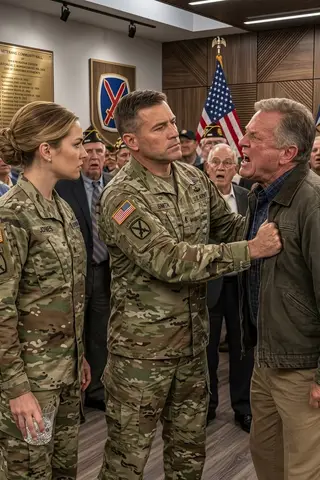
 The Retired Sergeant Called His Daughter "Little Puppy" at His Party
Chapter 97
The Gathering in Austin
In late May, the annual Southwestern Defense and Logistics Leadership Forum convened at the Austin Convention Center.
The forum drew over three thousand defense leaders, corporate executives, aerospace engineers, and military commanders from across the country. But unlike previous years, where panel discussions were dominated by multi-billion-dollar aerospace conglomerates, the opening plenary session had been assigned to a new voice: Derek Vance, Director of Domestic Supply Architecture.
I arrived with Eleanor and Richard an hour before the session began. The grand ballroom was packed, every seat filled, with rows of active-duty officers, university deans, and industry specialists standing along the back walls.
Richard wore his best charcoal suit, his 1991 combat veteran pin gleaming discreetly on his left lapel. Eleanor sat beside him, holding his hand, her face glowing with quiet anticipation.
When the house lights dimmed, Major General Nathan Garrett, Commanding General of the 1st Cavalry Division, stepped to the podium.
"Distinguished guests, officers, and civilian leaders," Garrett’s deep, parade-ground voice resonated through the hall. "For decades, the American military operated under the dangerous assumption that logistics was merely an administrative afterthought—something that could be outsourced, streamlined to the bare bone, or bought off the shelf at the eleventh hour. Over the past twenty-four months, that obsolete doctrine has been decisively overturned. Today, through the innovative architecture designed by Texas native and former Sergeant Derek Vance, our forward combat divisions have achieved the highest operational readiness rates since the end of the Cold War."
The applause was thunderous as Garrett stepped aside.
Derek walked onto the stage. He moved with the easy, measured confidence of a man who had mastered his craft. There was no hesitation in his stride, no lingering trace of the uncertain young sergeant who had once stood in the shadow of my rank and our father’s stern expectations.
He spoke for forty-five minutes, breaking down complex mathematical algorithms into clear, actionable principles of regional manufacturing, strategic material stockpiling, and real-time maintenance feedback loops. He spoke of the small machine shops in Temple, Waco, and Round Rock not as peripheral vendors, but as the essential bedrock of national defense.
"Readiness is not an abstraction," Derek concluded, his voice ringing clear through the auditorium. "It is the promise we make to the young men and women downrange that when they turn the ignition or pull the trigger, the equipment will not fail them. That promise begins in our workshops, on our factory floors, and in our hearts."
The standing ovation began in the front row with General Garrett and swept through the entire hall of three thousand people.
Beside me, Richard stood up. He clapped with hard, powerful strokes, tears shining openly in his eyes, his chest swelling with profound, unrestrained pride. He did not look around to see if anyone was watching. He simply looked at the young man on the stage, his son, who had taken the family legacy and elevated it into national prominence.
"That’s my boy," Richard whispered, his voice thick with emotion. "Look at him, Eleanor. That’s our son."
Eleanor pressed her face against Richard’s shoulder, smiling through her own tears. "I see him, Richard. I see him."
The End









