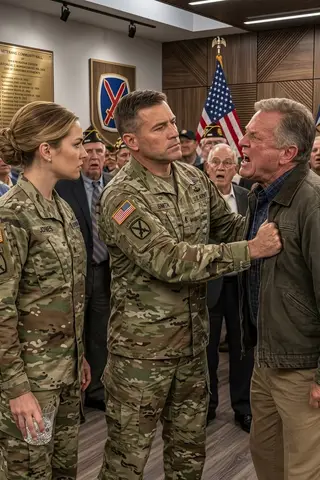
 The Retired Sergeant Called His Daughter "Little Puppy" at His Party
Chapter 1
The Weight of a Nickname
The air inside the American Legion hall smelled of stale beer, damp carpet, and decades of old cigarette smoke clinging to the drywall. It was the kind of Texas warmth that felt thick and heavy, pressing down on the shoulders of the hundred or so guests crowded around folding tables draped in red-white-and-blue plastic.
For the past three hours, the room had belonged to Richard Vance.
To the community of Austin, Texas, my father was a legend. A retired Master Sergeant who wore his twenty-five years of service like heavy armor, he commanded every room he entered simply by filling it with his voice. Tonight was his official retirement party, a milestone celebration complete with a catered brisket buffet, an open bar, and a steady stream of aging veterans slapping him on the back and buying him shots of whiskey.
I stood near the corner of the room, half-hidden in the shadow of a decorative pillar, nursing a club soda with lime. I wore a simple navy blue dress—nothing flashy, nothing that drew attention. To everyone here, I was Morgan Vance. The quiet, overly cautious daughter. The one who had taken the safe route.
Across the room, my younger brother Derek was holding court near the bar. Captain Derek Vance. Infantry. Ranger tab. Two combat deployments. He had his father's broad shoulders, his father's easy laugh, and his father's absolute certainty about his place in the world. Derek had been introduced at least half a dozen times that evening as the continuation of the Vance legacy.
“My boy, the infantry officer,” Dad had proclaimed loudly just twenty minutes earlier, wrapping a heavy arm around Derek's neck. “The one who keeps the family tradition alive. Real boots in the dirt.”
When people had asked about me—because someone always felt obligated to ask out of polite curiosity—Dad’s answer never changed. He would offer a dry, dismissive chuckle, wave his hand dismissively, and say, “Oh, that’s Morgan. She works behind a desk somewhere.”
Somewhere.
The word hung in the air like a minor inconvenience. Somewhere meant the Pentagon. Fort Meade. Forward operating bases in places where the sand turned to powder under the heat of a merciless sun. Places that had never made it into Richard Vance’s dinner table stories because I had stopped trying to tell him about them years ago.
My father never bothered asking about my deployments. To him, intelligence work wasn't real soldiering. If you weren't humping a seventy-pound ruck through the mountains or kicking down doors in the dead of night, you weren't a soldier in his eyes. You were a clerk. A paper-pusher.
A puppy.
The nickname had started when I was five years old. A severe thunderstorm had rolled across Central Texas, rattling the windowpanes of our house with violent claps of thunder. Terrified by the sudden noise, I had hidden under the kitchen table and cried. My father had pulled me out by the arm, not unkindly, but with a rough amusement in his eyes.
“Look at her,” he had laughed to my mother. “Shaking like a scared little puppy.”
The name stuck. It became a permanent fixture of my childhood and adolescence. When I broke my wrist falling from a backyard oak tree at nine and cried at the emergency room, I was his puppy. When I hesitated for three seconds before jumping off a high quarry ledge because Derek had dared me, I was his puppy. When I chose an ROTC scholarship with a focus on intelligence rather than enlisting straight out of high school into the infantry, the label hardened into a weapon of disappointment.
“You’ve got no grit, Morgan,” he had told me the night I received my scholarship. “Real soldiers charge the line. You’re just hiding behind intelligence reports.”
I had absorbed those words for years. I had let them sit heavy on my chest through grueling field exercises, through sleepless nights tracking electronic signatures in command bunkers, and through the quiet, terrifying moments when incoming mortar fire made the concrete walls of a tactical operations center hum like tuning forks.
My father didn't know anything about those nights. He didn't know that intelligence officers often walked outside the wire alongside infantry units to interpret real-time data feeds. He didn't know about the commendations locked away in a safe at Fort Meade, or the specific commendation medal that carried a very quiet, very real restriction on what I was allowed to discuss with family.
He only knew the version of me that made him feel superior.
The End









