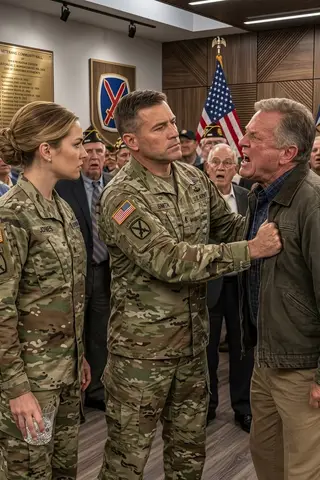
 The Retired Sergeant Called His Daughter "Little Puppy" at His Party
Chapter 96
The Rosslyn Cohort
When I returned to Virginia in late April, our third cohort of Defense Transition Fellows was preparing to graduate from the Rosslyn Institute.
The program, which Marcus and I had initiated eighteen months earlier, took junior enlisted logistics specialists and company-grade officers transitioning out of active duty and trained them in national industrial base management, defense acquisitions, and high-level policy analysis.
The graduation seminar was held in our main conference room, the large windows framing the blooming cherry blossoms across the river in Washington. Twelve fellows sat around the wide mahogany table, dressed in sharp civilian suits, their laptops open to final strategic capstone presentations.
Major Elena Torres had flown up from the Pentagon to deliver the keynote address on operationalizing strategic sustainment.
"When you take off the uniform," Elena told the fellows, her voice carrying the unmistakable authority of a seasoned joint staff officer, "you don't leave your oath behind. You simply move to a different vantage point on the battlefield. In the J5, we can write the most brilliant contingency plans in the history of warfare, but if an analyst in Rosslyn doesn't ensure that a factory in Ohio or Texas has the raw tooling to deliver parts on time, those plans are nothing more than ink on paper. You are the bridge between strategy and reality."
I watched Elena speak from the back of the room, remembering the young captain who had stood before the CENTCOM senior leadership two years earlier, nervous but unyielding, defending her analysis against institutional inertia. She had grown into an exceptional leader, respected throughout the Pentagon for her clarity, courage, and integrity.
After the seminar concluded, the fellows gathered in the reception alcove for coffee and certificates. One of the fellows, a former Army Staff Sergeant named Ramirez who had served three tours as a maintenance team leader in the 10th Mountain Division, approached me.
"Colonel Vance," Ramirez said, holding his program. "I just wanted to thank you, ma'am. When I received my ETS orders last fall, I thought my value to the military was finished. I thought civilian companies only wanted degrees and corporate buzzwords, not ten years of fixing combat vehicles in the mud."
"Staff Sergeant Ramirez," I said firmly, looking him in the eye, "the skills you learned keeping vehicles running in rough terrain are the most valuable strategic assets this country has. What you know about supply realities cannot be simulated in an academic lecture hall. You know what happens when a convoy runs out of bearings. You know what it feels like to wait for a part that never comes. That perspective makes you indispensable."
Ramirez stood taller, a proud, confident smile spreading across his face. "I accepted an offer yesterday, ma'am. Lead Logistics Analyst for the Army Tank-automotive Command in Detroit."
"Outstanding," I said, shaking his hand with the firm grip of one veteran to another. "Keep the depot commanders honest. And remember who you're working for: the soldiers who turn the wrenches."
Later that evening, as the offices emptied and the quiet dusk settled over the Potomac, Marcus walked in and set a thin manila envelope on my desk.
"From the White House Office of Management and Budget," Marcus said, his tone unusually solemn. "The President signed the executive directive this afternoon. The National Defense Industrial Base Strategy is officially operationalized. Your multi-year procurement framework is now federal policy."
I picked up the document. There, beneath the presidential seal, was the culmination of three years of unremitting effort: the end of hollow procurement cycles, the protection of domestic craft and manufacturing, and the establishment of a resilient supply architecture built to outlast any crisis.
"We did it, Marcus," I said softly.
"You did it, Colonel," Marcus replied with a respectful nod. "Now let's see what happens when the whole machine starts to roll."
The End









