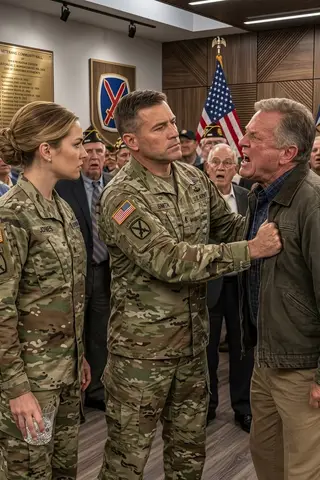
 The Retired Sergeant Called His Daughter "Little Puppy" at His Party
Chapter 14
The New Arena
The transition from military uniform to civilian business attire was more jarring than I had anticipated. For over two decades, my identity each morning had been dictated by Army Regulation 670-1: ribbons measured precisely one-eighth of an inch above the pocket seam, hair neatly secured off the collar, boots buffed to a dull sheen.
Now, standing in the marble lobby of a high-security consulting and strategic analysis firm in Arlington, Virginia, I wore a tailored navy blazer, gray slacks, and low heels. My silver colonel eagles were safely stowed in a velvet-lined mahogany shadow box in my home study.
"Director Vance?"
A sharp, twenty-something staffer with an electronic security tablet and a lanyard bearing the insignia of the National Security Analysis Group approached me with a polite smile.
"Yes," I replied.
"I'm David. I've been assigned as your executive aide for your onboarding week. Director Sterling is waiting for you in the West Executive Conference Room."
"Lead the way, David."
We took the secure elevator to the sixth floor, passing through two biometric checkpoints and a Faraday-shielded briefing area. The organization was a federally funded research and development center that handled high-level strategic intelligence evaluations for the Department of Defense and Congress. My new role as Senior Director for Transnational Threat Assessment put me at the intersection of policy, intelligence, and ground-level military operations.
Arthur Sterling, a retired ambassador with silver hair and razor-sharp intellect, stood up from the head of the conference table as I walked in.
"Morgan," Sterling said warmly, extending his hand. "Welcome to the private sector. Or at least, the slightly less regimented side of the public sector."
"Thank you, Arthur. It feels strange not having to salute the senior person in the room."
"Don't worry," Sterling chuckled, motioning toward the leather chair beside him. "The coffee is vastly superior here, and our budget meetings involve significantly fewer slide decks, though the politics can be twice as treacherous."
Spread out on the polished mahogany table were folders marked with crimson classification covers. A small team of analysts—young, brilliant, and visibly eager—sat around the perimeter with laptops open.
"We brought you in because the geopolitical landscape in Eastern Europe and the Indo-Pacific is shifting faster than the standard military bureaucracy can adapt," Sterling said, leaning forward. "We have plenty of theorists with doctorates from Harvard and Georgetown. What we don't have is someone who knows how operational intelligence actually moves from a reconnaissance satellite down to a team of Rangers clearing a compound."
I opened the top folder, scanning the mission parameters and intelligence summaries with practiced efficiency. The old muscle memory took over instantly. The acronyms, the operational timelines, the threat vectors—they were second nature.
"This data feed from the Baltic theater has a forty-eight-hour latency bottleneck," I noted, pointing to a discrepancy in the annex. "If you're relying on these logistics reports to predict force movements, you're looking at where the battalion was two days ago, not where their fuel reserves are positioning them tonight."
One of the senior analysts across the table blinked, looking down at his screen, his fingers flying across the keys. A moment later, he looked up, impressed. "She's right. The supply chain timestamps weren't calibrated to UTC."
Arthur Sterling smiled, leaning back in his chair with deep satisfaction. "Like I said, gentlemen. We hired the real thing."
For the rest of the day, immersed in strategic problems and high-stakes analysis, the shadow of my childhood in Texas didn't cross my mind once. I was no longer proving my right to exist. I was doing the work I was born to do.
The End









