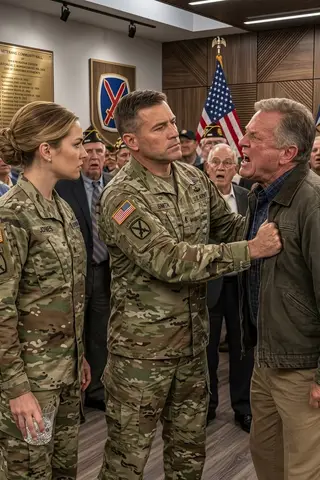
 The Retired Sergeant Called His Daughter "Little Puppy" at His Party
Chapter 30
Full Circle
That evening, the four of us drove south toward Lockhart, stopping at an old brick barbecue joint where smoke poured from the iron chimneys into the cool Texas night.
The dining hall was loud and unpretentious, filled with long communal picnic tables, the smell of smoked post oak and brisket, and the clatter of brown butcher paper trays.
Derek carried the heavy tray to our table: sliced brisket with thick black bark, jalapeño sausage, ribs, pickles, and stacks of white bread. There were no white tablecloths, no formal speeches, and no military banquets to stage an illusion.
Richard sat at the end of the table. He took his blood pressure pill with a swallow of water, placed the small pillbox neatly in his jacket pocket, and picked up a rib with fingers that still bore the rough scars of forty years of manual labor.
"Derek starts his new job Monday," Eleanor said, passing the potato salad down the table. "He found a nice apartment five minutes from the campus."
"Good," Richard said, chewing slowly. "Rent’s ridiculous up in Round Rock, but if the company’s covering tuition, it balances out."
He looked across the table at me. "How long you in town, Morgan?"
"Just until tomorrow evening," I said, tearing a piece of smoked brisket. "I have a briefing at the Pentagon at nine on Monday morning."
Richard nodded, his eyes lingering on the silver watch on my wrist. "Pentagon traffic’s a mess on Mondays. Make sure you leave early."
It was a mundane, fatherly piece of advice—the kind of simple, ordinary concern that normal fathers gave their adult children every day. It was small, but in our family, ordinary was a miracle.
"I will, Dad," I replied.
Outside the restaurant’s high windows, the vast Texas night stretched out under a canopy of endless stars. The long road from the humiliation at Post 447, through the sterile halls of St. David's, to this noisy table in Lockhart had been rough, scarred by the quiet collapse of an old man's pride and the steady rise of an unyielding truth.
Richard reached over and grabbed a slice of white bread, leaning back against the wooden bench. For the first time in my life, he looked completely at ease in his own skin—not as a Master Sergeant barking orders at shadows, but simply as a father sitting with his family at the end of a long, hard road.
The ledger was finally balanced. And the future, for the first time, belonged entirely to us.
The End









