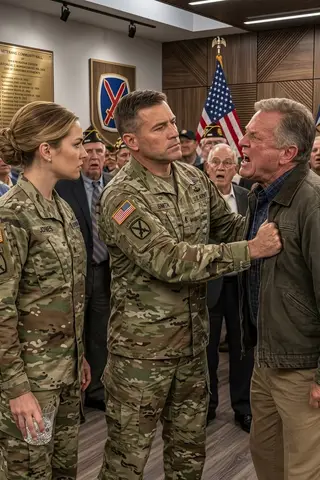
 The Retired Sergeant Called His Daughter "Little Puppy" at His Party
Chapter 29
The Transition Ceremony
In mid-February, the morning sun broke crisp and clear over the sprawling training grounds of Fort Cavazos. The wind swept across the asphalt parade field, carrying the familiar scents of diesel exhaust, scorched earth, and starch.
I flew down for the weekend to attend Derek’s formal out-processing and discharge ceremony. We stood outside the battalion headquarters building as soldiers in operational camouflage uniforms moved back and forth with duffel bags and equipment cases.
Derek walked down the wide concrete steps wearing a sharp, dark civilian suit. His military duffel was slung over one shoulder, and in his left hand, he carried a green binder containing his DD-214—the sacred document marking the honorable end of a soldier's active service.
Standing near the perimeter fence was Richard.
He was dressed in a clean navy windbreaker and khaki slacks, his hands clasped behind his back in the instinctive posture of a veteran non-commissioned officer. He had refused to lean on his cane today, though his steps were slow and cautious. Eleanor stood beside him, wearing a bright wool scarf, her arm linked gently through his.
Derek reached the bottom of the steps, tossed his duffel into the trunk of his car, and walked over to where our parents were waiting.
Richard looked at his son—no longer an infantryman under his command, no longer an extension of his own unfulfilled ambition, but a grown man stepping out into the civilian world.
"Everything squared away with finance?" Richard asked gruffly.
"Every dime," Derek replied. "Cleared supply, cleared the armory, cleared personnel."
Richard extended his right hand. Derek took it, and the two men gripped firmly.
"You served well, Sergeant," Richard said, his voice thick with unexpressed emotion. "No stains on your jacket."
"Thank you, Dad," Derek answered quietly.
Then Richard turned to look at me, standing a few paces back. For the first time, his gaze didn't hold that defensive, guarded glare. He looked at me with an old man's quiet clarity—seeing not an adversary, not a rival, but the daughter who had carried the Vance name higher than he had ever dreamed possible.
"Morgan," he said, nodding toward me.
"Richard," I replied, returning the nod with steady warmth.
There was no ceremony needed between us. The terms of our peace had already been written in the quiet room of a hospital and on the wooden planks of a sunset porch.
***
The End









