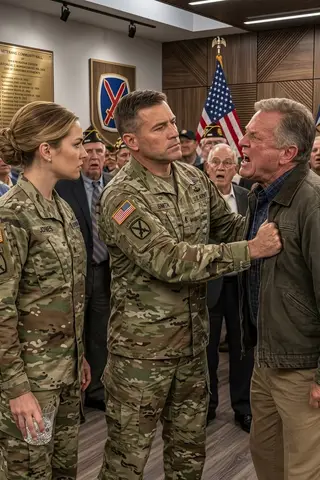
 The Retired Sergeant Called His Daughter "Little Puppy" at His Party
Chapter 80
The Horizon Line
By late September, a crisp, clean autumn wind blew down from the Blue Ridge Mountains, sweeping the summer haze out of the Virginia valleys.
I took a long weekend to return to Buda before the Dallas Museum exhibition opened in October.
On a golden Sunday afternoon, our entire family gathered once more around the wide cedar dining table beneath the pergola. Derek had brought his girlfriend, Sarah, a civil engineer from Austin who had immediately won Eleanor’s heart by admiring her garden layout and Richard’s handcrafted joinery.
We ate smoked pork loin, sweet corn, and fresh garden tomatoes, laughing as Richard told stories about the old Army—not the heavy, bitter tales of bureaucratic frustration, but the funny, human moments of young soldiers trying to navigate life in foreign lands.
"So there we were," Richard recounted, gesturing with his fork, his eyes twinkling, "stuck in the mud outside Baumholder in 1984. My driver looked at me and said, 'Sergeant, I don't think this tank is moving until spring.' I told him, 'Son, if this tank doesn't move in ten minutes, you're carrying the main gun barrel all the way back to the motor pool on your shoulders.' You never saw a young private shovel mud so fast in your life."
Derek and Sarah laughed, while Eleanor smiled warmly, shaking her head. "He never made anyone carry a gun barrel, Sarah. He was a soft-hearted sergeant who used to bring stray dogs back to the motor pool."
"Only dogs that knew how to stand at attention, Eleanor," Richard retorted with feigned dignity, sparking another wave of laughter around the table.
Later that evening, after Derek and Sarah had started the drive back to Round Rock and Eleanor had gone inside to package the final prints for Dallas, Richard and I walked out toward the back fence line.
The sun had sunk beneath the western hills, painting the wide Texas sky in breathtaking bands of crimson, violet, and deep gold. The air was cool and crisp, carrying the pungent scent of dry grass and cedar smoke.
We rested our arms on the cedar top rail of the fence, standing shoulder to shoulder in comfortable, unhurried silence.
Down in the valley, the distant lights of Buda began to twinkle through the gathering twilight. Overhead, the evening star appeared, sharp and brilliant in the deepening blue.
"Looks like good weather for the drive to Dallas next week," Richard remarked softly, looking out across the quiet pastures.
"Mom’s ready," I replied. "Her work is beautiful, Dad. You gave it a worthy frame."
Richard turned his head to look at me. His face was weathered by decades of sun, wind, and hard service, but his eyes were peaceful, filled with the quiet grace of a man who had completed his watch.
"We gave each other a worthy frame, Morgan," he said gently. "It took us a while to get the joints square, but it holds."
"It holds, Dad," I agreed softly. "It holds against any wind."
A gentle breeze stirred the leaves of the great live oaks overhead, whispering through the branches that had witnessed generations of our family come and go.
We stood together on the ridge, the retired Master Sergeant and the retired Colonel, watching the stars take command of the Texas sky—anchored in the earth, reconciled in the heart, and ready for whatever lay beyond the open horizon.
The End









