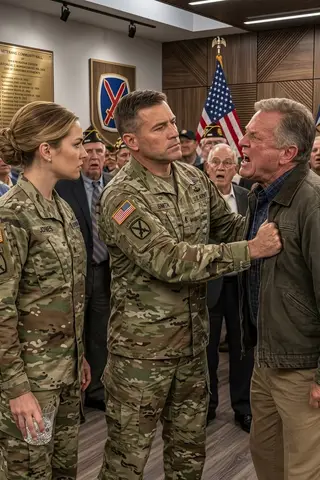
 The Retired Sergeant Called His Daughter "Little Puppy" at His Party
Chapter 34
The Shadow of Policy
In early April, the Department of the Army’s Office of the Assistant Secretary for Manpower and Reserve Affairs invited me to testify as an expert witness before a closed congressional subcommittee on defense personnel transitions.
The hearing was held in the Rayburn House Office Building. The committee room was paneled in heavy oak, with green leather chairs and microphone stalks protruding from the dais. The focus was the systemic failure of the transition assistance curriculum for mid-career non-commissioned officers and junior officers moving into the high-tech defense industrial base.
"Director Vance," began Representative Harrison, a conservative member from Ohio who had served in the Marine Corps during the 1980s. "The data shows that nearly forty percent of transitioning combat-arms personnel experience acute underemployment within twelve months of separation. The current program provides resume workshops and mock interviews. Where is the gap?"
I adjusted the microphone, looking directly at the five representatives on the panel.
"The gap, Congressman, is cultural translation," I said firmly. "For ten, fifteen, or twenty years, these men and women have operated in an environment where authority is absolute, structure is unambiguous, and personal worth is tied strictly to tactical rank. When they separate, the civilian economy does not speak their language, and more importantly, they do not understand how to communicate their strategic value without the crutch of their uniform."
A member from Virginia leaned in. "Can you elaborate on that?"
"In combat arms, an E-5 or an E-6 manages millions of dollars of sensitive equipment and leads personnel in life-or-death scenarios," I continued, thinking of Derek, and thinking—with sudden, piercing clarity—of Richard in 1991, returning from the Gulf to a country that saw only an angry man with a clipboard. "Yet on paper, a civilian recruiter sees only someone qualified for entry-level security or warehouse packing. When that veteran internalizes that dismissal, one of two things happens: they retreat into bitterness, weaponizing their past service as an emotional bunker, or they burn out in quiet frustration."
I leaned forward, resting my forearms lightly on the witness table.
"We do not need more resume templates. We need transition curricula built on industrial apprenticeships, corporate mentorship from veterans who have successfully navigated the private sector, and educational pipelines that give them accredited credentials before their terminal leave begins. If you want veterans to succeed in the civilian arena, you must teach them how to lead without the authority of the badge."
The room was silent for several seconds. Representative Harrison nodded slowly, jotting a lengthy note in the margins of his briefing book.
"Well said, Colonel—excuse me, Director Vance. Your written testimony will be entered into the record without objection."
Leaving Rayburn that afternoon, walking down the long stone steps into the bright spring sunshine of Independence Avenue, I felt an unfamiliar sensation settle deep in my ribs.
I had spent my entire adult life outrunning Richard’s narrow, dogmatic definition of what a soldier was. But here, in the highest policy corridors of the country, my father’s struggle—the unacknowledged trauma of his own return from the desert, the suffocating pride that had made him terrorize his own household—was the very insight that allowed me to help rebuild the bridge for thousands of soldiers like him.
The wound hadn't just healed. It had become useful.
***
The End









