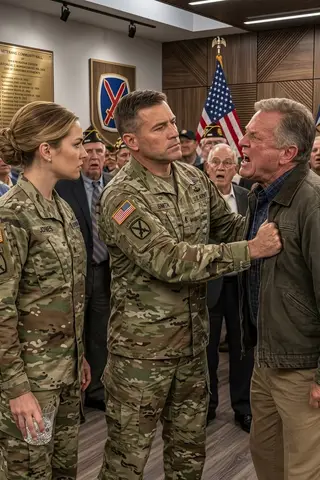
 The Retired Sergeant Called His Daughter "Little Puppy" at His Party
Chapter 31
The Monday Briefing
The Monday morning corridor leading to the E-Ring of the Pentagon possessed a cadence known only to those who had walked it in uniform. Boots clicked on polished linoleum, badge lanyards swung with purposeful strides, and the low, ambient hum of secure communications vibrated beneath the floorboards. Even in civilian tailoring—a tailored charcoal wool blazer, crisp silk blouse, and low heels—my muscle memory responded to the rhythm instantly.
I swiped my security badge at the cipher-locked portal to Conference Room 3E860. Inside, seven senior officials were already seated around the mahogany conference table: two deputy undersecretaries of defense, a three-star Air Force general from the Joint Staff J-4, and four senior analysts from the National Geospatial-Intelligence Agency.
"Director Vance," Lieutenant General Frank Vance—no relation, though we had joked about it during my days at USCENTCOM—nodded from the head of the table. "Right on time. We've got the Black Sea logistics telemetry pulled up on the monitors."
"Good morning, General," I said, setting my encrypted tablet into the docking cradle beside the podium. "Let’s get right to the bottleneck."
For the next fifty minutes, there were no patronizing assumptions, no sidelong glances, and certainly no domestic diminutives. I laid out the multi-modal distribution strategy for high-mobility artillery systems across NATO’s eastern flank, dissecting transport times from the Port of Constanța to forward logistical hubs. Every question thrown at me—from secondary fuel infrastructure to rail gauge disparities—was met with exact metrics, contingency vectors, and clear-eyed operational realism.
"The previous assessment presumed commercial carriers would absorb the transit risk without sovereign indemnification," I explained, tapping the stylus against the digital map. "They won't. If we don't underwrite the rail corridors through bilateral agreements by Q3, the entire forward sustainment pipeline will choke at the border."
The Undersecretary leaned back, tapping his pen thoughtfully against his pad. "That aligns with the concerns raised by EUCOM, but they didn't have the mitigation model. How soon can your shop deliver the implementation roadmap, Director?"
"My team will have the draft operational framework on your desk by close of business Thursday," I answered without hesitation.
"Make it happen," the General said, closing his folder with a decisive snap. "Outstanding brief, Morgan."
As the room cleared and the attendees exchanged the usual curt, respectful handshakes, I stood by the podium packing my tablet. Through the tall blast-resistant window, the Virginia morning sky was pale and clear, stretching out over the Potomac toward the monuments of Washington.
Forty-eight hours earlier, I had been sitting on a wooden bench in Lockhart, Texas, watching my father chew smoked brisket and remind me to watch out for Northern Virginia commuter traffic. He hadn't known the classification level of the briefing, nor the rank of the officers who would hang on my assessment. He had simply known that his daughter had work to do in Washington, and that the highway between Arlington and the Pentagon got congested on Monday mornings.
That distinction no longer carried the sting of invalidation. It carried the peace of total detachment. I didn't need Richard Vance to comprehend the scope of my authority to possess it. For the first time in my life, both worlds could exist in parallel without colliding.
***
The End









