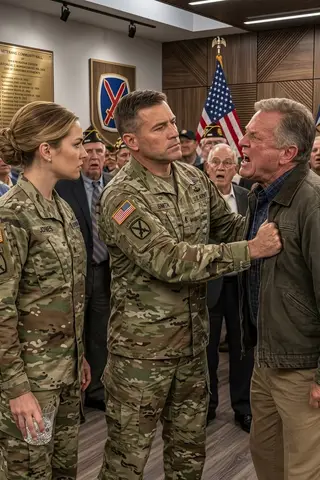
 The Retired Sergeant Called His Daughter "Little Puppy" at His Party
Chapter 79
The Corridor in Arlington
August arrived in Washington with the humid, sweltering weight typical of the Potomac basin, but inside our Rosslyn offices, the atmosphere was brisk, focused, and humming with steady progress.
The National Defense Authorization Act had passed the full Senate by a bipartisan vote of eighty-four to fourteen, retaining every key provision of our industrial base roadmap. Over at the Pentagon, Jack Albright had been selected for promotion to brigadier general, tapped to lead the newly formed Defense Supply Chain Resiliency Task Force.
I stood before the large digital map of the United States mounted on the wall of our senior conference room. Marked across the country were the seven regional industrial hubs established under our recommendations: Ohio, Texas, Pennsylvania, Alabama, California, Arizona, and Michigan.
Marcus, my deputy director, walked into the room carrying a freshly printed briefing packet. "Morgan, we just received the third-quarter supply metrics from the Defense Logistics Agency."
"Give me the top lines," I said, without turning away from the map.
"Emergency requisitions for critical missile electronics are down forty-four percent year-over-year," Marcus reported, his voice filled with professional pride. "Secondary component backlogs have dropped to single digits across all four military branches. And the contractor consortium in Round Rock just certified their forty-fifth local vendor ahead of schedule."
"And the transition fellows?"
"All twelve fellows from the April cohort have been placed," Marcus smiled. "Six at the Pentagon, three on Capitol Hill, and three in senior corporate strategy roles. Captain Torres's rotation at CENTCOM concludes next month—she's been slated for the Joint Staff J5 in the Pentagon."
I nodded slowly, looking at the glowing nodes connecting suppliers, depots, and forward commands across the nation.
It was a machine of staggering complexity, involving hundreds of thousands of civilian workers, uniform personnel, and industrial specialists. But stripped of its high-level titles and bureaucratic terminology, it was built on a very simple truth: when men and women step forward to serve their country, those who remain behind owe them nothing less than absolute reliability.
Richard had known that truth in 1991 when he checked the track tension on his armored fighting vehicles under the desert stars. Derek knew it when he audited microchip tolerances on a clean-room floor in Texas. Elena knew it as she tracked hostile movements through the waters of the Red Sea.
We were links in a long, unbreakable chain. And as long as each link held true to its purpose, the nation remained secure.
***
The End









