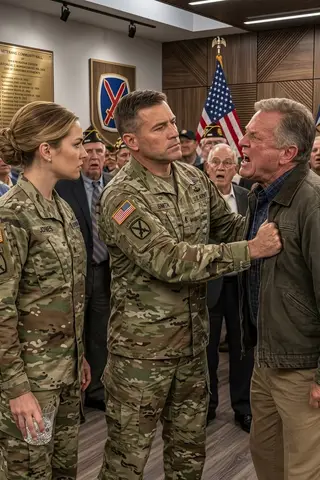
 The Retired Sergeant Called His Daughter "Little Puppy" at His Party
Chapter 44
The Hill Hearing
The formal public hearing of the Senate Armed Services Subcommittee on Readiness took place on a humid Tuesday morning in late September.
The hearing room was packed to capacity with defense industry executives, uniformed flag officers, congressional aides, and national security correspondents. The red lights on the television cameras gleamed along the perimeter, broadcasting the proceedings across C-SPAN and internal Pentagon feeds.
I sat alone at the primary witness table, wearing a tailored charcoal suit, my retired service lapel pin resting discreetly on the collar. Before me sat two thick binders containing our team's two-hundred-page interim report on national industrial vulnerability.
Senator Robert Sterling, a four-term conservative from a Southern state with substantial defense manufacturing interests, leaned over his microphone from the elevated dais.
"Director Vance, your report identifies severe supply chain vulnerabilities in several critical defense components, specifically regarding microelectronics and domestic forging capacity for submarine hulls," Sterling began, his voice booming through the chamber. "You're recommending that Congress mandate multi-year procurement guarantees for non-traditional tech firms, bypassing some of the standard military acquisition regulations. Some in the Pentagon argue that this undermines military oversight. How do you respond?"
I adjusted my microphone, took a sip of water, and looked directly into the senator's eyes.
"Senator, with respect to the traditional procurement pipeline, military oversight is only as effective as the results it produces," I said clearly, my voice carrying cleanly across the silent chamber. "When a Tier-1 contractor takes nine years to field an encrypted communications node because the specification manual is eight thousand pages long, our adversaries are fielding three successive generations of counter-technology in the same window."
The room remained utterly silent. Behind me, the gallery leaned in.
"I spent twenty-two years as an officer in the United States Army," I continued, unhurried and steady. "I have commanded tactical intelligence units in austere combat outposts where lives depended on whether a replacement component arrived in forty-eight hours or forty-eight days. The young men and women standing post in the Indo-Pacific or Eastern Europe do not care about bureaucratic jurisdiction. They care whether their systems work when the perimeter alarm sounds."
Senator Sterling listened intently, his pen resting motionless on the desk.
"Our assessment does not bypass oversight," I concluded. "It updates it for an era where industrial agility is deterrence. If we cannot manufacture and sustain the tools of our defense without relying on adversarial supply chains, our strategic doctrine is merely theoretical. The recommendations in this report are designed to ensure that our defense industrial base is as lethal, resilient, and forward-looking as the soldiers who rely upon it."
Senator Sterling stared down at me for several heartbeats. Then, slowly, a nod of deep institutional respect crossed his face.
"Director Vance," the senator said, his tone shifting from prosecutorial interrogation to bipartisan appreciation, "in my sixteen years on this committee, I have rarely heard a witness cut through the Pentagon's acronym-laden fog with such clarity and moral authority. Your record of service to this nation is well known to this committee, but this report demonstrates that your contributions in civilian leadership may prove just as consequential."
He tapped his gavel lightly. "The committee will adopt the Director's interim framework as the baseline for the upcoming defense authorization markup. We thank you for your service and your candor."
As the hearing recessed, I stepped back from the witness table. Jack Albright met me at the rail, shaking his head in admiration.
"I’ve seen four-star generals get chewed up like raw meat in that chair, Morgan," Jack whispered with a wide grin. "You had Sterling nodding like a recruit at basic training."
"When you tell people the truth without trying to protect a budget line, Jack," I said, picking up my portfolio, "they usually listen. It's the hedging that gets you killed."
"Let's get lunch," Jack offered. "My treat. The cafeteria downstairs makes a decent club sandwich."
"Lead the way, Colonel," I replied, feeling the satisfying weight of an objective thoroughly secured.
***
The End









