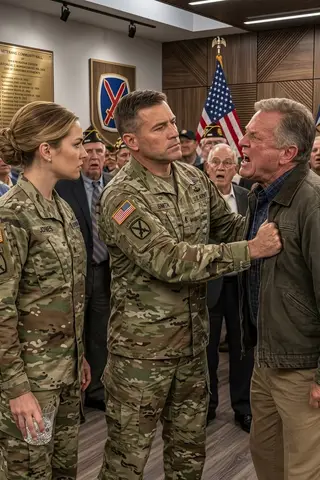
 The Retired Sergeant Called His Daughter "Little Puppy" at His Party
Chapter 92
The Depots in Winter
Two weeks later, an Air Force C-21 transport touched down on the snow-dusted runway of Anniston Army Depot in Alabama.
The air was sharp and bitter as I stepped down the mobile boarding stairs, flanked by Tom Henderson and two senior legislative aides from the Senate Armed Services Committee. Waiting on the tarmac in cold-weather flight jackets were Brigadier General Jack Albright and Anniston's depot commander, Colonel Raymond Shaw.
"Welcome to Anniston, Colonel Vance," Shaw said, offering a firm, heavy handshake. "The temperature's twenty-four degrees, but the rebuild bays are operating three shifts a day."
"Lead the way, Colonel Shaw," I replied. "Mr. Henderson wants to see the results of the ninety-day parts pipeline with his own eyes before the committee marks up the defense bill."
We rode an open-sided utility cart through the cavernous industrial complex. Anniston was the heartbeat of heavy armor modernization, where battle-tested Abrams tanks and Stryker combat vehicles were stripped down to bare steel hulls and rebuilt into pristine combat machinery. For decades, the Achilles' heel of the facility had been the procurement lag for precision hydraulic manifolds and fire-control wiring harnesses—specialized parts often held up in administrative purgatory.
Shaw brought us to Bay 4, where the chassis of an M1A2 SEPv3 tank was suspended over a massive assembly pit. Around it, civilian mechanics in blue coveralls moved with practiced efficiency, bolting in fresh powertrain components.
"Six months ago, this hull would have sat on wooden blocks for ninety days waiting for auxiliary power harness connectors from an overseas supplier," Shaw explained, shouting slightly over the pneumatic ratchets. "Under the domestic fast-track directive authorized by Colonel Vance's team, we certified a precision machining company in north Texas. They delivered forty certified harnesses in twenty-one days. The cost was four percent lower than the previous contract, and the failure rate during pressure testing was zero."
Henderson stepped forward, running a gloved hand along the immaculate welds of the hull. He turned to me, a faint, appreciative smile on his face.
"Your brother's supply framework?" Henderson asked quietly.
"Derek’s architectural model identified the excess capacity in the regional tool-and-die shops," I replied without boastfulness. "General Albright’s task force authorized the quality verification protocols. The result is what you see here: combat power returned to the line ahead of schedule."
Albright stepped up beside Henderson. "Tom, this isn't just about saving dollars in an audit cycle. If a conflict flares in the Pacific or Europe tomorrow, our operational readiness won't depend on container ships stalled in foreign ports. We build the spares here, we certify them here, and we install them here."
Henderson nodded slowly, taking notes in a pocket ledger. "The Chairman will want this exact shop-floor example on the record next week, Morgan. You’ve taken what was once an impenetrable tangle of procurement regulations and turned it into steel on the floor."
As the tour continued through the transmission overhaul shops, Albright fell into step beside me.
"Your father sent the first batch of symposium plaques last week, Morgan," Albright said, his eyes crinkling at the corners.
"Did they meet your standards, General?" I asked with a smile.
"They're works of art," Albright admitted. "The pecan wood has this deep, rich grain, polished until you can see your reflection in it. Richard Vance included a handwritten note with the bill of lading. Do you know what he wrote?"
"I can guess," I said.
"'*Built square and delivered on time. Brass plates seated to within one thirty-second of an inch. Cost: exactly what we agreed, not a penny more. MSgt R. Vance, US Army, Ret.*'" Albright shook his head with profound respect. "My chief of staff wanted to frame the invoice itself."
Looking across the vast expanse of the assembly bay, watching sparks shower against the concrete from a nearby cutting torch, I felt a deep, enduring pride. In Buda, in Round Rock, in Rosslyn, and here in the heart of industrial Alabama, the Vance standard remained unbroken: precise, honorable, and unyielding.
The End









