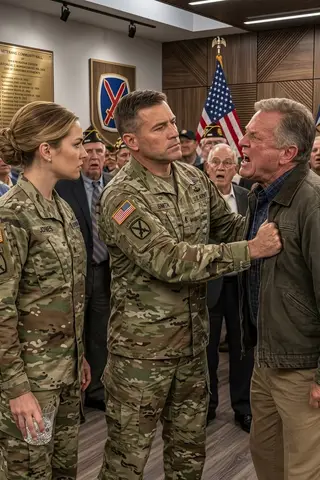
 The Retired Sergeant Called His Daughter "Little Puppy" at His Party
Chapter 76
The Austin Symposium
In late June, the University of Texas at Austin hosted the National Defense Industrial Association's Southwestern Logistics Summit at the AT&T Executive Education and Conference Center. Because of the national attention garnered by the ninety-day industrial base reforms, the organizing committee invited me to deliver the opening address on regional defense manufacturing resilience.
This time, I was not returning to Texas as a visitor seeking reconciliation; I was coming home to stand beside my family in our shared arena.
The grand ballroom was packed with over six hundred defense executives, university researchers, military logistics commanders, and state policy leaders. Seated in the front row, directly beneath the NDIA podium, were Richard, Eleanor, and Derek.
Derek wore a tailored navy suit, looking every bit the rising corporate director he had become. Beside him sat Eleanor in a cream linen dress, her face radiant and serene. And next to her was Richard, sitting straight and tall in his gray suit, his hair white as limestone, his blue eyes sharp and focused as he watched the crowd take their seats.
When the NDIA Southwestern president took the lectern, he stepped to the microphone and cleared his throat.
"Ladies and gentlemen, distinguished guests, and members of the armed forces: our keynote speaker this morning is a veteran of twenty-two years of service, a former commander in Iraq and Afghanistan, and the recipient of the Bronze Star with Valor and the Legion of Merit. As the director of the Senate's independent review of our defense industrial base, she has reshaped how our country ensures our service members receive the equipment they need, when they need it."
He paused, smiling out at the front row.
"Please welcome Colonel Morgan Vance, United States Army, Retired."
Applause rolled across the grand hall, deep and sustained.
I walked up the carpeted steps, shook the director's hand, and adjusted the microphone. I looked down into the audience, meeting Richard's eyes. He didn't blink. He sat there with his head held high, looking up at me not with the lingering pride of a father who had been humbled, but with the boundless honor of a soldier who recognized his commander.
"Distinguished colleagues," I began, my voice ringing clear and steady through the audio monitors. "We often speak of the defense industrial base as a network of facilities, balance sheets, and procurement schedules. But an industrial base is not an abstraction of capital. It is an extension of the front line."
I spoke for thirty minutes, laying out the practical realities of national preparedness. I shared the data from the ninety-day pilot, the vital necessity of certifying local suppliers, and the irreplaceable value of veterans working on the civilian factory floor.
"When we certify a machine shop in Round Rock or Dayton," I told them, "we are not merely cutting procurement lead times. We are honoring a sacred covenant with every young man and woman who raises their right hand and swears to defend this nation. We are promising them that when their moment comes, the home front will not fail them."
When I concluded, the entire assembly—flag officers, chief executives, and engineers alike—rose to their feet in a standing ovation.
From the podium, I saw Richard stand with them. He didn't applaud right away. He stood at attention, shoulders back, chin lifted, looking up at me through eyes bright with unashamed emotion. Then, slowly and deliberately, he brought his weathered hands together, leading the applause from the front row.
***
The End









