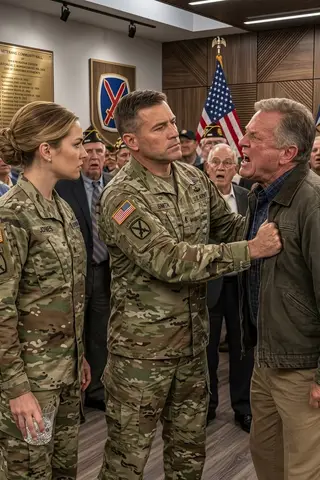
 The Retired Sergeant Called His Daughter "Little Puppy" at His Party
Chapter 6
The Weight of Command
The color in my father’s face shifted from crimson to an unhealthy, chalky gray. He looked smaller suddenly, his broad shoulders slumping slightly under the sudden, crushing weight of public humiliation and undeniable reality.
For twenty-five years, Richard Vance had built his entire identity on being the supreme patriarch of a military family. He was the Master Sergeant. He was the ultimate authority on grit, sacrifice, and survival. He had weaponized his service to belittle anyone who didn't fit his narrow, cinematic definition of a warrior—including his own daughter.
And now, in front of his friends, his peers, and the community he had lorded over for decades, he had been unmasked not by an enemy combatant, but by the very person he had spent a lifetime calling a puppy.
Derek pushed his way through the stunned circle of veterans, his face pale and tight. He looked at Brody’s chest ribbons, then up at the silver oak leaf on his shoulder, and finally down at me.
“Morgan,” Derek said, his voice dropping to a harsh, disbelieving whisper. “A full Colonel? You’re an O-6?”
“Yes, Derek,” I said quietly, my voice steady and devoid of triumph. “I pinned on colonel six months ago.”
“Why didn't you ever... why didn't you ever tell us?” Derek asked, genuine confusion breaking through his defensive posture. He was an infantry captain; he knew what rank meant. He knew the years of brutal evaluations, advanced schooling, command boards, and institutional survival required to reach O-6 in the modern United States military.
I looked at my brother, seeing for the first time how thoroughly our father’s shadow had warped his perception of the world as well.
“Because every time I tried to talk about my work, Dad turned it into a punchline,” I answered plainly. “After a while, you stop sharing your life with people who only want to use it as ammunition to make themselves feel taller.”
My father’s lips parted, but no words came out. He looked around the table, but the retired veterans who had been laughing and slapping his back moments ago were now staring intently at their whiskey glasses, deeply uncomfortable, suddenly realizing the sheer magnitude of the disrespect that had just been publicly dismantled.
In military culture, respect for rank and verified combat service is absolute. By mocking a superior officer—and specifically a decorated combat colonel—in such a public, derogatory manner, my father hadn't just insulted me as his daughter; he had committed a massive social and professional faux pas that the older veterans understood immediately.
“Master Sergeant Vance,” Brody said, his voice cutting through the heavy silence one last time as he neatly folded the official biography and slid it back into its manila envelope. “On behalf of the United States Army and the personnel who served under her command, I suggest you finish your drink, sit down, and reflect on what real service actually looks like.”
Brody snapped a crisp, razor-sharp salute.
It wasn't directed at the retired Master Sergeant. It was directed at me.
Instinctively, my hand rose in a clean, flawless military salute, returning the gesture with twenty years of muscle memory and hard-earned pride.
The End









