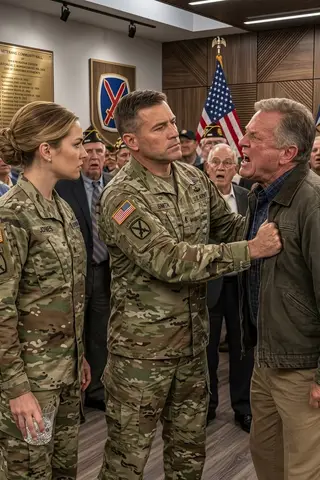
 The Retired Sergeant Called His Daughter "Little Puppy" at His Party
Chapter 62
The Ninety-Day Threshold
The winter air in Washington was biting and clear when I stepped out of the Metro station at Rosslyn on Tuesday morning. Ice clung to the granite parapets overlooking the Potomac, and the spires of Georgetown rose pale and sharp across the river.
By eight-thirty, I was seated in the fourth-floor executive conference room of our advisory firm, facing a wall of monitors linked to the Pentagon's Acquisition and Sustainment directorate. Dr. Arthur Wallace and Colonel Jack Albright appeared on the primary high-definition feed from Room 3E834.
"Good morning, Morgan," Wallace said, shuffling a brief stack of hard-copy memoranda. "I understand your address at the First Cav symposium made quite an impression in Austin. Garrett called the Vice Chief over the weekend to praise the industrial resilience framework."
"Major General Garrett was a gracious host, Arthur," I answered, keeping my tone measured and professional. "More importantly, the Texas defense corridor is beginning to realign around domestic capacity. But today is about our ninety-day benchmarks."
Jack Albright leaned forward on the screen, tapping a red folder on his desk. "We have the preliminary quarterly data from the Defense Logistics Agency and the Joint Microelectronics Program Office. The fast-track authority Congress enacted based on your SASC review has cleared forty-seven critical component waivers in sixty days. We’ve cut the lead time on radiation-hardened microcontrollers for precision guidance systems from twenty-eight months to nine months."
Marcus Vance, my deputy director, clicked a wireless remote from the end of the table, bringing up a series of comparative bar graphs on our side of the display.
"The numbers bear that out, Director," Marcus said. "By leveraging domestic fabrication plants in Sherman, Texas, and Columbus, Ohio, under the Defense Production Act Title III authorities, the unit cost has stabilized within four percent of the original baseline. We eliminated thirty-four single-point foreign dependencies in a single fiscal quarter."
I studied the metrics carefully, tracing the supply flows from raw wafer fabrication through packaging and assembly. For decades, the department had operated under the delusion that commercial efficiency equated to strategic security. It had taken a systemic shock and months of rigorous congressional pushback to prove that sovereignty carried a logistical price tag.
"What's the status of the Tier-3 supplier certifications?" I asked, looking directly at Albright. "It's easy to contract with prime manufacturers. The breakdown usually happens two levels down, in the machine shops and chemical refineries that provide raw substrate."
Albright grinned, nodding in agreement. "You anticipated that, Colonel. We embedded small-business liaison officers directly at the regional depot level. In fact, one of our prime avionics contractors out in Round Rock just submitted a prototype supplier-vetting framework that bypasses forty percent of traditional administrative backlog."
My chest tightened with pride, though I kept my face impassive. "Who developed the framework, Jack?"
"A junior integration team out of their Austin campus," Albright replied, checking his notes. "Lead analyst named Derek Vance. Good kid. Former Cavazos supply sergeant, apparently. Knew exactly where the logistics chain gets gummed up because he used to sign for the broken assemblies himself."
Wallace glanced up, adjusting his tortoiseshell glasses. "Any relation to you, Morgan?"
"My younger brother, Arthur," I said, allowing a faint, proud smile to surface. "He learned inventory control under one of the strictest master sergeants in the United States Army."
Wallace let out a low whistle of genuine admiration. "Seems the Vance family makes a habit of fixing our broken systems. Send his model through our policy shop, Jack. If it works at Round Rock, I want it implemented across all four military service acquisition executives by the third quarter."
"Understood, Mr. Secretary," Albright said.
I looked out the panoramic window of the conference room toward the Pentagon’s western façade across the river. The pieces were locking into place. Not through grand speeches or bureaucratic edicts, but through the patient, unrelenting precision of people who knew how the machinery actually turned.
***
The End









