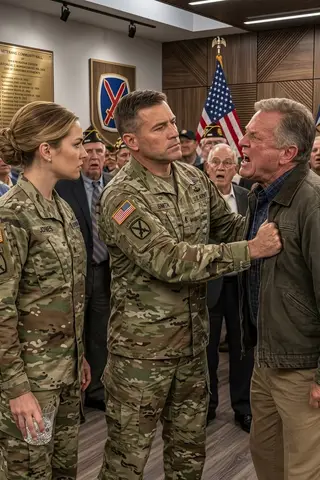
 The Retired Sergeant Called His Daughter "Little Puppy" at His Party
Chapter 52
The Blueprint on the Counter
On the morning of Black Friday, while millions of shoppers descended on retail centers across the state, our house remained an oasis of quiet industry.
Eleanor had retreated to her sunroom studio early to work on a commissioned landscape for a client in San Marcos, the soft scratching of her brushes against heavy cotton paper barely audible through the hallway. In the kitchen, Derek and I spread his university coursework and company project blueprints across the butcher-block island.
"This is the current bottleneck," Derek explained, pointing a pen at a complex node diagram illustrating the semiconductor supply path for naval sonar assemblies. "The primary contractor is in Round Rock, but three of the passive ceramic components are sourced through an intermediary in Singapore that subcontracts to a Tier-3 vendor in Taiwan. If lead times slip by even two weeks, the whole integration schedule collapses."
I leaned over the diagram, examining the procurement chains with practiced eyes. "What’s the alternative domestic baseline?"
"There isn't an active one on contract," Derek admitted. "There's a specialized precision-die fabricator outside Fort Worth, but their unit cost is fourteen percent higher, and DoD qualification takes six months."
A heavy set of footsteps sounded behind us. Richard walked into the kitchen, carrying two clean mugs and a fresh pot of dark roast coffee. He poured two cups, set one beside my elbow and one beside Derek's, and then stood quietly behind us, his reading glasses perched low on his nose as he studied the schematic.
Years ago, Richard would have dismissed this entirely as pencil-pusher paperwork, barking that real soldiers didn't care about supply manifests as long as the ammunition was on the truck. Now, he leaned closer, pointing a thick, calloused finger at the node Derek had highlighted.
"Fourteen percent cost difference sounds like a lot on a spreadsheet," Richard said quietly, his voice low and measured. "Until a storm knocks out a cargo terminal in the Pacific, or a foreign government decides to hold up an export permit. In ninety-one, during Desert Storm, we had a maintenance bay outside King Khalid Military City stall out for three weeks because the hydraulic seal kits were stuck on a commercial container ship sitting off Bahrain. We had twenty-eight Bradleys deadlined in the sand over fifty-dollar gaskets."
Derek looked up at him, surprised by the sharp operational context. "What did the division do?"
"We scrounged, we fabricated what we could on mobile lathes, and we took parts off reserve hulls," Richard said, shaking his head slowly. "It was sloppy, dangerous, and it cost time we shouldn't have lost. If your Fort Worth vendor can deliver within driving distance without an ocean between the plant and the assembly line, that fourteen percent premium is just insurance."
I looked from Richard to Derek, feeling a profound sense of continuity. "Your father's right, Derek. In the Senate review we just submitted, we recommended establishing a defense-readiness tax credit specifically to bridge that fourteen percent delta for domestic critical components. Write that into your project proposal. Frame it not as an increased operational expense, but as a risk-mitigation hedge for programmatic continuity."
Derek smiled, scribbling notes rapidly in the margin of his paper. "Man. Having a retired Colonel and a retired Master Sergeant as technical consultants is going to break the curve in my master's seminar."
"Just make sure the spelling is correct," Richard said dryly, but a small, proud smile tugged at the corner of his mustache as he stepped back to the counter to pour his own coffee. "A sergeant's work should always stand up to inspection."
***
The End









