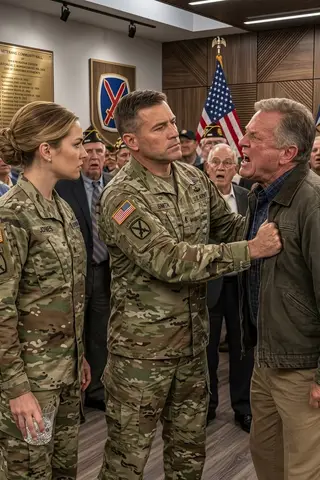
 The Retired Sergeant Called His Daughter "Little Puppy" at His Party
Chapter 43
The Gallery on Main
By mid-August, Central Texas was locked in its standard summer crucible, with temperatures hovering near triple digits by noon. But inside the newly renovated municipal arts center on Main Street in Buda, the air conditioning was brisk, humming with the murmur of thirty or forty local residents holding glasses of chilled white wine and sparkling water.
Eleanor stood near the center partition, wearing an elegant linen dress of soft lavender, her silver hair neatly pinned back. Beside her hung six framed watercolor paintings—her first collection chosen for a juried regional showcase titled *Hill Country Horizons*.
I had flown in early Saturday morning on the red-eye from Dulles, determined not to miss the opening reception. When I walked through the double glass doors, the first thing I saw was not my mother, but my father.
Richard Vance was wearing a dark navy blazer over a crisp, pressed white button-down shirt, khaki trousers with an immaculate crease, and freshly shined leather loafers. He wasn't slouching against the perimeter wall with his arms crossed, glaring at the crowd as he once would have. He was standing near the guest book, handing informational brochures to visitors with practiced, polite efficiency.
"Good afternoon," Richard said to an elderly couple who approached. "The landscapes on this wing are by Eleanor Vance. The one on the left is the old lime kiln near Kyle. She worked on the shadow depth for three weeks to get the limestone texture right."
The couple nodded politely, admiring the painting, while Richard watched them with the watchful intensity of a sentry guarding a priceless relic.
I stepped up quietly behind him. "Master Sergeant Vance. Are you working security for the artist, or are you her publicist?"
Richard spun around, his weathered face breaking into a genuine, startled smile. "Morgan! What are you doing here? Your mother said you had committee hearings until Monday."
"I rescheduled the deposition review for Tuesday," I said, leaning in to give him a brief, firm hug. He hugged me back—no hesitation, no stiff-armed formality. "I wasn't going to miss Mom's first formal gallery exhibition."
"Look at her," Richard murmured, nodding toward the crowd where Eleanor was animatedly discussing her brushwork with a retired art professor from Austin. "She’s glowing. Half the county came out. Two of the paintings already have red dots on the placards—that means sold, you know."
"I do know," I smiled. "Which ones sold?"
"The one of the old windmill outside Lockhart, and the cedar creek bed," he said, puffing his chest out slightly. "Some lawyer from West Lake bought the windmill. Paid four hundred and fifty dollars. I told him he got a bargain."
I laughed softly. "Dad, did you negotiate the price?"
"Hell no," he scoffed, though his eyes twinkled. "I just told him my wife didn't paint cheap scenery for tire shops. He wrote the check on the spot."
I shook my head, touched beyond words. The man who had spent thirty years treating his wife’s artistic inclinations as a trivial distraction from domestic duties was now standing sentry over her canvas, threatening to run off anyone who didn't respect her talent.
Eleanor caught my eye through the gathering and excused herself, walking across the polished concrete floor with a lightness in her step that had been absent for decades.
"Morgan!" she exclaimed, wrapping her arms around my neck. "You made it!"
"Wouldn't have missed it for the world, Mom," I said, admiring the nearby watercolor of a storm breaking over the Blanco River. "These are extraordinary. The light in the storm clouds is incredible."
"Your father built the drying racks in the garage so the humidity wouldn't warp the heavier paper," Eleanor said, glancing at Richard with an affectionate, conspiratorial smile. "And he drove into Austin three times because the first two framing shops didn't use non-reflective glass."
Richard cleared his throat gruffly, adjusting his collar. "If you're going to put something on a wall, you frame it right. No point doing half a job."
"He was very particular," Eleanor added, resting her hand lightly on his arm. Richard didn't pull away; he covered her hand with his own rough fingers.
Standing there in that sunlit gallery, watching my parents operate as true partners, the last lingering shadows of my childhood dissolved. The angry, combative sergeant who had called his daughter a "little puppy" to protect his own wounded pride had surrendered his command. In his place stood a man who had finally discovered that the greatest victory a soldier can win is learning how to love the people who survived his war.
***
The End









