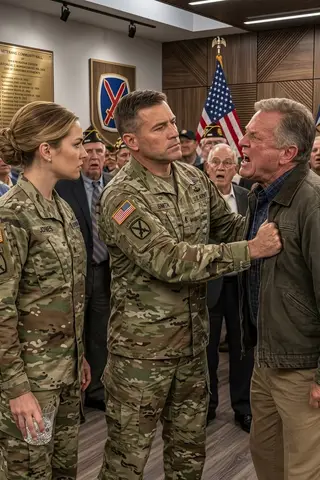
 The Retired Sergeant Called His Daughter "Little Puppy" at His Party
Chapter 100
The Red Sea Flash
Back in Washington, the heat of mid-July lay heavy and humid over the Potomac basin.
The defense industrial base reforms were fully institutionalized across five federal agencies, and our Rosslyn office had transitioned into its permanent role as the National Strategic Sourcing Center. My life had settled into a steady, productive rhythm: morning strategy briefings, afternoon oversight sessions with congressional committees, and regular check-ins with Derek in Texas and Elena at the Pentagon.
On a Tuesday morning at 0645, I was walking down the carpeted hallway of our Rosslyn suite, holding a mug of black coffee and reviewing the agenda for an upcoming hearing before the Senate Armed Services Committee.
Suddenly, Marcus stepped out of the communications vault, his face stark white, his eyes wide with shock.
"Morgan," he said, his voice a tense, breathless whisper. "Get in here right now."
I set my mug on the nearest credenza and followed him through the heavy acoustic door into the secure SCIF.
The wall of high-definition monitors was flashing red alert banners from the National Military Command Center. Across the center screen, live encrypted telemetry and satellite feeds from the southern Red Sea displayed a chaotic, rapidly expanding operational crisis.
"What happened?" I demanded, stepping up to the main tactical terminal.
"Twenty minutes ago, an unprecedented coordinated swarm of over forty low-observable anti-ship ballistic missiles and autonomous subsurface attack drones targeted a commercial convoy in the Bab-el-Mandeb Strait," Marcus said, his hands flying across the keyboard to decrypt the incoming combat logs. "The destroyer USS *Thomas Hudner* and the guided-missile cruiser USS *Philippine Sea* intercepted thirty-six targets, but the volume overwhelmed the forward battery magazines. Both ships have expended their entire primary inventory of Standard Missile-3 and SM-6 interceptors."
I leaned over the console, my heart pounding against my ribs. "What about the maritime sustainment corridor Elena established?"
"That’s the worst part," Marcus said, turning to look at me, his voice trembling with dread. "The forward prepositioned logistics hub in Djibouti—the facility holding the emergency reserve interceptors—was hit by three hypersonic cruise missiles four minutes ago. Communications are completely severed."
My blood ran cold. "Elena was on the ground there. She flew out from the Pentagon on Sunday to oversee the final inventory inspection."
"Her transponder signal dropped off the network at 0641," Marcus said, pointing to a blinking red question mark over the Gulf of Tadjoura. "CENTCOM is declaring a theater-wide logistics blackout. All air transport routes into the southern Red Sea are locked down."
Before I could speak, the secure red landline on the center console began to wail—the direct emergency channel from the White House Situation Room.
I picked up the receiver with a steady hand, my voice instantly snapping into the hard, absolute focus of command.
"This is Colonel Vance."
"Colonel, this is the Chairman of the Joint Chiefs," the voice on the other end said, urgent, strained, and stripped of all formality. "The President has just activated the National Strategic Defense Mobilization Protocol. We have lost our primary maritime corridor, our forward stockpiles are burning, and five thousand sailors are sitting in the strike envelope without missile reloads. I need you in the Situation Room in fifteen minutes—and Morgan, I need your father on the phone right now."
The End









