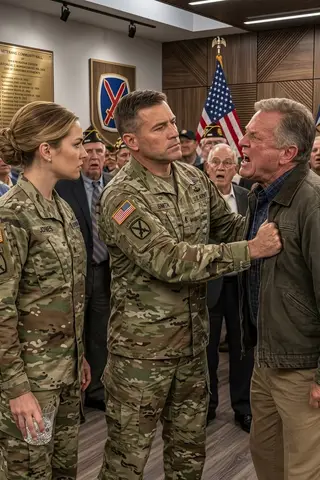
 The Retired Sergeant Called His Daughter "Little Puppy" at His Party
Chapter 49
Passing the Baton
At two o'clock sharp, a brisk knock sounded at my door.
Captain Elena Torres stepped inside, wearing her service uniform, her brass shining, her ribbons perfectly aligned. But unlike our meeting four months ago, there was no anxiety in her posture, no nervous hesitance in her eyes. She stood tall, balanced, and radiating quiet professional confidence.
"Director Vance," she said, coming to attention briefly before relaxing at my gesture.
"Have a seat, Elena," I said, gesturing to the leather chairs around the small conference table. "How was your out-processing from the Pentagon fellowship?"
"Complete, ma'am," she said, sitting down and placing a neat folder on the table. "My orders for USCENTCOM in Tampa came through yesterday. I report to the Joint Intelligence Center on the first of December."
"Congratulations," I said warmly. "How did your line battalion commander take the news?"
Elena smiled—a sharp, confident expression that reminded me of my own younger days. "He told me I was making a mistake by stepping off the traditional division path. He said joint billets are where careers go to hibernate."
"And what did you say?"
"I told him that the future of warfare is joint, distributed, and data-driven," Elena answered without missing a beat. "And I told him that if I spent my career managing motor pools just to check a box on a traditional promotion board, I wouldn't be doing my duty to the soldiers I’m supposed to lead."
I let out an appreciative chuckle. "Direct, unapologetic, and completely accurate. How did he respond?"
"He stared at me for ten seconds, signed the clearance voucher, and said, 'You sound just like Colonel Vance.'"
The words hung in the quiet office, carrying an immense, unspoken resonance.
"I took it as a compliment, ma'am," Elena added softly.
"You should," I told her, meeting her gaze steadily. "Elena, the hardest part of leadership isn't making tough tactical decisions under fire. It's having the moral courage to tell the institution when it's wrong, even when doing so puts your own career at risk. When you get to Tampa, you're going to be surrounded by officers who are terrified of making mistakes. Don't be one of them. Do the analysis honestly, speak truth to the commanders, and take care of your junior analysts."
"I will, Director," she said, her voice rich with conviction. "Thank you. For showing me that you don't have to surrender your intellect or your identity to be a great officer."
"You don't," I said, standing up and extending my hand. "You just have to be willing to carry the weight. Safe travels to Florida, Captain."
She gripped my hand firmly, exchanged a crisp salute, and walked out of the office.
Watching her stride down the corridor, her head high and her boots clicking sharply on the floor, I felt a deep, profound sense of closure. The legacy of service was not about rank, plaques on a wall, or the grudges of retired veterans drinking stale beer in dark Legion halls. It was about opening the road for the generation that followed.
***
The End









