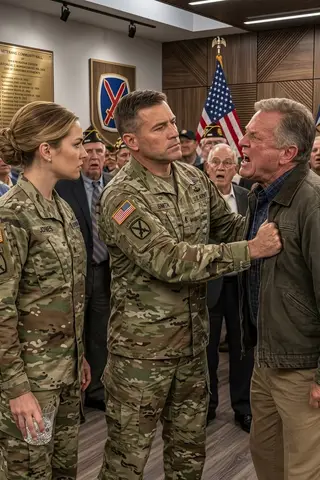
 The Retired Sergeant Called His Daughter "Little Puppy" at His Party
Chapter 94
The Test on the Line
Early March brought the first major operational test of our national supply chain reforms.
A severe winter gale across the North Atlantic combined with an electrical fire aboard a forward supply ship in Rota, Spain, threatened to ground an entire squadron of F-35A fighters scheduled for deployment to the eastern Mediterranean. The failure involved critical titanium servo housings—components that historically required an eight-month lead time through traditional defense prime contractors.
I was in the Rosslyn war room at six in the morning when the emergency tasking came through from the Office of the Deputy Secretary of Defense.
"The airframe readiness window is thirty days," Marcus said, taping the red-bordered alert notification to the whiteboard. "If those jets don't make the transit to Souda Bay by April second, the entire NATO deterrence patrol rotation collapses. CENTCOM and EUCOM are both leaning on the Pentagon."
I sat at the conference table, staring at the schematic of the housing. "Where is the casting certified?"
"Nowhere in the prime's domestic network," Marcus replied grimly. "The casting was subcontracted to a foundry in northern Italy that’s currently offline due to regional power disruptions. The traditional procurement pipeline says October at the earliest."
I pulled out my phone and dialed Derek’s direct line at his corporate office in Round Rock. He answered on the second ring.
"Derek, did the emergency alert hit your dashboard?" I asked.
"Ten minutes ago," Derek responded instantly, the clatter of keyboard keys audible in the background. "I’m already looking at the CAD files for the titanium servo housing. Morgan, we have a qualified Tier-3 precision casting facility in Waxahachie, Texas. They were certified under your pilot program three months ago. They have four five-axis CNC milling machines currently open between commercial aerospace runs."
"Can they hold the five-micron tolerances required for the F-35 flight control system?" I asked.
"Yes," Derek said without hesitation. "Their master machinist is a former Navy aviation structural mechanic. They did sample runs for the depot at Corpus Christi in January. Defect rate was zero. But to authorize the emergency titanium billet release from the Defense Logistics Agency strategic stockpile, we need an immediate O-6 sign-off and an expedited task order from the Joint Staff."
"Elena is on watch at the J5 right now," I said. "Send the data package directly to my terminal. I’ll clear the statutory review with Henderson and Albright, and we’ll have the task order signed before noon."
For the next four hours, the network functioned with surgical precision.
In Rosslyn, Marcus and I bypassed eighty pages of redundant bureaucratic waivers using the fast-track authorities Congress had codified in the NDAA. In the Pentagon, Major Elena Torres carried the authorization memo directly into Brigadier General Albright’s office, securing the Joint Staff operational necessity waiver in twenty-five minutes. In Round Rock, Derek coordinated the freight transport, locking down two dedicated flatbed haulers to move twenty thousand pounds of aerospace-grade titanium billet from the DLA depot in Warren, Ohio, straight to the factory floor in Waxahachie.
By four o’clock that afternoon, the milling spindles in Texas were spinning, cutting metal with microscopic accuracy.
Albright called me at five. "Morgan, the Air Force Logistics Command just updated the squadron readiness tracker. Delivery of the replacement servos is scheduled for March twenty-first. Nine days ahead of the operational deadline."
"That’s how the machine is supposed to run, Jack," I said, feeling the tension slowly leave my shoulders.
"Twenty-two years ago, when you and I were majors in the 1st Cav, an emergency like this would have taken a congressional inquiry and six months of fingers pointing between Dayton and Washington," Albright said. "What you and your family have built across this country is saving missions before the aircraft even leave the tarmac."
"It wasn't built by one person, Jack," I said quietly. "It takes good steel, square joints, and people who aren't afraid to do the work."
The End









