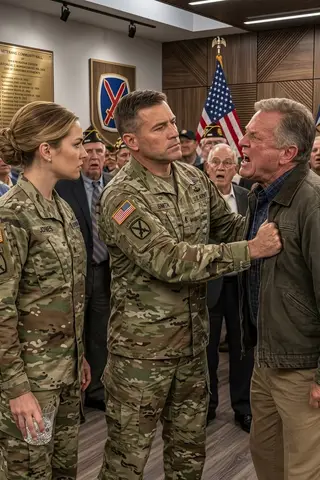
 The Retired Sergeant Called His Daughter "Little Puppy" at His Party
Chapter 67
The Pentagon Scorecard
By mid-March, the ninety-day evaluation window closed.
The Pentagon's executive conference room in the E-Ring was packed with senior stakeholders for the quarterly Defense Industrial Base Readiness briefing. The Under Secretary of Defense for Acquisition and Sustainment presided, flanked by three-star representatives from the Army, Navy, Air Force, and Marine Corps requirements directorates.
I sat at the primary presenter's table alongside Dr. Wallace, with Jack Albright seated directly behind us.
The ninety-page quarterly assessment report sat before every general officer and civilian executive in the room, bound in black with the gold seal of the Department of Defense.
"Ladies and gentlemen," I began, my voice carrying clean and steady across the cavernous room without the need for a microphone. "Three months ago, the Senate Armed Services Committee directed this working group to test whether our industrial base could respond with the speed and agility demanded by modern strategic competition. The data in front of you answers that question."
I walked them through the core metrics, slide by slide, stripping away unnecessary bureaucratic verbiage.
"We have reduced critical weapon-system supply lead times by thirty-eight percent across three major categories. We have certified two hundred and twelve domestic Tier-2 and Tier-3 suppliers. We have eliminated foreign critical dependencies on seventy-four primary semiconductor and rare-earth components. And most importantly, we achieved this without a dollar in cost-overrun by enforcing direct accountability at the depot and contractor plant level."
The room was silent, save for the quiet turning of pages.
A three-star Marine lieutenant general with a row of combat ribbons looked up from his report, fixing his gaze on me. "Colonel Vance, your team's methodology for vetting sub-tier machine shops—the decentralized certification model—where did that originate? Our procurement staff has been trying to crack that administrative roadblock for five years."
"It came from the operational deck plates, General," I answered without hesitation. "It was developed by analyzing how tactical supply sergeants resolve deadlined equipment in the field. When a squad needs a replacement part, they don't wait for a three-month policy review. They verify the specification, confirm the material integrity, and install the component. We applied that same non-commissioned officer common sense to corporate supply networks."
Dr. Wallace leaned in, nodding emphatically. "Director Vance's review reminded us of a fundamental truth: our procurement architecture had grown so insulated that it forgot how the end-user operates. This model reconnects the engineer to the soldier."
The Under Secretary closed his folder, resting his hands flat on the mahogany conference table.
"Colonel Vance, Dr. Wallace. The findings of this ninety-day review are adopted in full as standard operating procedure across all military departments effective immediately. Furthermore, the Secretary of Defense has directed that your advisory group prepare the comprehensive five-year strategic road map for the upcoming presidential budget submission."
The room broke into brief, respectful table-knocking from the flag officers—the traditional military gesture of unreserved approval.
"Thank you, Mr. Secretary," I said, acknowledging the decision with a crisp nod. "We will deliver the road map on schedule."
As the room began to empty, Jack Albright stepped beside my chair, grinning broadly.
"Thirty-eight percent lead time reduction in ninety days, Morgan," Albright said quietly. "You just saved the taxpayer billions, and more importantly, you made sure our units won't be caught short if the balloon goes up."
"We gave them the tools, Jack," I said, packing my briefing notes into my leather portfolio. "Now we just have to make sure they keep using them."
"Your father would be pleased," Jack remarked.
"My father would say we met the minimum standard and ask what we're doing tomorrow," I smiled. "And that's why it works."
***
The End









