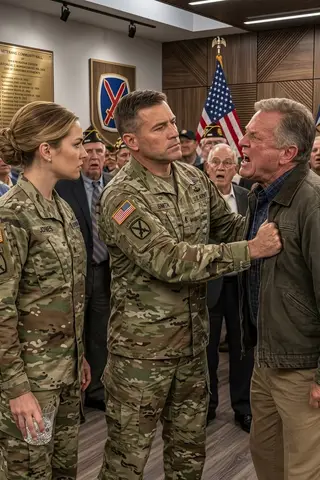
 The Retired Sergeant Called His Daughter "Little Puppy" at His Party
Chapter 26
The Briefing Room
By the beginning of December, the transition from military command to corporate executive leadership felt entirely natural. The rhythm of high-level intelligence work was familiar, even if the suits replaced the combat uniforms.
On a rainy Thursday morning, I stood before a joint committee of private defense consultants, Department of Defense liaisons, and congressional budget advisors in a secure SCIF in northern Virginia.
"The procurement bottlenecks in Eastern Europe aren't caused by manufacturing shortfalls," I stated, pointing a laser at the flow diagram on the encrypted digital display. "They are caused by administrative red tape at secondary border crossings in Poland and Romania. If we don't streamline bilateral transit agreements, our response time for emergency resupply will degrade by forty percent over the next six months."
A retired two-star admiral sitting across the table leaned forward, resting his chin on his steepled fingers. "And what’s your recommendation, Director Vance? The state department hasn't managed to move that needle in eighteen months."
"Because State approached it as a diplomatic treaty," I answered immediately, my tone cool, authoritative, and direct. "It isn't a diplomatic treaty. It’s a commercial customs exemption under existing NATO status-of-forces frameworks. We invoke Annex C, reroute through civilian rail lines, and bypass municipal transit fees entirely."
The admiral stared at the slide, then at me. A slow, appreciative nod broke across his stern face. "Straight out of the tactical playbook. Efficient. Uncomplicated. Thank you, Colonel."
He caught himself, offering a brief, apologetic smile. "Excuse me, Director Vance."
"Either title works, Admiral," I said with a composed smile. "The execution remains the same."
As the briefing wrapped up and the participants gathered their classified folders, several senior liaisons approached me to exchange business cards and discuss further operational briefings. There was no condescension in their eyes, no dismissive references to "office clerks," and no patronizing assumptions.
I left the facility at noon, stepping into the crisp, cool air of the courtyard. The rain had stopped, leaving the pavement slick and shimmering beneath the gray sky.
For years, Richard’s voice had lived in the back of my head like static—a low, constant hum insisting that whatever I built, I was still just a little girl playing dress-up in a soldier's world. Standing in that courtyard, feeling the cold breeze against my face, I listened for that static.
There was only silence. The ghost in my head had finally lost its voice.
***
The End









