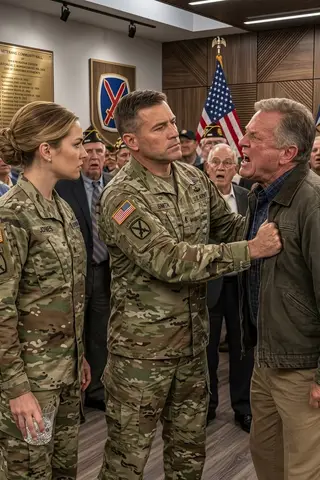
 The Retired Sergeant Called His Daughter "Little Puppy" at His Party
Chapter 38
The Next Generation
Back in Northern Virginia by the end of May, my schedule returned to the rapid tempo of national security advisory work. But my calendar now held deliberate blocks of time that had nothing to do with corporate deliverables or joint defense contracts.
On a rainy Tuesday afternoon, I sat in the glass-walled cafeteria of our Rosslyn office with Captain Elena Torres.
Elena was thirty years old, an active-duty Army military intelligence officer currently serving a fellowship at the Pentagon, facing the critical career milestone between company command and major’s promotion boards. Her personnel file had landed on my desk through an Army women’s mentorship initiative I had quietly joined earlier that spring.
"Director Vance," Elena began, her fingers nervously tracing the rim of her coffee cup. "My brigade commander told me that if I take the joint intelligence assignment in Tampa instead of going back to a division staff at Fort Liberty, I’m putting a ceiling on my career. He said line battalions want officers who stayed in the dirt, not staff officers who sat behind screens."
I listened, letting the familiar echo of old institutional dogma wash over me.
"Captain Torres," I said, my voice calm, steady, and commanding. "How long was your company command?"
"Eighteen months in South Korea, ma'am."
"Did you receive a superior rating on your evaluation report?"
"Yes, ma'am. Top block."
"Then you have already proven you can lead soldiers in the dirt," I told her, looking her directly in the eyes. "The men who tell you that tactical dirt is the only metric of leadership are often the ones who are terrified of strategic complexity. The Army of the next twenty years does not need commanders who merely know how to maneuver a company in a valley. It needs leaders who understand how satellite data, cyber infrastructure, and coalition logistics intersect at the operational level."
Elena’s posture straightened, the tension leaving her shoulders. "He made it sound like I was taking the easy road."
"There is nothing easy about strategic command," I said with a slight, knowing smile. "It is lonely, it is politically fraught, and it requires a level of independent moral courage that tactical manuals don't teach. If you want to spend twenty years pleasing traditionalists who think warfare hasn't changed since Desert Storm, take the division desk. If you want to lead the future, take the Tampa billet."
She sat back, exhaling a long, measured breath. "Did people tell you that when you transferred out of field artillery into strategic intelligence?"
"Every single day," I answered honestly. "My own father told me I was abandoning real soldiering to become a clerk."
"How did you handle that, ma'am?"
"I became a Colonel," I said evenly. "And I let the work answer the noise."
Elena looked at me for a long moment, a slow, determined smile breaking across her young face. "Understood, Director. Tampa it is."
Watching her walk toward the security turnstiles with her head held high, I realized that the hardest battles we fight in uniform aren't always against adversaries abroad. Sometimes, they are against the ghosts of old men who cannot bear to see the world move beyond the boundaries of their own experience.
And for Elena Torres, the road would be just a little bit wider, because someone had already cut the wire.
***
The End









