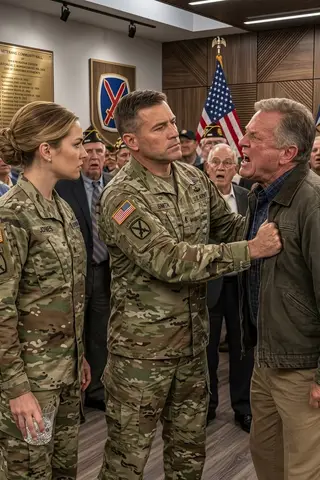
 The Retired Sergeant Called His Daughter "Little Puppy" at His Party
Chapter 45
A Call from the Past
Two weeks after the congressional hearing, an unexpected email appeared in my official inbox. The subject line read: *Message from an old 1st Cav trooper / Richard Vance's daughter.*
I opened it. It was from a man named Arthur Campbell, a retired Command Sergeant Major living outside Belton, near Fort Cavazos.
*Director Vance,* the email began.
*You don't know me, but I served with your father, Dick Vance, in the 1st Cavalry Division during Desert Shield and Desert Storm. I was a platoon sergeant in the neighboring troop when he was a Master Sergeant handling division maintenance and movement.*
*I’m writing because I saw your testimony before the Senate Armed Services Committee on television last week. When the news anchor introduced you as Colonel Morgan Vance, retired, and noted your decorations, I nearly dropped my coffee. Then I recalled the commotion that happened down at the Legion post in Austin last fall.*
*I ran into your father three weeks ago at the VA clinic in Temple. To be completely honest with you, ma'am, Dick Vance and I hadn't spoken more than ten words in fifteen years. In the old days, Dick was a hard man to be around—wound tighter than a clock spring, bitter about his retirement rank, and constantly picking fights with anyone who had more stripes or brass than he did.*
*When I saw him in the waiting room, I prepared myself for an argument. Instead, Dick stood up, shook my hand, and asked about my grandchildren. And then he spent twenty minutes showing me newspaper clippings and photos of his kids. He showed me a picture of Derek at his new job in Round Rock, and he showed me your official retirement portrait with the O-6 eagle on your shoulders.*
*He told me: 'Arthur, I spent half my life thinking leadership was about making people feel small so they wouldn't notice how scared you were. My daughter Morgan taught me that real command means holding the door open so the people behind you can walk through.'*
*I just wanted you to know that, ma'am. There are a lot of old men from our era who go to their graves bitter, locked inside their own little foxholes. Whatever you did to break through Dick's armor, you saved him from that. You did something the Army never could.*
*Respectfully,*
*Arthur Campbell, CSM (Ret.), USA.*
I sat in my quiet office in Rosslyn, reading the email three times through.
The late afternoon sun slanted across the Potomac, throwing long, golden reflections across the surface of my glass desk. Outside, the steady drone of Northern Virginia traffic moved along the parkway—a world in perpetual motion, hurrying toward tomorrow.
I thought back to the American Legion post in Austin on that sweltering afternoon a year ago. I remembered the heavy, suffocating silence that fell over the banquet hall when Colonel Albright read my orders aloud. I remembered the sudden paleness of my father's face, the trembling of his fingers, and the humiliating collapse of the small, petty kingdom he had constructed out of old grievances and manufactured authority.
At the time, I had felt only the icy, resolute satisfaction of justice—a long-overdue settling of an abusive emotional ledger.
I had not anticipated that the collapse of that false kingdom would be the very thing that allowed Richard Vance to become a human being again.
I pressed the reply button, typing a simple, heartfelt response:
*Dear Sergeant Major Campbell,*
*Thank you for taking the time to write. My father was a good soldier who carried heavy baggage home from a difficult war. It took us both a long time to learn how to put the packs down.*
*I will tell him you said hello.*
*Warmly,*
*Morgan Vance, Colonel (Ret.), U.S. Army.*
I hit send, closed my laptop, and leaned back, watching the dusk gather over the capital. The war was not just over; the ground had finally begun to heal.
***
The End









