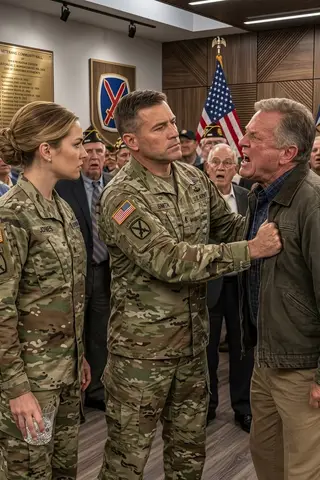
 The Retired Sergeant Called His Daughter "Little Puppy" at His Party
Chapter 59
Return to the Red River
On a bright, cold Friday in late January, the grand ballroom of the AT&T Conference Center on the University of Texas campus in Austin was packed to capacity.
More than five hundred people filled the hall: active-duty officers in dress blues with shining gold braids, corporate leaders from Texas's burgeoning defense corridor, university deans, and distinguished veterans wearing service-branch pins on their lapels.
At the head table, elevated on a low riser before the giant First Cavalry Division crest, sat Major General Garrett, the Command Sergeant Major of Fort Cavazos, the Dean of the LBJ School of Public Affairs, and the Vance family.
Richard looked immaculate. He wore a crisp navy blazer with his silver miniature master sergeant rank and combat infantry badge pinned neatly to his lapel, his gray hair trimmed to regulation neatness, sitting tall beside Eleanor, whose elegant cream dress and quiet poise commanded immediate respect. Derek sat on Richard's left, looking every bit the rising corporate executive in a tailored charcoal suit.
Major General Garrett stepped to the podium, his voice amplified across the room.
"Distinguished guests, soldiers, and partners," Garrett began. "Today we gather to examine how our military adapts to the rapidly evolving threats of the twenty-first century. But as we look toward advanced technology, AI integration, and autonomous systems, we must never forget that the bedrock of American power has always been its people—and the families who produce them."
Garrett turned toward our table, gesturing broadly.
"Our keynote speaker today is someone who bridges every facet of this enterprise. A combat veteran, a former brigade commander, the Advisory Lead for the Senate Armed Services Committee, and the daughter of this division's own proud heritage. Please welcome Colonel Morgan Vance."
The ballroom erupted into thunderous applause.
As I stood up, Richard caught my eye. He didn't say a word, but he gave me a slow, deliberate nod of absolute respect—a master sergeant yielding the floor to his commander.
I walked to the lectern, adjusting the microphone. The room quieted instantly, hundreds of eyes fixed on me, waiting for direction.
"General Garrett, Command Sergeant Major, honored guests, and fellow soldiers," I began, my voice carrying through the hall with natural authority. "When I was commissioned as a second lieutenant thirty years ago, the conventional wisdom told us that rank was the ultimate measure of service. We believed that authority was conferred by the insignia on your collar, and that leadership was simply the art of imposing your will upon a formation."
I paused, looking out over the crowd, catching sight of several young lieutenants and junior sergeants seated near the back.
"I learned how wrong that was—not in the halls of the Pentagon, and not in the seminar rooms of the War College. I learned it from a Master Sergeant who served this division in the sands of Iraq thirty-four years ago."
I gestured gently toward the head table. Every head in the room turned toward Richard.
"My father, Master Sergeant Richard Vance, taught me that true authority is not demanded; it is earned through competence, accountability, and the courage to tell the hard truth when comforting lies are easier. The lethality of the American military does not live in our weapon systems. It lives in the unbroken line of discipline passed from the non-commissioned officer to the commander, from the front line to the national strategic headquarters."
Richard sat motionless, his jaw clenched, his eyes glistening with unshed tears as the entire ballroom—generals, colonels, sergeants, and civilians alike—stood as one and applauded him.
I waited for the ovation to settle, feeling a profound, radiant stillness within my chest.
"Now," I continued with a confident smile, "let us discuss how we build a defense industrial base worthy of the soldiers who carry our colors."
***
The End









