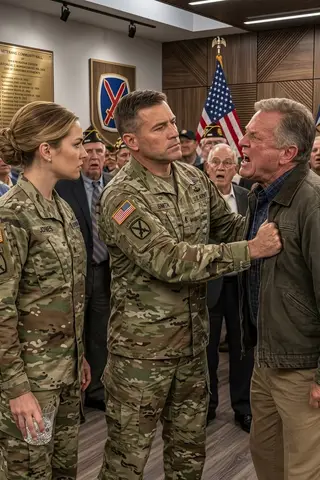
 The Retired Sergeant Called His Daughter "Little Puppy" at His Party
Chapter 69
The Next Cohort
On the first Monday of April, the morning air in Rosslyn was soft with the promise of spring. The cherry blossoms across the river in Washington were beginning to burst into clouds of pale pink and white along the Tidal Basin.
In the lower conference room of our advisory firm, twelve young men and women sat around the seminar table.
They were recent transition fellows: former captains, senior lieutenants, and staff sergeants who had completed their operational military tours and were now entering the civilian national security policy arena through a fellowship program our firm had established with the Department of Veterans Affairs.
I stood at the head of the table, dressed in a sharp charcoal blazer, holding a single dry-erase marker.
"Good morning," I said, looking across the circle of eager, attentive faces. Many of them still wore the unmistakable habits of recent service—the ramrod posture, the cropped hair, the wary glance toward the senior officer in the room.
"When you take off the uniform," I began, speaking slowly and deliberately, "there is a temptation to believe that your authority stayed behind on the base. You wonder if your operational experience translates into a world governed by spreadsheets, legislative statutes, and corporate boardrooms."
I set the marker down on the rail beneath the whiteboard.
"I spent twenty-two years as an Army officer. I commanded battalions, sat in joint operations centers in combat theaters, and retired as a full Colonel. And when I first stepped into the civilian arena, I wondered if anyone in this town would understand what I brought to the table."
A former Marine captain seated near the middle raised his hand slightly. "Did they, Director Vance?"
"Not at first," I replied with a candid smile. "They expected me to be rigid. They expected me to demand obedience rather than inspire alignment. And they assumed that because I was a combat veteran, my only value was tactical execution."
I leaned against the edge of the table, crossing my ankles.
"Your value in this arena is not that you know how to fire a weapon or maneuver a platoon. Your value is that you have looked into the eyes of young Americans who trusted you with their lives, and you understand the human cost of bureaucratic failure. When an analyst in this town makes an error on a supply forecast, nobody dies in the office. But six thousand miles away, a squad sits deadlined in the sand because the part never arrived."
The room was completely still. Every veteran at the table understood exactly what I meant.
"You are here to bridge that gap," I continued. "Do not apologize for your service. Do not shrink your voice to fit the comfort of people who have never carried a pack. Master your policy ground, learn the data, respect the institution, but never forget where you came from."
After the seminar concluded, several of the fellows lingered to ask questions about my Senate testimony and Derek’s logistics model. Watching them exchange ideas with sharp, disciplined focus, I saw the future of our strategic leadership beginning to take shape.
We were not just fixing the industrial base; we were building the people who would guard it for the next thirty years.
***
The End









