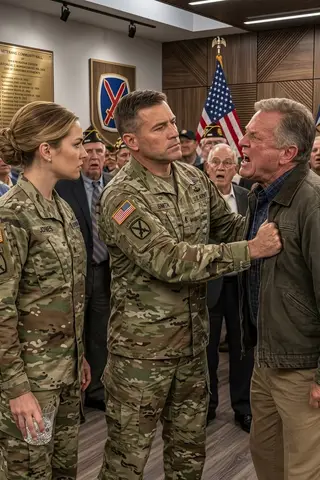
 The Retired Sergeant Called His Daughter "Little Puppy" at His Party
Chapter 41
The Scoping Gavel
The hearing room in the Dirksen Senate Office Building smelled of polished mahogany, old parchment, and the dry, recirculated air peculiar to Capitol Hill. Sunlight filtered through tall, draped windows, illuminating dust motes that drifted lazily above the horseshoe dais where members of the Senate Armed Services Committee would eventually sit.
For today’s scoping session, however, the dais stood empty. We gathered around the long witness table below—twelve men and two women representing the Joint Staff, the Office of the Under Secretary of Defense for Acquisition and Sustainment, three major commercial tech consortia, and the intelligence directorates.
I sat at the center of the table with Marcus Vance to my right and Colonel Jack Albright, freshly settled into his Pentagon liaison assignment, seated directly behind me in the staff tier.
"Director Vance," began Lieutenant General Thomas Vance—no relation to me or Marcus, an ironic administrative reality that had caused three separate scheduling mix-ups that morning. The three-star director for Joint Force Development leaned forward, his silver-trimmed glasses reflecting the recessed overhead lights. "The services are protective of their proprietary acquisition pipelines. If this independent review intends to recommend consolidating supply chain oversight into a civilian-led board, you're going to encounter severe resistance from the service chiefs."
I didn't blink. I had spent two decades navigating tactical combat commands, joint intelligence hubs, and the stubborn dogmas of entrenched field commanders. Resistance in a committee room was simply friction against a bearing; you didn't fight the friction, you applied proper lubrication and kept the machinery moving.
"General, this review is not an audit of service prerogatives," I answered, keeping my voice measured, crisp, and devoid of defensive inflection. "It is an assessment of vulnerability. When a tier-three supplier in Ohio halts production of solid-fuel rocket motors because of a single point-of-failure microchip manufactured overseas, that doesn't just affect the Army’s precision fires; it grounds the Navy’s strike groups and starves Air Force munitions depots. We aren't here to strip authority from the services. We are here to ensure that when the next major theater deployment occurs, your line units aren't waiting on empty shipping containers."
Jack leaned forward slightly, whispering over my shoulder, "Hit them with the INDOPACOM readiness metric from twenty-two."
I gave a fractional nod, continuing without breaking cadence. "Two years ago, during Pacific Sentry, the joint force experienced a forty-six percent delay in forward ordnance prepositioning due to fragmented digital inventories. That failure didn't happen because soldiers and sailors weren't doing their jobs. It happened because the institutional architecture hasn't caught up to modern logistics. The committee gave us full independence precisely because internal reviews tend to protect sacred cows. I intend to deliver an unvarnished assessment."
A quiet settled over the room. Several civilian tech representatives exchanged approving glances. General Vance studied me for several seconds, the skepticism in his weathered features gradually giving way to the cold pragmatism of an experienced warfighter who knew a truth when he heard it.
"Very well, Director," the general said, sketching a brief note on his legal pad. "The Joint Staff will open all readiness telemetry to your team by close of business Friday."
"Thank you, General," I said. "Marcus, coordinate the data-transfer protocols with the General's staff. We reconvene with preliminary models in three weeks."
As the room cleared and the rustle of briefcases and polite handshakes signaled the end of the meeting, Jack walked up beside me, carrying his service cap under his arm.
"You handled him well, Morgan," Jack remarked with a faint smirk. "For a minute there, I thought he was going to challenge you to a debate on Title 10 authorities."
"General Vance is infantry down to his bones," I said, packing my briefing binder into my leather satchel. "He respects clear boundaries and plain language. If you try to hedge with a man like that, he senses weakness and digs in."
"Sounds like someone else I used to know," Jack said quietly.
I looked at him, catching the warmth in his eyes. He was referring to Richard.
"My father was louder," I replied with a wry smile. "And General Vance doesn't have an old toolbox to hide behind. But the instinct is the same: when you spend your life guarding a perimeter, you suspect anyone approaching the wire. You just have to show them your credentials without apologizing for holding them."
"Speaking of Richard," Jack said as we walked into the cool marble hallway, "how's the old Master Sergeant doing back in Buda?"
"He's building raised cedar planters for Eleanor's heirloom tomatoes," I said, feeling an unexpected swell of affection. "And he hasn't yelled at a single municipal inspector in over two months."
Jack laughed, the sound echoing off the vaulted corridor of the Capitol complex. "Miracles never cease, Colonel. Miracles never cease."
***
The End









