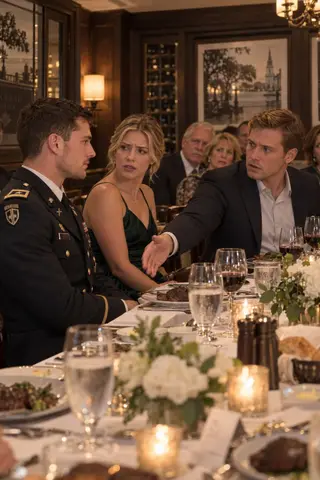
 My Sister Called Me a "Fake Soldier" at Her Engagement Dinner
Chapter 8
Under the Iron Sky
Three weeks passed in absolute radio silence.
The initial shockwave had settled into a grim new normal. Liam had officially returned to his home station at Fort Stewart, forty minutes south of Savannah. From what I heard through mutual contacts in the brigade, he had thrown himself into his work, preparing his platoon for a large-scale combined-arms exercise out in the pine barrens.
I didn't reach out to him. A man needs room to clear his head after a blast, literal or figurative.
Then, on a stormy Thursday afternoon in late August, Savannah got caught under an atmospheric front that turned the sky the color of a bruised plum. The rain came down in solid sheets, flooding the low-lying roads near the coastal marshes and reducing visibility along Interstate 95 to less than thirty yards.
I was driving my truck back from an off-post supply run when my radio scanner, tuned to the local emergency mutual-aid frequency, crackled to life with a priority dispatch.
“All units, priority traffic. Multi-vehicle collision on Highway 17 near the Fort Stewart back boundary. One military tactical vehicle overturned, civilian passenger van involved. Severe entrapment. Multiple casualties reported. EMS units delayed by flash flooding on the access causeway.”
Highway 17 was two miles from my location.
I didn't think about uniforms. I didn't think about family politics or wounded pride. When you are a medic, the muscle memory takes over before your brain even finishes processing the words. I hit the emergency blinkers, swung the truck around across the grass median, and accelerated into the torrential downpour.
When I arrived at the scene, it looked like a small combat zone. A military LMTV—a heavy five-ton troop transport—had skidded on the hydroplaned asphalt, swerved to avoid a sedan, and rolled onto its passenger side in the ditch. Two young soldiers in wet uniforms were standing on the embankment, dazed, blood streaming down their foreheads from glass cuts.
Pinched beneath the crumpled passenger side of the cab was a gray sedan, its hood crushed inward.
I grabbed my heavy trauma aid bag from behind the passenger seat of my truck and ran through the mud, rain blinding my vision.
“Who’s in charge?” I barked at the two standing soldiers, my voice cutting through the roar of the downpour with the natural command of a senior NCO.
One of the soldiers turned, his face pale. “Sergeant First Class! Our lieutenant... Lieutenant Miller’s inside the crushed car, trying to hold the civilian driver’s airway open! The roof is caving in!”
Lieutenant Miller. Liam.
I scrambled down the slick mud bank, dropping to my knees in four inches of muddy water next to the shattered driver-side window of the sedan.
Inside the crushed cabin, Liam was wedged upside down between the crumpled roof and the center console. His uniform was soaked in blood and engine oil, his teeth gritted in sheer agony. He had both hands braced against the steering column, using his own back and shoulders as a human jack to prevent the collapsed metal frame from crushing the chest of an unconscious elderly woman trapped beneath him.
“Liam!” I shouted through the broken glass.
His head whipped around, his eyes bloodshot, wide with shock. “Chris?! What the hell are you doing here?!”
“Shut up and report,” I commanded, thrusting my trauma kit through the window frame. “What are your injuries?”
“Right arm’s broken,” he gasped, his voice straining under the massive weight of the roof. “Ribs are cracked. I’m holding the frame off her... she’s barely breathing... tension pneumothorax on her right side, I think... she’s turning blue!”
“Hold the weight,” I told him, my voice completely level. “Hold it for sixty seconds, Lieutenant.”
I didn't wait for civilian firefighters who were stuck three miles away in traffic. I reached through the window, my hands moving with cold, mechanical efficiency. I ripped open the woman’s blouse, found the second intercostal space along the midclavicular line, pulled a three-and-a-quarter-inch, fourteen-gauge decompression needle from my kit, and drove it cleanly through her chest wall.
The hiss of trapped air rushing out of her pleural cavity sounded like a punctured tire.
Instantly, the woman took a deep, ragged gasp of air. Her gray, suffocating skin began to flush faintly pink.
“Airway secured,” I told Liam. “Now get out of the damn way before this frame snaps your spine.”
I wedged my heavy Pelican case between the car frame and the seat rail, creating a temporary mechanical brace. Then, reaching inside with both arms, I grabbed Liam by the back of his tactical vest and hauled him backward through the shattered rear windshield into the mud and rain.
He collapsed onto the grass, coughing violently, clutching his broken right arm against his chest.
I knelt beside him, wrapping a rapid splint around his forearm and securing it with medical tape before turning back to assess the civilian in the crushed car.
Liam lay in the mud, staring up at me through the sheet of falling water. His face was covered in grease, blood, and rain, but his eyes were completely clear.
“You’re really never off duty, are you?” he croaked through cracked lips.
I tied off the tape with a sharp jerk of my teeth.
“Nobody guards a gate when the bridge collapses, Liam,” I answered quietly. “Now lie still. The ambulance is two minutes out.”
The End









