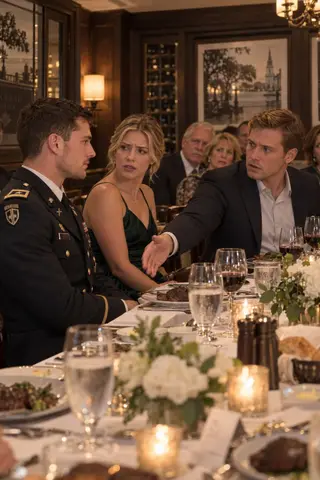
 My Sister Called Me a "Fake Soldier" at Her Engagement Dinner
Chapter 17
Macon Redux
The weekend before Christmas, our father called.
“Chris,” Dad said, his voice unusually hesitant over the cell connection. “The weather’s supposed to be clear on Sunday. I was wondering... if you weren't on post... maybe you could come out to the house for an afternoon? Liam and Maya are driving up from Stewart. I want to show you something in the garage.”
A year earlier, a trip to the house in Macon felt like an annual inspection where you were guaranteed to fail the audit. But the voice on the other end didn't belong to the blustering regional sales director who measured human dignity by corporate titles. It sounded like an old man trying to find his footing on unfamiliar ground.
“I’ll be there at noon, Dad,” I said.
When I pulled my Tacoma into the asphalt driveway on Sunday, the house looked different. The pristine, country-club perfection of the front lawn had given way to something warmer; there was a small wooden sign near the porch that said God Bless Our Troops, and the expensive luxury sedan Dad had leased every two years had been replaced by a sensible, pre-owned truck.
When I stepped through the front door, the smell of roasted turkey and fresh bread filled the hallway. Mom came out of the kitchen, wiping her hands on an apron, her face lighting up with genuine, unforced warmth as she pulled me into a brief hug.
“Your father is out back,” she whispered. “Go on out.”
I walked through the laundry room into the two-car garage.
Dad was standing by his old workbench under the hanging fluorescent light. The space, which had once been filled with golf bags, expensive fishing rods he never used, and pristine storage bins, was now stacked with cardboard boxes labeled Operation Care Package - Middle Georgia.
Dad turned around, holding a roll of brown packing tape. He had lost some weight, and his hair was almost entirely silver now, but his shoulders looked lighter than they had in a decade.
“Chris,” Dad said, nodding toward the boxes. “Take a look.”
I walked over to the workbench. Inside the boxes were wool socks, high-grade foot powder, beef jerky, tactical rifle cleaning cloths, and handwritten letters from middle school students in Macon.
“I retired from the firm last month,” Dad said quietly, leaning his palms against the wood. “Took the early buyout. I realized I was spending forty hours a week arguing with twenty-five-year-olds over quarterly margins while my daughter was running a homeless shelter and my son-in-law was heading to a combat zone.”
He looked up at me, his eyes full of profound, painful honesty.
“I took over the logistics chair for the local American Legion post,” Dad said. “We’re shipping two hundred boxes a month to forward operating bases in the Levant. It’s... it’s not much. I don't know how to shoot a rifle, and I don't know anything about medicine. But I know how to move freight. I know how to get supplies from point A to point B without losing inventory.”
I looked at the meticulously organized pallets, the custom inventory spreadsheets taped to the wall, and the clean, military-grade packing jobs.
“Dad,” I said softly. “This is incredible.”
He walked over to the back wall of the garage. There, mounted neatly between two steel shelving units, was a small oak shadowbox.
Inside the glass was a single photograph of me in my desert multicams, taken six years ago in an Afghan valley, sitting on the ramp of a Chinook with my aid bag between my knees. Next to it was an authentic 1st Battalion Ranger coin and a small, folded American flag.
“For ten years, I was ashamed because you didn't wear a tie to work,” Dad said, his voice breaking as he stared at the glass. “I told my friends you were a technician because I was too small of a man to understand what real manhood looked like. I robbed myself of ten years of being proud of my boy.”
He turned around, tears running freely down his lined cheeks, and extended his hand.
I didn't shake it.
I stepped forward, wrapped my arms around my father’s shoulders, and pulled him into a chest-to-chest embrace. He buried his face in my shoulder, his hands gripping my canvas jacket like a drowning man finding a raft in an open sea.
“It’s okay, Dad,” I told him, feeling the decades of unspoken hurt dissolve into the cold December air. “You’re on the line now. That’s all that matters.”
The End









