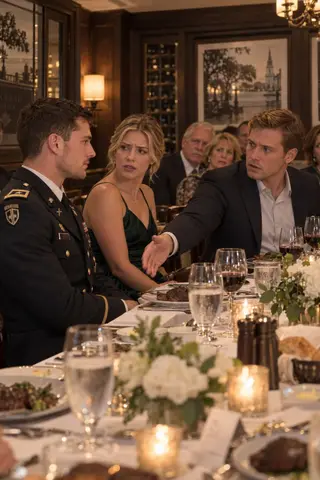
 My Sister Called Me a "Fake Soldier" at Her Engagement Dinner
Chapter 39
The Debt Returned
On a blustery Tuesday morning in May, I was sitting at my desk in the instructor’s annex at Fort Liberty, reviewing medical rotation schedules for the summer cadre.
A knock sounded at the open wooden door.
“Sergeant First Class Miller?”
I looked up. Standing in the doorway was a man in his mid-thirties, wearing dark slacks, a clean blue button-down shirt, and carrying a leather briefcase. His right leg was slightly stiff, dragging a quarter-inch with each step, but his posture was upright, confident, and distinctly military.
Holding his left hand was an eight-year-old boy with bright hazel eyes, wearing a miniature tan ballcap and a wide, excited grin.
I stared at the man’s face. The years had added lines around his eyes and a few gray hairs to his temples, but the sharp, angular jaw and the faint shrapnel scar running from his ear down his neck were burned into my memory with absolute clarity.
“Morales?” I said, rising slowly from my desk.
“Staff Sergeant Daniel Morales,” the man answered, his voice trembling slightly. “Formerly 3rd Platoon, Bravo Company, 1st Battalion, 75th.”
I walked around the desk, stopping two feet from him.
October 14, 2017. The Pech Valley. A rocky riverbed churning with white water, swept by PKM machine-gun fire from two fortified stone bunkers on the ridge. Morales had taken a high-caliber round through the upper femoral artery, collapsing in three feet of freezing water. I had spent four hours lying prone in that river, holding manual pressure on his groin with my thumbs while mortar fragments tore my own field vest to ribbons.
“You’re walking,” I said, looking down at his leg.
“They told me I’d be in a wheelchair for life, Chris,” Morales smiled, a tear finally escaping his eye. “Took four surgeries at Walter Reed and three years of physical therapy. But I walk two miles every morning with my boy.”
He looked down at the eight-year-old standing beside him.
“Leo,” Morales said, his voice thick with reverence. “This is the man. This is Sergeant Miller.”
The little boy let go of his father’s hand, stepped forward onto the office carpet, brought his small heels together, and snapped the cleanest, most earnest salute an eight-year-old child could muster.
“Thank you for saving my daddy, sir,” the boy said, his voice clear and proud.
The breath caught in my throat. All the awards, the Silver Star ribbon in the oak case in Macon, the Legion of Merit pinned to my uniform—none of it meant anything compared to the sound of that little boy’s voice in an ordinary office on a Tuesday morning.
I brought my heels together, snapped a crisp, razor-sharp salute back to the child, and dropped my hand.
“Your daddy was the toughest Ranger in the valley, Leo,” I told the boy, kneeling down to look him in the eye. “He didn't quit when the water was cold, and he didn't quit when the fire was hot.”
Morales stepped forward, pulling me into a fierce, brotherly embrace that lifted my feet off the floor. We held on for a long time—two men who had shared the mouth of hell and returned to see the sunlight.
“I’m teaching high school history now down in Wilmington,” Morales told me as we sat in my office drinking coffee while Leo explored the plastic anatomical models on the bookshelf. “I drove up today because Leo had a school project on real-life heroes. His teacher wanted him to write about an astronaut or an athlete.”
Morales looked at his son, smiling with profound peace.
“Leo told his class that his hero wasn't on television,” Morales whispered. “He told them his hero was an enlisted medic from Georgia who didn't let go of his dad’s leg in the river.”
I looked at the boy holding a plastic stethoscope, realizing that the harvest of ten years of sacrifice wasn't measured in battles won or territory held. It was measured in children who had fathers to teach them how to throw a baseball.
The End









