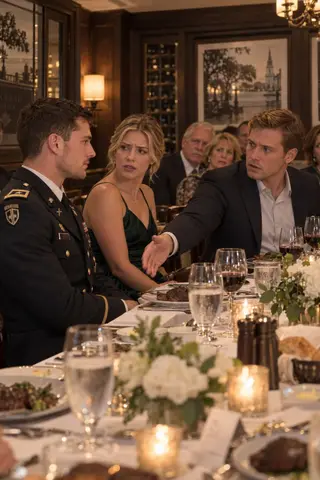
 My Sister Called Me a "Fake Soldier" at Her Engagement Dinner
Chapter 48
The Letter to Iowa
For five years, there was a debt I had carried in the quietest, darkest corner of my heart—a debt that ribbons, promotions, and time could not settle.
In late May, during the Memorial Day four-day weekend, I took leave from Fort Liberty and drove nine hundred miles northwest into the rolling cornfields of eastern Iowa.
The town of Eldridge was small, quiet, and wrapped in the green abundance of early summer. Two miles north of the grain elevators, at the end of a gravel lane lined with lilac bushes, sat a white two-story farmhouse with a wraparound porch.
I parked my Tacoma near the barn. Resting on the passenger seat was a polished cherry-wood box, ten inches square, built by my father in his Macon workshop.
Inside the box was an authentic 1st Battalion Ranger scroll, an unsoiled combat patch, a field-worn compass, and the silver dog tags belonging to Corporal Nathan Reid—the nineteen-year-old soldier who had died in my arms in the Korengal Valley in 2016.
I walked up the wooden porch steps, my heart hammering against my ribs with an intensity I hadn't felt since my last night combat jump.
I knocked on the screen door.
A woman in her late fifties answered. She wore a simple floral apron over faded jeans, her silver-streaked hair tied back in a low ponytail. Her eyes were warm, hazel, and carried that unmistakable, enduring shadow that marks every Gold Star mother in America.
“Can I help you, son?” she asked gently.
I pulled my ballcap off, standing tall on the porch boards. “Mrs. Reid... my name is Christopher Miller. I was Nathan’s platoon medic in Bravo Company.”
The woman froze. Her hands flew to her mouth, her breath hitching in her throat. For ten seconds, neither of us spoke; the only sound was the wind rustling the young cornstalks across the road.
“Christopher,” she whispered, her eyes filling with tears that had been waiting nine years to fall. “You’re the boy from Georgia.”
“Yes, ma'am.”
She pushed the screen door open, stepped out onto the porch, and wrapped her arms around my neck. She held me with a fierce, trembling strength, burying her face into my shoulder as she wept softly into the fabric of my canvas coat.
“He talked about you in every letter,” Mrs. Reid whispered against my collar. “He told me that if anything ever happened, his medic was the bravest man he ever knew. He said you never let anyone quit.”
I closed my eyes, the ghost of that rocky Afghan riverbed rushing back into my mind—the cold mud, the smoke, the smell of cordite, and the feel of Nathan’s fingers clutching my wrist in the ditch.
“Mrs. Reid,” I choked out, the knot that had lived in my throat for nine years finally breaking open. “Nathan... Nathan wanted me to tell you that he didn't cry. He fought like an absolute giant. He thought of you until the very end.”
I handed her the cherry-wood box.
She took it with trembling hands, sat down on the porch swing, and lifted the lid. When her fingers touched Nathan’s silver tags, a deep, beautiful peace settled over her lined face.
“Thank you for bringing him home, Christopher,” she said softly, looking up at me through her tears. “You don't have to carry him alone anymore. He’s home.”
We sat on that porch for three hours, drinking sweet lemonade, talking about the farm boy who loved fixing old tractors and dream of seeing the mountains.
When I finally drove away from Eldridge that afternoon, looking back through the rearview mirror at the American flag fluttering from the farmhouse porch, the heavy iron weight that had rested on my shoulders since 2016 was gone, replaced by the pure, unburdened clarity of a debt finally paid in full.
The End









