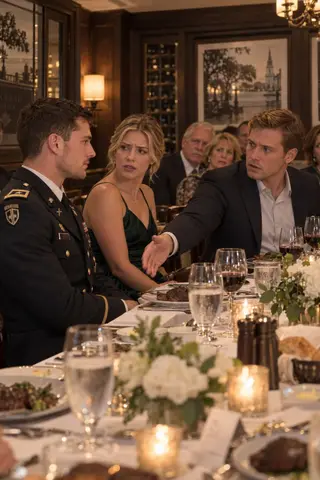
 My Sister Called Me a "Fake Soldier" at Her Engagement Dinner
Chapter 47
The Standard of the Board
In early April, Liam faced the crucible of military advancement: the Department of the Army Major Selection Board at Fort Moore.
Promotion to field grade rank is the great dividing line in an Army officer’s career. It is the transition point where operational command often collides with institutional politics, staff bureaucracy, and the subtle pressures to prioritize career progression over the welfare of the troops.
The board review was held in the executive conference chamber of McGinnis-Wickam Hall, presided over by Brigadier General Vance Holloway and a panel of three senior infantry colonels.
Liam sat in the center of the room, dressed in his pristine Army Green Service Uniform. His captain’s bars gleamed on his shoulders, his Ranger tab and Airborne wings sat straight, and above his left pocket rested the Bronze Star with 'V' device and the Combat Infantryman Badge.
General Holloway reviewed Liam’s personnel file, tapping the thick binder with his pen.
“Captain Miller,” the general began, his eyes sharp and analytical behind gold-rimmed glasses. “Your file is exceptional. Company command reports from the 3rd Infantry Division rank you in the top five percent of maneuver officers. Your combat valor citation in Syria demonstrates exemplary tactical competence. But there is a point in your file that requires clarification.”
Liam kept his posture rigid, eyes fixed on the general. “Sir.”
“During your command of Alpha Company,” Holloway said, leaning forward, “you instituted an unconventional policy regarding combat casualty care certification. You required all your vehicle commanders and squad leaders to complete eighty hours of advanced trauma training supervised by Special Operations medics, pulling them off tactical gunnery schedules for three weeks. Your brigade executive officer noted that this decision temporarily lowered your company’s gunnery readiness scores by six percent during a critical reporting quarter.”
The room fell quiet. The three colonels watched Liam closely, waiting to see if he would offer administrative excuses or blame his subordinates.
Liam took a slow, measured breath.
“Sir,” Liam said, his voice deep, resonant, and unwavering. “A tank or an armored fighting vehicle can be replaced by depot logistics in forty-eight hours. An eighteen-year-old infantryman cannot. The training my company conducted was designed to ensure that when our vehicles were compromised by improvised explosive devices, my junior leaders had the mechanical competence to prevent catastrophic exsanguination before the medical evacuation aircraft arrived.”
Holloway raised an eyebrow. “Even at the expense of administrative reporting metrics, Captain?”
“Sir, with respect,” Liam replied, looking the general dead in the eyes with the quiet, unyielding authority he had learned in the mud of Highway 17 and the dust of the Euphrates. “I did not join the United States Army to manage quarterly spreadsheets. I joined to lead soldiers into hostile fire and bring them home alive to their families. If the Department of the Army requires officers who prioritize administrative perfection over the preservation of human life, then I am not the officer this board is looking for. But as long as I wear this uniform, my standard will remain the same: the soldier on the line comes first.”
The three colonels exchanged subtle, approving glances.
General Holloway stared at Liam for five long, unbroken seconds. The stern, demanding mask on the general’s face slowly softened into a broad, respectful grin.
The general closed the binder with a firm snap.
“That is the correct answer, Captain Miller,” Holloway said, his voice rich with approval. “Too many officers in this building have forgotten the difference between management and leadership. You learned your trade from the right people. Dismissed.”
Liam stood up, snapped the sharpest salute of his career, and marched out into the Georgia sunlight.
When he stepped out the front doors, Maya and I were waiting near the monument plaza.
Liam walked up to us, pulled his service cap from his head, and let out a long, victorious laugh that echoed across the courtyard. He swept Maya into his arms, spinning her around on the granite pavers, kissing her soundly on the lips.
“How did it go, Captain?” I asked with a knowing smile.
Liam set Maya down, looked at me, and tapped his chest right over his valor ribbon.
“The standard held, Chris,” Liam said proudly. “The standard held.”
The End









