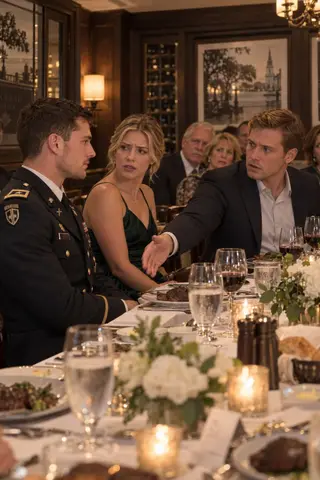
 My Sister Called Me a "Fake Soldier" at Her Engagement Dinner
Chapter 35
The Crucible of Mackall
Two months later, the brief warmth of Georgia had faded into the harsh, biting reality of a North Carolina winter.
Camp Mackall, the historic remote training enclave thirty miles west of Fort Liberty, was wrapped in freezing fog. The red clay roads had frozen into rutted iron, and the scrub oaks were stripped bare by the cutting northern wind.
It was 0330 on the final night of the Special Operations Combat Medic Culmination Exercise—the legendary "Robin Sage" phase where candidate medics are tested to absolute physical and cognitive failure before earning their regimental assignments.
I stood on the timber observation tower, holding an infrared night-vision monocular to my eye. Beside me, Master Sergeant Holloway checked the telemetry screens tracking the candidate squads maneuvering through the pine barrens below.
“Squad Three just walked into the simulated complex ambush at Grid 44,” Holloway reported, his breath fogging in the freezing air. “Two mass-casualty simulators, simulated phosphorus burns, and traumatic amputations. Candidate Harris is the primary triage lead.”
“Let’s go down to the pit,” I said, descending the wooden ladder into the darkness.
When we reached the mock compound, the sensory assault was overwhelming. The air was thick with the sulfur reek of non-lethal flash charges and dense theatrical smoke. Loudspeakers blasted recorded screams and machine-gun fire at ear-splitting volume, while strobes flashed across blood-spattered dirt floors.
Inside the ruined brick bunker, Candidate Harris—the young soldier who had struggled on the first day at Liberty—was on his knees in the mud.
Before him lay two hyper-realistic animatronic training mannequins. One was screaming via an embedded audio speaker, hydraulic blood pumping from a severed brachial artery; the other lay silent, its chest wall completely still, exhibiting the classic signs of a tension pneumothorax.
Harris had frozen.
His tactical medical pack lay open on the dirt, its contents spilled in disarray. His hands, clad in black nitrile gloves, were shaking violently. The cold, the relentless noise, and the sheer volume of simulated trauma had overwhelmed his sensory processing. He was staring at the spurting arm, his chest heaving, trapped in the cognitive freeze that kills soldiers in the first three minutes of contact.
I didn't yell. I didn't insult him.
I stepped into the mud, knelt directly opposite him across the bleeding mannequin, and grabbed both of his shoulders with iron grips.
“Harris,” I said. The tone was low, calm, and cut straight through the deafening roar of the loudspeaker sirens like a razor.
The kid blinked, his pupils wide and dilated with panic. “Sergeant First Class... I—I lost the priority! Both of them are crashing! I can’t stop the bleed and clear the airway at the same time!”
“Look at me, Harris,” I commanded, locking my eyes onto his beneath the rim of his Kevlar helmet. “You are not a spectator. You are the master of this room. The bleeding arm has sixty seconds before cardiac arrest. The silent chest has ninety. Which one do you kill first?”
“The—the brachial bleed,” Harris stammered, his mind clawing its way back to logic.
“Then apply the tourniquet,” I told him, releasing his shoulders. “High and tight. Don't think about the noise. Don't think about the cold. Think only about the five inches of nylon in your fingers. Breathe through your nose. Execute.”
Harris took a massive, shuddering breath. The panic drained out of his eyes, replaced by that cold, mechanical focus that distinguishes an elite operator from an amateur.
His hands stopped shaking. He snatched the CAT tourniquet from his belt, slipped it over the mannequin's arm, cranked the windlass rod until the arterial flow sensor clicked red-to-green, locked the clip, and immediately pivoted to drive a decompression needle into the second casualty's pleural cavity with textbook geometric precision.
The hissing release valve signaled successful decompression.
Both simulated vitals stabilized on the instructor’s monitoring tablet.
Harris looked up, sweat cutting pale channels through the black camouflage paint on his cheeks. He was breathing hard, but his spine was straight, his chin lifted, and his soul forged anew in the fire.
I stood up, wiping mud from my knee, and looked down at the young soldier.
“Slow is smooth, Harris,” I said quietly. “Smooth is fast. Welcome to the fraternity.”
From the doorway of the bunker, Master Sergeant Holloway smiled in the shadows, nodding with deep, professional approval. The line had another guardian.
The End









