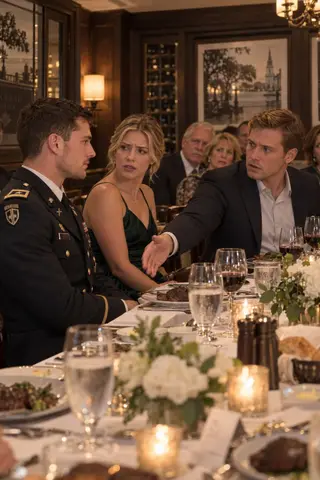
 My Sister Called Me a "Fake Soldier" at Her Engagement Dinner
Chapter 25
Into the Dark Water
Georgia winters are deceptive. While the rest of the country deals with heavy blizzards, the coastal plains around Savannah often suffer through torrential, freezing rainstorms that turn the low-lying river basins into raging torrents of dark, muddy water.
In mid-January, an intense squall line stalled directly over Chatham and Bryan counties. Within six hours, seven inches of ice-cold rain fell across the Ogeechee River basin, collapsing culverts and washing out two secondary access bridges near the rural boundaries of Fort Stewart.
It was 2200 on a freezing Wednesday night when my personal phone rang.
The caller ID displayed the name of Major Frank Caldwell, the battalion operations officer for the 75th Ranger Regiment at Hunter.
“Miller,” Caldwell’s voice came over the speaker, clipped, urgent, and stripped of administrative formality. “Civilian authorities in Bryan County have declared a state of emergency. A civilian school bus returning from an out-of-town youth retreat was swept off County Road 144 into the Black Creek tributary. The water is rising fast. Local volunteer rescue squads don't have swift-water extraction gear, and Chatham County search-and-rescue is cut off by flooded roadways.”
My adrenaline spiked, burning away the evening’s exhaustion in a single second. “How many on board, Major?”
“Twelve teenagers and the adult driver,” Caldwell reported. “The bus is pinned against a stand of cypress trees, partially submerged. Bryan County Sheriff requested emergency military mutual-aid. Post commander authorized our specialized rescue cadre to assist under immediate disaster assistance protocols. We need our most experienced water-rescue personnel. Can you roll?”
“Wheels up in ten minutes, sir,” I answered, already grabbing my heavy cold-weather Gore-Tex kit and tactical pack from the closet.
Thirty minutes later, I arrived at the Hunter flight line. A twin-engine UH-60 Black Hawk from the 160th Special Operations Aviation Regiment was already turning its rotors, the twin turbines screaming against the howling wind and driving rain.
I hauled my heavy equipment bag onto the aluminum deck, securing my harness beside four other senior NCOs from our battalion rescue detachment. Across the cabin, kneeling near the crew chief’s station in full combat uniform and a wet-weather parka, was Captain Liam Miller.
I blinked, shouting over the roar of the engines: “Liam?! What the hell are you doing on this bird?!”
Liam leaned in, his voice cutting through the mechanical deafening roar. “County Road 144 borders my brigade’s training sector! My mechanized company had two heavy engineer recovery vehicles staged two miles from the wash-out! When the mutual-aid alert popped on our sector radio, my battalion commander ordered me to coordinate ground staging with your air extraction team!”
I looked at him closely. The hesitation and trauma from the Syrian deployment were completely gone. In their place was the sharp, commanding focus of a professional officer who knew his terrain and understood his mission.
“Then let’s go get those kids, Captain!” I shouted back.
The Black Hawk lifted off into the stormy blackness, banking hard toward the south. Below us, the Georgia landscape was an unbroken sheet of churning water, reflecting the flashes of lightning that split the iron clouds.
Ten minutes later, the helicopter descended over the tree line near Black Creek.
The scene below was terrifying. The yellow school bus was tilted at a thirty-degree angle, wedged against three massive, moss-draped cypress trees in the middle of a roaring, brown torrent of water. The muddy floodwaters had already reached the lower windows of the bus, and through the glass, we could see terrified young faces pressed against the rear emergency exit, waving flashlights frantically into the darkness.
“Current is moving at fifteen knots!” the crew chief yelled through our headsets. “Debris field approaching from upstream! We can’t land! Hoist operations only!”
“I’m going down first!” I signaled to the crew chief, clipping my heavy carabiner to the steel hoist cable.
“I’ll anchor the recovery line from the engineer vehicle on the road embankment!” Liam shouted, leaning out the cabin door to assess the drop zone. “Once you get the kids out the rear hatch, we’ll haul them up the slope to my medical trucks!”
The cable whined as the hoist lowered me through the freezing blast of the helicopter’s rotor wash. The rain stung like needles against my face as I plunged into the churning, ice-cold current.
The water struck my chest like a physical blow, fighting to sweep me downstream into the debris. I kicked hard, clawed my way along the slippery metal side of the submerged bus, and reached the rear emergency exit door.
I hammered on the glass with the butt of my heavy rescue knife. “Open the hatch! Special Operations Rescue! Open the hatch!”
The emergency door creaked, popping open three inches against the pressure of the rising water. The adult driver, an elderly man with blood trickling down his forehead from a fractured brow, pulled with all his remaining strength to let me inside.
The interior of the bus was freezing, dark, and filled with terrified screams. Six inches of water was already sloshing across the floorboards, and the twelve middle school kids were huddled on the elevated rear seats, shivering violently in soaked jackets.
“Listen to me!” my voice boomed through the narrow confines of the bus, carrying the absolute, unshakeable calm of a seasoned combat medic. “Nobody dies tonight! The United States Army is right outside this door! We’re going to extract you one by one into the harness! Big kids first, little kids next! Trust the line!”
For the next forty-five minutes, time ceased to exist.
Working with cold, mechanical efficiency, I fitted each child into the rescue sling, connected them to the helicopter hoist, and guided them through the rear door into the rotor wash. Up on the highway embankment, through the sheets of rain, I could see Liam directing his soldiers, catching each child as the hoist swung them to the bank, wrapping them in heavy wool blankets, and carrying them into heated tactical ambulances.
By the time we reached the eleventh child—a small, terrified twelve-year-old girl who was crying for her mother—a massive, uprooted oak tree crashed downstream, slamming directly into the front axle of the bus with a sickening shudder.
The metal groaned. The cypress trees holding the vehicle began to lean.
“Miller!” the crew chief screamed over the headset. “The bus is breaking loose! Get out now!”
“Negative!” I roared back, grabbing the little girl by her jacket. “I still have two souls on board!”
I thrust the girl into the hoist harness, signaled the winch operator, and watched her lift cleanly into the sky just as the rear axle of the bus broke free from the mud. The vehicle tilted violently, cold river water pouring through the broken front windshield.
I grabbed the elderly driver by his collar, dragging his semi-conscious frame toward the back door.
We fell together into the raging water.
The current ripped my helmet from my head, dragging us under the surface into the pitch-black cold. My lungs burned. Every survival instinct screamed to let go of the heavy dead weight in my left arm and swim for the surface.
I didn't let go. You don't leave people behind. That was the Ranger Creed, written on the walls of my building at Hunter, carved into my soul by ten years of war.
Suddenly, a massive, gloved hand plunged into the dark water, grabbing the shoulder strap of my life vest with unyielding strength.
“I got you, Chris! Pull!”
It was Liam.
He had tied a safety line around his own waist, waded waist-deep into the roaring current from the bridge abutment, and reached into the darkness. With a desperate, violent heave, he dragged both me and the old driver out of the river channel onto the muddy gravel of the roadbed.
We collapsed together in the mud, coughing up brown river water, our chests heaving against the cold Georgia night.
The school bus groaned one last time, rolled over in the current, and was swept away downstream into the swamp.
Liam lay on his back beside me, rain pouring over his scarred temple, his uniform soaked in mud and fuel. He turned his head toward me, coughing hoarsely, and flashed a wide, exhausted grin.
“That’s twelve kids and a driver, Sergeant First Class,” Liam wheezed through chattering teeth.
I rolled onto my side, spitting out gravel, and smacked him hard on the shoulder.
“Not bad for a regular mechanized unit, Captain,” I answered.
Above us, the Black Hawk hovered in the storm, its searchlight illuminating two brothers who had held the line together when the bridge washed out.
The End









