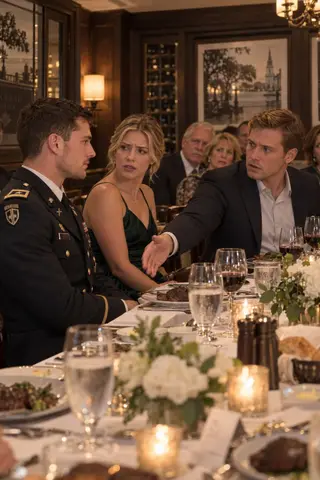
 My Sister Called Me a "Fake Soldier" at Her Engagement Dinner
Chapter 27
The Weighing of Bones
Every soldier knows that the military is a jealous mistress; eventually, she asks for payment in cartilage, bone, and spinal fluid.
In late March, shortly after my thirty-first birthday, I sat on the paper-covered examination table at the Hunter Army Airfield flight surgeon’s clinic, waiting for the results of my comprehensive annual physical.
Major Dr. Evans, a veteran orthopedic surgeon who had spent twelve years treating special operations personnel, walked into the room carrying a thick digital tablet. He pulled over a rolling stool, sat down, and looked at me with that calm, unvarnished bluntness common to military doctors who don't have time for bedside pleasantries.
“Well, Miller,” Evans began, tapping the screen. “The good news is your blood work is pristine. Heart rate forty-eight, blood pressure 110 over 70. You could probably out-run half the eighteen-year-olds in basic training.”
“What’s the bad news, Doc?” I asked, leaning back against the wall.
Evans rotated the tablet, displaying high-resolution MRI scans of my lumbar spine and right knee.
“The bad news is physics,” Evans said plainly. “You have seventy-four operational parachute jumps with full combat loads. You have three blast concussions on record, an old fragment track in your left thigh from Kunar, and the L4 and L5 vertebrae in your lower back look like they’ve been hammered with a sledgehammer. You’re missing eighty percent of the disc space between the vertebrae.”
I looked at the scans. The dark, compressed spaces between the white bone segments told a story that my body had been whispering to me for two years every time I rolled out of bed at 0500.
“Am I grounded from jump status?” I asked.
“If you take three more hard parachute landings on frozen ground with an eighty-pound aid bag,” Evans said, looking me dead in the eyes, “you won't be able to walk without a cane by the time you’re forty. You’re thirty-one, Chris. You’ve given ten years to 1st Batt. You have a Silver Star, two Bronze Stars, and a CMB. You’ve dragged twenty men out of the fire. You don't have a single damn thing left to prove to anyone in uniform.”
The room fell quiet. The hum of the air conditioning unit overhead sounded immense.
“What are my options?”
“Regimental headquarters wants you,” Evans replied, his voice softening slightly. “They’re standing up a permanent Special Operations Medical Training Center at Fort Liberty. They want you as the Senior Enlisted Advisor for combat trauma curriculum. No jumps. No sixty-mile rucks. Just teaching three hundred young medics a year how to keep men alive when the sky falls down.”
I looked down at my hands—calloused, scarred, the faint white line of a phosphorus burn still marking the skin between my thumb and index finger.
Leaving the operational line is the hardest death a soldier ever dies. When you spend your entire youth running toward the sound of gunfire, the idea of stepping behind a podium feels like an admission of defeat. It feels like abandoning your post.
“Take twenty-four hours, Sergeant First Class,” Evans said, standing up and closing the file. “Talk to your family. Then come back and sign the paperwork.”
That evening, I drove out to Tybee Island.
I walked along the wet sand at the edge of the Atlantic, watching the gray waves crash against the granite seawall under a darkening sky. The salt wind bit into my cheeks, cold and clean.
I pulled out my phone and called Maya.
She answered on the second ring. “Hey, Chris. Liam just got home from the motor pool. Are you coming over for dinner?”
“Maya,” I said, looking out over the endless expanse of gray ocean. “Doc Evans reviewed my jump physical today. He wants me to transition off the operational line. Take a senior instructor billet at Liberty.”
A brief silence fell over the line. I expected her to celebrate, to tell me that she was relieved I would finally be safe from deployments and midnight parachute drops.
Instead, Maya spoke with the quiet, profound wisdom of a sister who truly understood what that uniform meant to her brother’s soul.
“How does your heart feel about it, Chris?” she asked softly.
A lump rose in my throat, catching me completely off guard. I had swallowed shrapnel, watched helicopters burn, and held dying boys without flinching, but hearing my sister ask about my heart broke through ten years of armor.
“It feels like... it feels like stepping off the wall while the watch is still manned,” I confessed, my voice barely audible over the crashing surf.
“Chris,” Maya said, her voice rich with unwavering love and strength. “You didn't step off the wall. You built the wall. You spent ten years standing in the dark so Liam, Mom, Dad, and I could sleep in the light. If you go to Liberty, you’re not quitting. You’re teaching a thousand other boys how to build that same wall. There is no shame in passing the torch when your hands have carried it through the fire.”
I stood in the cold surf, letting her words sink into my chest like water into dry clay.
“Thank you, Maya,” I whispered.
“Come home, Chris,” she said gently. “Dinner’s getting cold.”
The End









