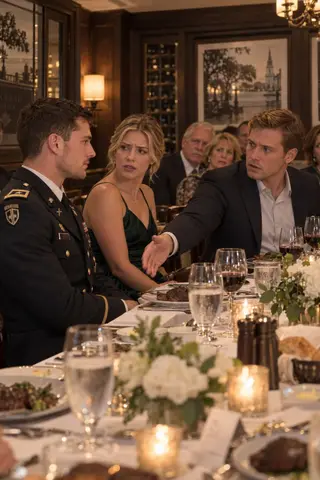
 My Sister Called Me a "Fake Soldier" at Her Engagement Dinner
Chapter 19
The Long Silence
The hardest part of modern warfare isn't the combat. It’s the blackout.
For two months, Liam’s deployment followed the routine rhythm of overseas operations: brief WhatsApp video calls at 0400 from a dusty plywood hut, grainy photographs of barren desert hills, and quick texts confirming that his platoon was conducting routine patrols along the demarcation line.
Then, on a stormy Thursday in late March, the communications line went dead.
At the shelter in Atlanta, Maya was sitting at her desk reviewing housing applications when her phone showed the dreaded alert on the brigade’s official social media channel:
Immediate Blackout Protocol Initiated. All communications from Area of Operations Falcon are restricted until casualty notifications are completed.
The world stopped.
Maya didn't scream. She didn't call the Pentagon. She closed her laptop, picked up her keys, and drove straight down I-75 to our parents' house in Macon.
When she walked into the kitchen at midnight, she found Dad sitting at the kitchen table with three landline phones laid out in front of him, a spiral notebook open to the directory of the 3rd Infantry Division rear detachment. Mom was sitting by the stove, holding a rosary between her fingers, her lips moving in silent, continuous prayer.
Nobody spoke. There were no words to offer. When the blackout hits, every military family enters the exact same purgatory: you sit in the dark, watching your front driveway, waiting to see if a government sedan with two officers in dress uniforms turns into the gravel.
At 0600 on Friday morning, my Tacoma pulled into the driveway.
I hadn't slept in thirty-six hours. As a senior NCO in the 75th, I had back-channel access to operational tracking networks that civilian families never see. I walked into the kitchen, my boots heavy on the tile.
Maya stood up immediately, her knuckles turning white against the back of a wooden chair. Her face was pale, hollowed out by twelve hours of pure terror.
“Chris?” she whispered.
I looked at my family—my mother clutching her beads, my father gripping his logistics notebook, my sister standing with her heart in her throat.
“Liam’s company was hit yesterday afternoon outside an outpost near the Euphrates,” I said, keeping my voice entirely devoid of panic, laying out the ground truth with clinical precision. “A suicide vehicle detonated at an entry control point, followed by sustained small-arms fire from an ambush line.”
Mom let out a choked gasp, burying her face in her apron. Dad stood up, his jaw trembling.
“Is he...?” Maya couldn't finish the sentence. The word caught in her throat like broken glass.
“Liam is alive,” I said firmly.
Maya’s knees buckled. She didn't fall to the floor because Dad was there in half a second, catching his daughter under her arms and holding her upright against his chest.
“He took fragment wounds to his left shoulder,” I continued, walking over to them. “Non-fatal. He is currently stabilized at the role-three surgical hospital in Erbil. But that’s not the whole story.”
Maya looked up through a flood of tears, her breath coming in ragged gasps. “What happened, Chris?”
I pulled a folded piece of tactical dispatch paper from my breast pocket.
“When the vehicle detonated, Liam’s platoon sergeant took heavy shrapnel to his femoral artery,” I told them, the words carrying the quiet, immense gravity of reality. “The platoon’s assigned medic was pinned down on the opposite side of the barricade by sniper fire. Liam dragged his sergeant behind an engine block, pulled a combat tourniquet from his own kit, applied it high and tight, and performed a needle decompression on the sergeant’s collapsed right lung under active machine-gun fire using the exact technique we drilled on Highway 17.”
The kitchen fell into a stunned, reverent silence.
“The flight surgeon at Erbil reported that if that tourniquet had been delayed by thirty seconds, the sergeant would have bled out in the sand,” I finished, looking straight at my sister. “Your husband saved a father of three under direct fire, Maya. He held the line.”
Maya buried her head against Dad's chest, crying tears that were no longer born of fear, but of an overwhelming, awe-inspiring reverence for the man she loved.
The End









