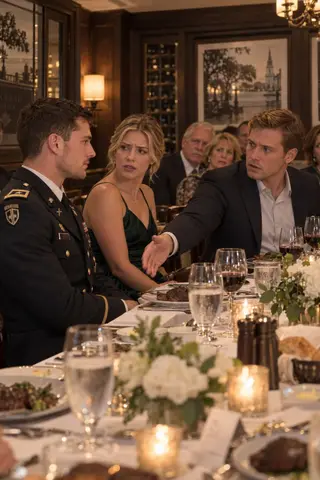
 My Sister Called Me a "Fake Soldier" at Her Engagement Dinner
Chapter 37
The Haven on High Street
By early March, the chill had broken across Middle Georgia, giving way to the brilliant yellow bloom of wild forsythia and blooming dogwoods.
In Macon, two blocks from the old railroad depot on the industrial edge of town, a crowd of two hundred people had gathered on the freshly swept asphalt of an old brick warehouse.
Above the wide double entry doors hung a handsome cedar sign, hand-carved and sealed against the weather:
THE MACON VETERANS WORKSHOP & LOGISTICS CENTER.
The building had once been an abandoned automotive repair depot, decaying behind chain-link fences. Over the past eight months, my father, Marcus, and a rotating crew of twenty-five local veterans had gutted the interior, replaced the rotted roof timbers, installed modern electrical conduits, and built ten fully equipped woodworking and small-engine repair bays.
The facility was designed to provide free vocational training, transitional employment, and supply storage for the Middle Georgia care-package network.
Dad stood near the podium wearing a crisp white dress shirt, rolled up at the sleeves, his silver hair neatly combed. He wasn't looking at a quarterly earnings chart; he was looking at the faces of men and women who had worn the uniform of their country, standing shoulder-to-shoulder with local business owners who had donated materials.
Beside Dad stood Marcus, wearing a tailored navy blazer over an open collar, holding a pair of ceremonial ribbon-cutting shears. Marcus had been officially appointed as the Center’s Executive Director.
Dad tapped the microphone. The chatter of the crowd faded into the gentle hum of the afternoon breeze.
“Friends and neighbors,” Dad began, his clear, resonant voice carrying across the parking lot with an authority that didn't need corporate jargon to command respect. “For thirty years in the business world, I believed that a man’s value was determined by the title on his business card and the size of his annual bonus. I chased spreadsheets. I judged people by what kind of car they drove into the country club lot. And in doing so, I was blind to the greatest truth of human existence.”
Dad paused, his eyes sweeping across the front row where Mom, Maya, Liam, baby Tommy, and I were standing.
“Real dignity,” Dad continued, his voice thick with unashamed emotion, “is not found in what you take from this world. It is found in what you are willing to give to the person standing next to you when the storm breaks. This building was not built by government grants or corporate sponsorships. It was built by men who know what it means to hold a perimeter in the dark, and by citizens who finally understand that when our sons and daughters return from war, our duty to them has only just begun.”
Dad turned to Marcus, placing a heavy, affectionate hand on the younger man’s shoulder.
“Marcus,” Dad said, his eyes shining. “Cut that ribbon. Open the doors.”
The crowd erupted into thunderous cheers as the red ribbon fell to the pavement.
Inside the warehouse, the smell of fresh cedar sawdust, motor oil, and sweet barbecue filled the air. Local citizens toured the workstations, while elderly veterans examined the state-of-the-art lathes and CNC milling machines that would allow disabled soldiers to learn modern fabrication trades.
Near the back bay, my former vice president from Dad’s old firm—Tom Henderson—stood looking at an operational tractor engine that had been rebuilt by two young Marines suffering from traumatic brain injuries.
Henderson turned as Dad and I walked up. The wealthy executive looked humbled, holding a paper plate of potato salad, his eyes taking in the bustling, purposeful energy of the room.
“Tom,” Dad greeted him with a warm, easy smile. “Glad you could make it down from the north side.”
“Tom... this is incredible,” Henderson said, shaking his head in open amazement. “My firm spent six months trying to organize a charity gala in Atlanta that had half this energy. How did you pull this off with no public relations staff?”
Dad looked at me, a subtle, knowing wink touching the corner of his eye.
“We don't do public relations here, Tom,” Dad said quietly. “We just do the work. And when the work is real, people show up.”
Henderson looked at the floor, swallowed his pride, and pulled a checkbook from his jacket. “Where do I make out the donation for the tool fund, Tom?”
“Marcus is at the front desk,” Dad replied, clapping his old colleague on the shoulder. “Make it payable to the future.”
The End









