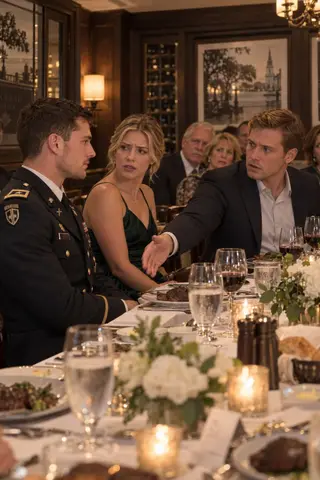
 My Sister Called Me a "Fake Soldier" at Her Engagement Dinner
Chapter 44
The Ridge at Range 74
Two weeks after Dad’s hospital scare, winter arrived in North Carolina with a vengeance. An arctic cold front swept down the eastern seaboard, plunging the pine barrens around Camp Mackall into twenty-degree temperatures and coating the dirt roads in a treacherous glaze of black ice.
It was 0200 on a Thursday morning. I was supervising the night triage station at Range 74 during the final evaluation phase for Class 05-26.
The simulated training scenario was interrupted by the high-pitched, urgent warble of an actual administrative emergency on the regimental radio net:
“All cadre stations, this is Range Control. Priority real-world incident. Commercial heavy transport vehicle carrying generator equipment overturned on Firebreak Road 9, two miles north of the LZ. Vehicle cab crushed against an embankment. Civilian operator trapped. Severe weather is delaying Moore County civilian rescue units. Requesting nearest military medical cadre respond immediately.”
Firebreak Road 9 was eight hundred yards from my position.
“Harris! Vance! Grab the heavy extraction kit and the hydraulic spreaders!” I barked into the tent. “Live mission! Move!”
Within ninety seconds, my four senior candidate medics and I loaded into an open-topped tactical rescue vehicle, skidding across the frozen gravel as we accelerated into the pitch-black woods.
When we arrived, the scene was grim. A commercial flatbed truck loaded with industrial generators had slid off the crowned dirt road on a sharp curve, rolling sixty degrees down a steep embankment into a dry ravine. The cab was pinned upside down against a massive granite boulder, the steel roof crushed down toward the dashboard like a stepped-on tin can.
Steam hissed violently from a ruptured radiator, filling the freezing air with the sharp, sweet smell of boiling antifreeze.
I scrambled down the slick frozen mud bank, dropping onto my knees beside the crumpled driver’s door. Inside, wedged into a space barely eighteen inches wide between the crushed steering wheel and the collapsed roof, was the civilian driver—a man in his late fifties, his face covered in blood from a deep scalp laceration, groaning faintly in hypothermic shock.
His left leg was hopelessly trapped beneath the crushed pedal assembly, and every breath came in short, agonizing wheezes.
“He’s got paradoxical chest movement on the left side, Sergeant First Class!” Specialist Harris called out from beside my shoulder, holding an emergency flashlight through the shattered windshield. “Flail chest! Trachea is deviating to the right! Tension pneumothorax developing fast!”
“Then what are you waiting for, Harris?” I said, stepping back six inches onto the frozen clay, intentionally yielding the primary treatment position to the candidate. “You have the kit. Execute.”
Harris hesitated for half a second, his eyes flashing to mine. He saw no hesitation in my expression—only the immovable confidence of an instructor who knew his student was ready.
Harris took a sharp, steadying breath through his nose. The young medic dropped into the freezing mud, slid his upper body through the broken window frame, and prepped the decompression needle.
“Hold the light steady on the second intercostal space!” Harris commanded his fellow candidate with absolute clarity. “Wiping site with betadine! Decompressing now!”
Harris drove the three-and-a-quarter-inch needle cleanly through the driver’s chest wall.
The immediate, loud hiss of escaping air cut through the cold night. The driver’s ragged breathing eased instantly, his chest rising and falling in a deeper, more natural cadence.
“Chest decompressed! Stabilizing the flail segment with a bulky dressing!” Harris reported, his hands moving with the calm, mechanical fluidity we had drilled a hundred times in the simulation bays. “Vance, bring the hydraulic cutter to the A-pillar! We need to roll this dashboard before the hypothermia takes him!”
For the next twenty minutes, I stood on the embankment with my arms crossed against the biting wind, watching my students work. They cut the steel hinges, braced the roof with oak cribbing blocks, and carefully extricated the injured driver onto a rigid spine board without a single wasted motion or a raised voice.
By the time the civilian county ambulance arrived, navigating carefully down the icy access road, the driver was secured in a heated litter bag, his airway stable, an IV line infusing warm saline into his right arm, and his vitals clearly charted on a triage card pinned to his jacket.
The civilian paramedic jumped out of the ambulance, took one look at the patient’s condition, and let out a whistle of profound appreciation.
“Who did the field decompression and dashboard lift?” the paramedic asked, looking at the group.
Specialist Harris stepped forward, his uniform covered in red Carolina clay and radiator grime, his breath fogging in the emergency headlights.
“We did, sir,” Harris said simply. “Special Operations Medical Cadre.”
The paramedic shook Harris’s hand with genuine reverence before loading the patient into the back of the rig.
I walked over to Harris as the ambulance pulled away into the darkness. The young soldier was wiping sweat and mud from his brow, his hands steady, his shoulders back.
“Good work, Harris,” I said quietly.
Harris looked at me, snapped to attention, and shook his head. “I only did what you taught me on the mats, Sergeant First Class. Smooth is fast.”
“You didn't just do what I taught you,” I told him, clapping a heavy hand on his shoulder armor. “You owned the problem. You’re ready for 1st Batt, son. Go get some dry clothes.”
As the candidate marched up the bank toward our truck, I stood alone in the dark pines for a moment, feeling the cold wind bite my cheeks. My back ached, my joints burned, but inside my chest, there was only the quiet, triumphant warmth of knowing that the line had been successfully passed to stronger, younger hands.
The End









