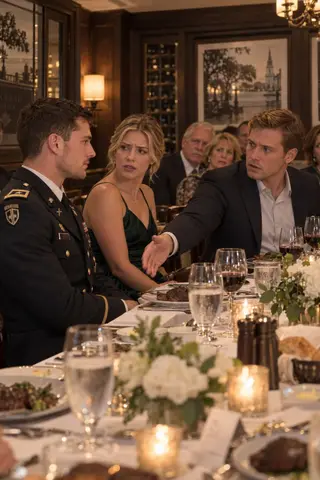
 My Sister Called Me a "Fake Soldier" at Her Engagement Dinner
Chapter 36
The Weight on the Shoulder Straps
While I was evaluating medics in the pine barrens of North Carolina, Captain Liam Miller was facing the true, unyielding trial of military command at Fort Stewart.
In late January, during a battalion live-fire gunnery exercise conducted under blackout conditions, a mechanized Bradley Fighting Vehicle from Liam’s company threw a track while traversing an uneven drainage berm. The forty-ton armored vehicle slid sideways into a ravine, pinning the lower half of the vehicle commander, a twenty-year-old Specialist named Tyler Evans, beneath the steel turret ring.
Liam had been on scene within two minutes. He had personally directed the recovery winch operations, crawled beneath the crushed hull to apply a pelvic stabilization binder himself, and remained with the soldier until the medevac helicopter departed for Memorial Health.
Evans had survived, but the crushed pelvis meant a twelve-month medical recovery and the permanent end of his infantry career.
I drove down to Fort Stewart on Saturday morning to check on my brother-in-law.
When I arrived at their house in Richmond Hill, the living room was quiet. Baby Tommy was asleep in a wooden crib near the window, wrapped in a fleece blanket.
Liam was sitting on the back screened porch in his operational uniform, his boots coated in dried gray swamp mud, staring blankly at the marshland beyond the fence line. A mug of cold black coffee sat untouched beside his hand.
Maya walked out of the kitchen carrying a tray of sandwiches. She had her hair pulled back, wearing a comfortable flannel shirt, moving with that quiet, unhurried strength that had become her signature.
She set the plate down, kissed Liam’s temple gently, and looked at me.
“He hasn't slept in forty-eight hours, Chris,” Maya said softly. “He spent all yesterday at the hospital with Specialist Evans’s parents, and all last night writing the preliminary command inquiry for the brigade commander.”
Liam looked up, his face lined with the deep, hollow exhaustion of leadership.
“I was the company commander, Chris,” Liam muttered, his voice hoarse. “The route through that creek bed was on my operational overlay. I signed off on the night-vision driving profiles. That kid is twenty years old. He joined the Army to follow me, and now he’ll walk with a limp for the rest of his life because my risk assessment didn't account for soil saturation after Tuesday’s rain.”
I pulled up a folding chair, sitting directly across from him.
“Liam,” I said, leaning forward until my forearms rested on my knees. “Did you enforce vehicle safety inspections before roll-out?”
“Yes.”
“Were the night-vision goggles calibrated to standard?”
“Yes.”
“Did you crawl into that ditch with a field binder and hold that boy’s femoral artery before the civilian EMTs even arrived?”
Liam looked down at his boots, swallowing hard. “Yes.”
“Then shut up about your guilt,” I said, my tone firm, uncompromising, but laced with profound brotherhood. “Command is not an exercise in perfection, Liam. You are maneuvering forty-ton iron monsters through dark woods with twenty-year-old kids operating the throttles. Accidents in tactical maneuvers happen because terrain and physics are indifferent to human intentions. What defines you as a commander is not whether bad things happen on your watch; it is whether you abandon your soldiers when the blood is on the deck.”
Maya stepped behind Liam’s chair, resting her hands firmly on his broad shoulders.
“Chris is right,” Maya whispered into her husband's ear. “I spent all morning on the phone with the Veterans Assistance Foundation in Atlanta. We’ve already arranged for Specialist Evans’s mother to stay at an extended-stay suite near the hospital free of charge, and our non-profit is assigning an administrative advocate to handle his medical board paperwork so the Army doesn't shortchange his disability benefits.”
Liam looked up at his wife. The surprise in his eyes gave way to overwhelming gratitude.
“You did that?” Liam asked, his voice shaking.
“Of course I did,” Maya replied, smiling with quiet grace. “You take care of the soldiers in the motor pool, Liam. I take care of the families behind the wire. That’s our job.”
Liam reached up, covering her hands with his own scarred fingers, and leaned his head back against her chest.
I watched them together—the combat officer and the advocate, two pillars holding up a roof that sheltered a hundred and twenty families—and knew that the Miller standard was no longer an ideal written on oak. It was alive, breathing, and unbreakable.
The End









