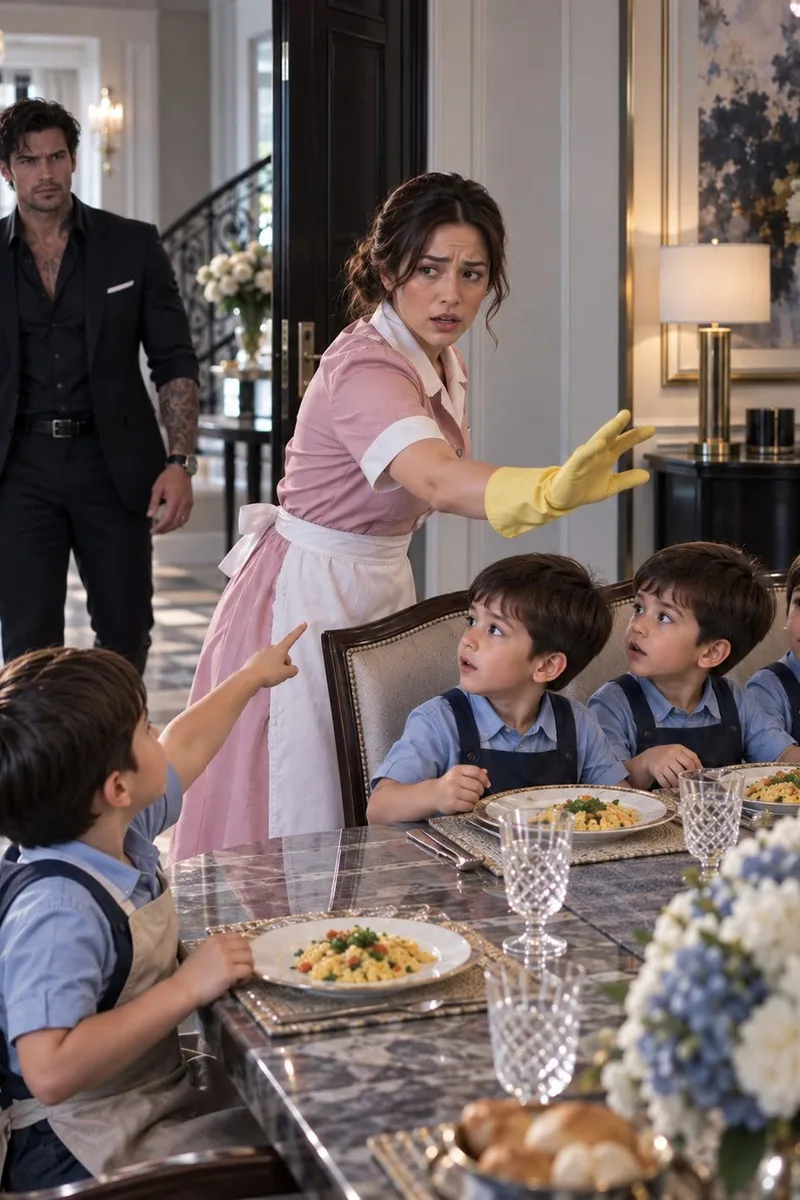
 When Four Little Boys Who Looked Like Me Appeared in My Mansion, Sofia's Warning Finally Made Sense
Chapter 6
A Letter Without a Claim
The next morning I asked Nadia to deliver the four letters through Cora and Peter rather than sending them with a driver. It was a small procedural choice, but I understood why it mattered. I had spent years making people appear when I called, as if distance were merely an inconvenience money could overcome. The boys would receive my words when their caregivers decided the moment was right. I could wait. The promise I'd made in the conference room would mean nothing if I broke it on the first ordinary morning.
Rafael came in with a business report and found me staring at the empty dining table. He asked whether the boys were returning. I said I didn't know. Then I asked him to review our staff policies with an independent adviser, including how employees could raise concerns without fear.
He looked puzzled by the change in priorities. I told him that Sofia had been afraid of the way our household responded to problems and that I could no longer pretend the reputation we'd built was unrelated to the life she had chosen to keep from me.
The discussion was harder than I expected. Rafael reminded me of the years we'd spent protecting the organization from rivals and employees who betrayed us. I acknowledged that some threats had been real. I also said we'd used danger as an explanation for controlling people who had done nothing wrong.
He asked whether I intended to walk away from the business. I told him I was beginning to separate the legitimate enterprises from the criminal activity that had shaped my name. It would take legal advice and time, and there would be consequences. But I could no longer invite children into a life organized around fear.
I met with counsel experienced in business compliance and criminal matters. I didn't pretend the path to lawful conduct would be simple or that past choices could be erased by a declaration. We discussed preserving records, stopping misconduct, cooperating with lawful requirements, and protecting employees who wanted to work without intimidation.
My attorney warned that real change could involve scrutiny, financial loss, and legal consequences I couldn't control. I told her I understood as much as I could from where I stood. The alternative was continuing a life Sofia had described so clearly that I couldn't claim ignorance.
Cora called that afternoon to say the boys had received the letters. Mateo wanted to know whether the man in the mansion could make pancakes. Leo had drawn a fountain with three fish in it. Nico had asked why adults sometimes knew the answer to a question but didn't say it.
Tomas had listened while Peter read my note twice, then asked whether Sofia had liked the same garden. Cora said they'd answered as best they could. I laughed at the pancake question and promised nothing more than to learn how to make them.
She said the boys were comfortable enough to consider another short visit, this time at a family-services center near their home. I could travel there without an entourage and agree to the rules established by the people responsible for the children. The appointment would depend on what the professionals thought appropriate. I accepted every condition. When the call ended, I opened a calendar and wrote the proposed date in pencil. I had never treated a calendar entry as something I might have to earn before.
The genetic testing results arrived through Nadia several days later. The report supported a biological connection between me and the boys. Nadia explained the conclusion carefully, including what the testing established and what it did not. The children appeared to have been born from embryos created during my marriage to Sofia, though the documentation of the transfer remained a separate legal issue. I read the report with a feeling I couldn't name. The resemblance I'd seen in the dining room had not been my imagination. Neither had Cora's years of raising them.
I asked Nadia whether I could tell everyone immediately. She asked whom I meant by everyone. I thought of Rafael, my remaining relatives, the men who would treat the boys as heirs before learning their names. I said nobody outside the people already involved. Nadia nodded.
We would discuss how to share the information with the children in language they could understand and preserve their privacy while the legal questions were addressed. I realized that secrecy and privacy were not the same thing. Sofia had used secrecy because she feared my power. Now I could use discretion to respect the boys' lives.
At the family center I arrived without guards, carrying four small picture books. A staff member checked my identification and explained the plan for the visit. Cora and Peter were present, along with Elena. The boys came through the door in a cluster, then slowed when they saw me. Mateo held a folded paper. Leo rushed toward a shelf of toys. Nico immediately asked why the building had so many chairs. Tomas stayed close to Peter. I greeted each by name and waited for them to decide where to sit.
We played a simple board game. I lost twice because Nico insisted on rules he'd invented after the game began. Mateo told me that wasn't fair, and we all laughed. When Tomas became overwhelmed by the noise, Peter took him to a quieter corner. I wanted to follow, but Cora gently shook her head. I stayed with the other boys and learned a lesson I hadn't expected: being present didn't require being involved in every moment. Sometimes it meant trusting someone else to provide the comfort a child needed.
At the end of the visit, Mateo handed me his paper. It was a drawing of a house with six windows, four boys standing in front, and a bird on the roof. He said it was the house where they lived. I asked whether he wanted me to keep it. He nodded. I thanked him and promised to bring it back if he ever wanted to change the picture. He seemed satisfied. Cora helped the boys gather their coats, and they left without a dramatic farewell.
I sat alone for a moment after the door closed. I had learned less about their biology than their ordinary preferences, and it felt like the most valuable hour of my life. Nadia asked whether I understood that future visits might remain limited for some time. I said yes.
The old me would have wanted a schedule I could enforce. The man sitting in that room wanted only to be someone the boys might look forward to seeing again. That difference had begun with Sofia's letter, and it would have to survive long after the ink on the report dried.
The End









