 When Four Little Boys Who Looked Like Me Appeared in My Mansion, Sofia's Warning Finally Made Sense
Chapter 3
Four Different Boys
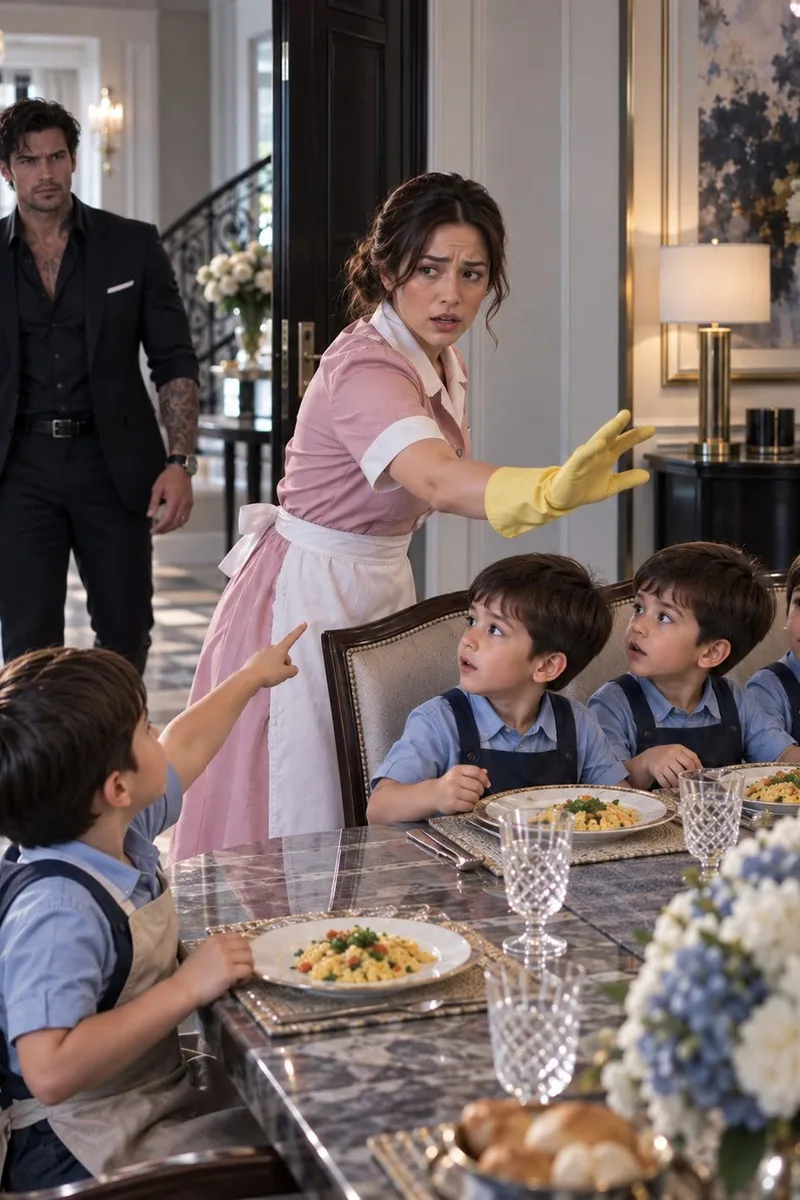
On the third morning, Tomas climbed into the breakfast chair beside me and asked whether I could cut his toast into squares. I looked toward Elena, who nodded. I had negotiated business agreements worth millions, but I was unsure how small a square should be for a four-year-old. Tomas watched my knife with serious attention, then informed me that Nico preferred triangles. Across the table, Nico said he didn't, and Leo announced that he wanted circles. Mateo sighed as though he'd been mediating such disputes his whole life.
I laughed before I could stop myself. The boys looked alike, but their differences filled the room. Mateo asked careful questions and wanted to know what time they would go home. Leo ran toward every new sound. Nico treated each answer as the beginning of an argument. Tomas listened until he was certain he understood, then asked something that made the adults stop speaking. I was beginning to see them as children rather than evidence. Elena noticed the change and allowed herself to sit while we ate.
Later Nadia arranged a video call with Cora, the woman who had carried and helped raise the boys. Her voice was calm and tired. She said the pregnancy had been high risk and the births premature, followed by months of medical appointments. She had loved the boys through those early years alongside her husband, Peter. They were the children's legal and emotional home, whatever genetic information eventually emerged. I listened without interrupting. I had imagined discovering sons would make fatherhood begin at once. Cora made clear that a household already existed around them.
She showed us copies of the court orders and guardianship documents she had available, with the originals to be reviewed by Nadia. The legal structure was complicated. Certain decisions had been made under Sofia's estate plan, while other documents concerned Cora's rights and the boys' care.
Nadia warned everyone not to summarize the arrangement into a sentence about ownership. I asked Cora why she had waited until now to contact me. She said she'd followed advice meant to protect the children's privacy and believed Sofia had good reasons for keeping my name out of their daily lives.
"Did she think I'd hurt them?" I asked. Cora looked at me through the screen. "She was frightened of the people around you," she answered. "And of the way you dealt with fear." The words were familiar from Elena's explanation. I wanted to insist that Sofia had known the man beneath my reputation. Then I remembered how many nights she'd waited for me to come home, never knowing whether some argument in my business would follow me through the door. I had made her uncertainty part of the marriage. She had not invented it.
Cora said Martin Vale had been pressing the trust administrator for access to records and money. She believed he was working for a former associate of mine, but she did not have proof. He had learned the boys existed through an improperly disclosed document, then contacted her with warnings that she would lose her home if she did not cooperate.
Nadia asked Cora to preserve messages and speak to local counsel and the relevant authorities. We agreed no one would confront Vale directly. I understood that every step toward the truth needed to leave a record a neutral person could trust.
After the call I walked through the mansion and saw it differently. I had kept Sofia's favorite reading chair in the sunroom, though I rarely sat in it. The boys were now in the garden with Elena, watching a bird tug at a twig.
I stood at the window and tried to imagine Sofia here, older than the woman in the photographs, telling them about the trees. She had never had that chance. Perhaps the arrangements she'd made were an attempt to give them a life she could not share. Perhaps she had made choices I would question once the evidence was complete. Neither possibility made her easy to understand.
Rafael approached me in the hall with a list of employees who had learned the boys were visiting. I read it, then asked him to explain why the list existed. He said he'd wanted to make sure no one spoke carelessly. I thanked him but told him not to question staff about private family matters.
We would issue a straightforward instruction protecting the children's privacy, not make employees afraid of a secret they had accidentally witnessed. He frowned at the change. "Since when do we trust people to do the right thing without consequences?" he asked. "Since we're trying to give these boys a reason not to fear this house," I answered.
The afternoon brought the first practical disagreement with Elena. I wanted the boys to remain another night while Nadia arranged the next meeting. Elena said Cora was expecting them home and had not consented to an extension. I felt an impulse to argue that it would be safer behind my gates. Then I stopped. I had no basis for deciding that my property was safer than the home where they'd grown up. I called Nadia and asked her to help coordinate their return according to the caregivers' wishes. Elena looked surprised, then relieved.
Before they left, I asked whether I might say goodbye without making promises I couldn't keep. Elena agreed. We stood in the front hall, where four small backpacks waited beside the door. Leo asked whether I had a dog. Nico wanted to know why the house was so quiet.
Mateo asked if I knew how to make pancakes. Tomas held Sofia's photograph against his chest. I answered each question honestly, then told them I had enjoyed meeting them. I did not say I was their father. I didn't know what the word meant for us yet.
Tomas stepped closer and held up the photograph. "She told Elena to keep us safe," he said. I knelt so I could meet his eyes. "I know." He asked whether I was the dangerous part. The question was quiet, and I felt every adult in the hall become still. "I've made choices that frightened people," I told him. "I'm working on making better ones." I did not ask him to forgive me for something he could not understand. He thought for a moment, then nodded and returned to Elena.
After the car left, I went to the dining room and found four circles drawn in crayon on the back of a menu. They were meant to be faces, each with slightly different hair and eyebrows. Underneath, Mateo had written the first letter of his name with Elena's help.
I placed the paper beside Sofia's photograph rather than locking it away. For years I had controlled information because I believed secrecy kept me powerful. Now the most important thing in the house was a picture a child had made, and keeping it safe required nothing more than letting it remain where people could see.
The End









