 When Four Little Boys Who Looked Like Me Appeared in My Mansion, Sofia's Warning Finally Made Sense
Chapter 1
The Cars at the Gate
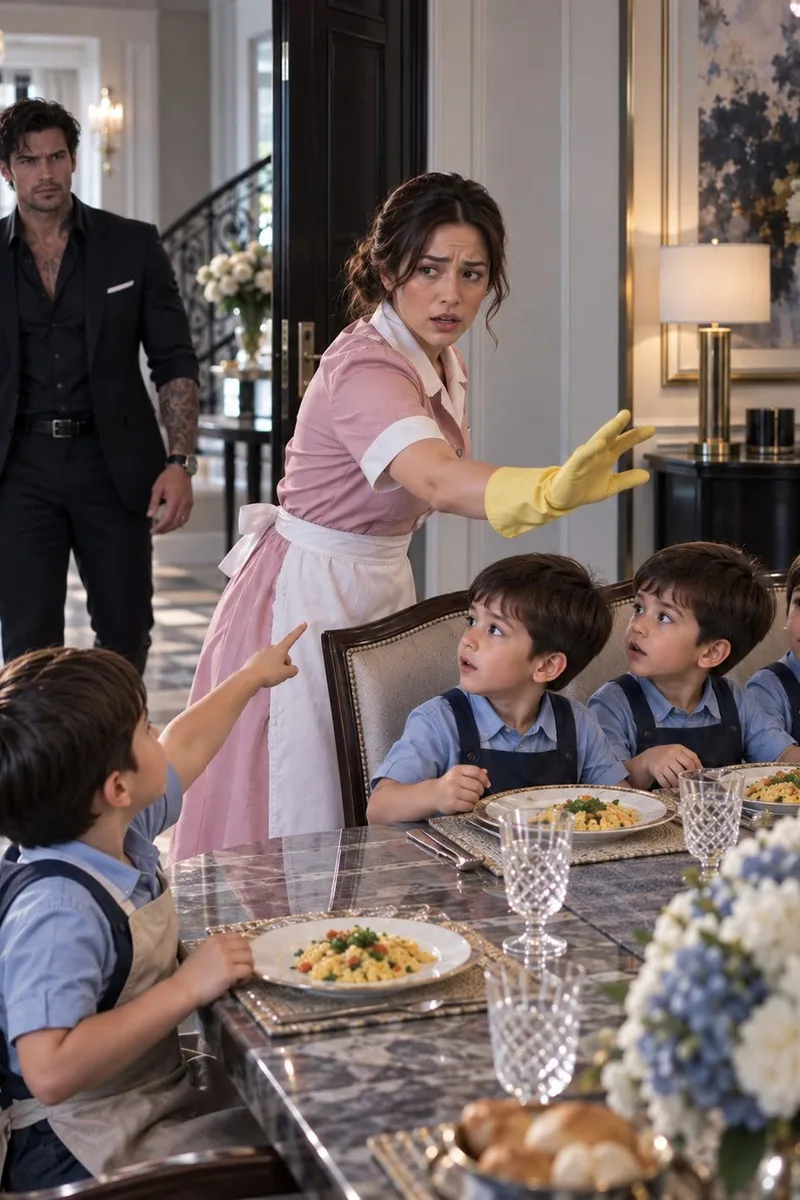
I told Elena to take the boys away from the windows. It was the first useful sentence I had spoken since finding four small faces at my dining table and a photograph bearing my dead wife's handwriting. Outside, my security chief was shouting about three black SUVs. Inside, Mateo was still holding the corner of his backpack, staring at me as if I might turn into someone from a story he knew. I wanted to ask why Sofia had written that they needed protection from me. Instead I pointed Elena toward the pantry door leading to the interior hall.
She hesitated, searching my face. I lowered my voice. "You know this house better than anyone. Get them somewhere quiet. I won't follow." The promise seemed to surprise her. She gathered the four boys, one by one, and led them away. The smallest glanced back. "Is he angry?" he whispered. I heard Elena answer that I was confused, and the accuracy of it hurt more than an insult would have.
My security chief, Rafael, met me near the staircase. He had worked for me for fourteen years and rarely sounded unsettled. The vehicles had stopped outside our private gate, and their occupants were demanding to speak to Elena. They hadn't entered the property. I told Rafael not to admit them and to contact the local authorities about an unwanted approach.
He looked at me strangely. In the past, my orders about uninvited visitors had been less restrained. I could feel the old instinct pulling at me, but four children were in the house, and I wouldn't turn their first sight of me into something frightening.
I asked for the names of the visitors. One driver had presented himself as Martin Vale, an attorney representing a private client. The claim meant little to me. Plenty of men in Chicago had called themselves lawyers while doing things no court would recognize.
But the name Vale was familiar from a folder Sofia had kept in our bedroom before she died. I could not place why. Rafael asked whether to bring the man inside. I said no. If there was a legitimate legal matter, he could contact my attorney. Nobody was going to negotiate children's safety at a driveway gate.
From the dining room I could hear a chair scrape and a boy ask for more rice. The ordinary sound almost broke me. Sofia had been gone five years. I had buried her after a short illness that neither of us could name aloud until the last weeks. We had tried to have children, then stopped speaking about it because the treatment appointments became another source of grief. At least that was what I had believed. Four boys who looked exactly like me were now eating lunch in the house I'd kept frozen around her absence.
I took the photograph to my study. Sofia stood beside Elena in sunlight, smiling in a way I could still picture without looking. Across the bottom, in firm black letters, she had written KEEP THEM SAFE FROM ALEJANDRO. I traced the word from with my eyes. My name was not a place of safety in that sentence. It was the danger itself. If Sofia had left such a warning, she had feared something I either had done or was capable of doing. I couldn't erase the fear by telling myself she had misunderstood me.
Rafael returned to say the visitors had left after receiving our attorney's contact information, though one vehicle remained on the public road for several minutes. The police had been notified. He asked what had happened in the dining room.
I told him four children were visiting Elena and that no one on my staff was to photograph them, ask about them, or discuss them with anyone outside the house. Rafael looked toward the hallway. "Are they yours?" he asked. "I don't know," I said. It was the first time in years I'd spoken those words without feeling the need to punish the person who heard them.
I called my attorney, Nadia Brooks, and told her exactly what Elena had said, including the photograph and the vehicles. Nadia asked whether the children appeared to be in immediate danger. I said they were inside with a caregiver who knew them and seemed frightened of me.
She told me to preserve what I had, avoid confronting anyone without guidance, and make sure the boys' needs came before my curiosity. She would check the visitor's claimed legal status and advise me on what could be established properly. Then she asked whether I had any documents concerning fertility treatment from before Sofia's death.
The question seemed absurd until it wasn't. We had attended appointments in New York years ago, when Sofia was still hopeful that our marriage could hold a child as easily as it held our business obligations. There had been frozen embryos, complicated forms, and arguments about what would happen if either of us died. I remembered signing papers without reading every clause, trusting the clinic and Sofia to understand what we were deciding. The memory made my stomach tighten. Nadia asked me not to draw conclusions before she could examine the records. I agreed, though my mind was already racing.
I approached the pantry hall but stopped at the closed door. Inside, Elena was telling the boys a story about a bird that lost its way home. Their laughter rose in uneven bursts. I didn't go in. Instead I knocked softly and asked whether Elena needed food or medicine or anything else. She opened the door a few inches. Her expression was wary, but she said the boys were safe and tired. I offered to have the guest rooms prepared. She asked whether she could use the rooms farthest from the front entrance. I said yes.
"Why did Sofia write that?" I asked quietly. Elena looked back at the children. "Because she knew what men around you did when you said something belonged to you," she answered. I felt the words land. I wanted to argue that I would never hurt a child. But I had spent twenty years building a world in which people feared losing what I claimed. Sofia had lived close enough to see it. Elena had protected the boys from the idea of me long before they met the actual man.
She asked whether I would promise not to take them away from her that night. I said I would. I knew I might have questions about legal responsibilities later. I also knew four frightened children were not property to be moved around while adults argued. Elena opened the door wider. Mateo stood behind her with the photograph in his hand. "Did you know Sofia?" he asked. My throat closed. "Yes," I managed. "I loved her." He studied me with the serious gaze of a child testing whether words matched what he'd been told.
After Elena settled the boys in the guest rooms, she asked for a private conversation the next morning. She said there were records I needed to see, but she was afraid of what would happen when my associates learned the children existed. I promised no one would be told until we understood the situation and had proper advice.
That night I sat alone beneath the portrait Sofia had hated because it made her look like a stranger. I had spent five years believing her death was the greatest secret the house could hold. Now I understood there had been a promise made in her absence, and I was the last person she had trusted to keep it.
The End









