 When Four Little Boys Who Looked Like Me Appeared in My Mansion, Sofia's Warning Finally Made Sense
Chapter 10
Four Places at the Table
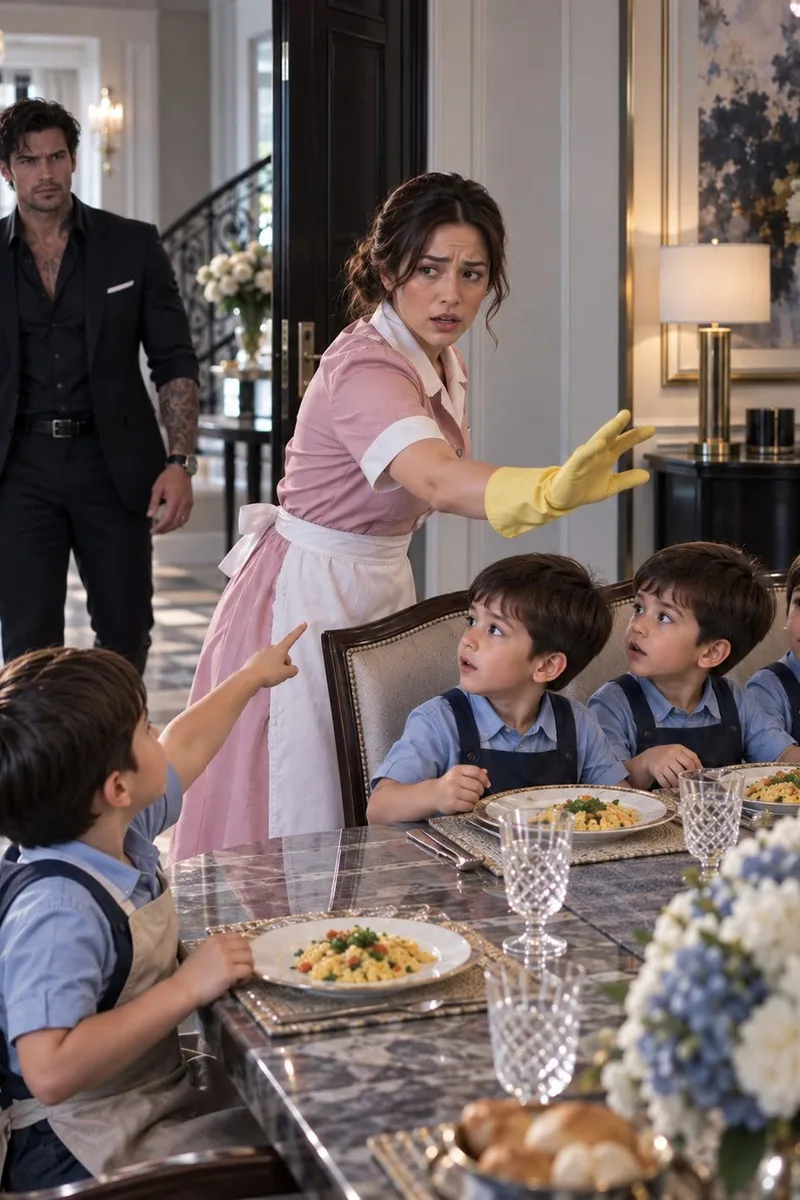
The boys returned to the mansion in early spring, this time by invitation, with Cora and Peter beside them. Elena prepared lunch but didn't hide it from me. She set four plates at one end of the dining table and two more for the adults who had raised the children. I stood in the doorway watching her work, remembering the spoon that had fallen when she first saw me. That day fear had made the whole room go silent. Now she asked me to fetch napkins.
I had spent the morning trying to make pancakes. The first batch had been edible, though Nico later informed me that they were too thick. Leo asked for blueberries, Mateo wanted his cut into squares, and Tomas preferred a small piece of toast before he tried anything new. I listened to their requests without treating them as a referendum on my worth. Cora laughed when I admitted I'd practiced. Peter offered to show me how he kept the centers from burning. I accepted the advice. Fatherhood, whatever form it might take for me, was going to involve more learning than commanding.
The legal questions about the transfer had not all been resolved. Professionals were still reviewing the authorization history, and the arrangements concerning the boys' care remained subject to appropriate legal processes. I had accepted that their stable home would not be disrupted while the adults worked through those matters. Nadia helped us document agreements about contact, privacy, and support that could be reviewed as the children grew. It wasn't the instant family reunion I had imagined when I first saw their faces. It was something I could trust more because nobody had been forced into it.
Martin Vale's attempts to obtain confidential information had been addressed through formal action. The remaining trust claims would be handled through counsel rather than by men who could frighten the boys. I had learned that a threat did not have to become a battle simply because someone expected one.
After lunch the boys asked to see the garden. I took them to the fountain, where the water had been turned on for the season. Leo inspected the edge, Nico wanted to know how the pump worked, and Mateo organized a game in which they counted birds landing on the grass.
Tomas held back until I offered my hand without moving toward him. He took it for a moment, then released it to follow Peter. I felt a flash of disappointment and let it pass. He was a child choosing the person who felt safest, and I had promised I would not make that choice hurt him.
Cora asked whether I wanted to hear how the boys had been doing at school. We sat on a bench while they played within sight. She told me about a class project and the way Mateo had helped a younger child who couldn't find his gloves.
She described Leo's frustration when a toy broke and Nico's pride in sounding out his first long word. Tomas had begun sleeping through the night more often. I listened and asked questions without implying that I should have known these things. Cora answered with the ease of someone who no longer expected every detail to become a demand for control.
Peter showed me a classroom drawing of their family holding hands. Cora and Peter stood beside four small figures. At the edge was a dark-haired adult labeled Alejandro. I stared at the picture. I had once thought belonging meant standing at the center. The boys had placed me at the edge, connected but not replacing anyone.
Peter let me keep a copy. He asked about my business changes. I said some employees had left, others had gained protection, and outside professionals were establishing lawful oversight. Peter respected the effort but would judge by what the boys experienced. I told him he should.
Near the end of the afternoon Elena brought out a small box of Sofia's photographs. I'd asked her earlier whether she thought the boys were old enough to see some of the happier images. She had consulted Cora and Peter, and they'd chosen a few that could be explained simply. We sat together on the rug while Elena turned the pages. Sofia appeared in a garden, on a train platform, and beside a kitchen window holding a mug of tea. The boys pointed at her smile and asked whether she'd been funny.
"Very," I said. I told them how she'd once put salt in my coffee by accident and laughed so hard she spilled her own. Mateo wanted to know whether I was angry. "For about one second," I answered. "Then I laughed too." The story seemed to satisfy him. I noticed Elena watching me. For years we'd spoken about Sofia as though her death were a room we weren't allowed to enter. Now four children were asking ordinary questions about the woman she'd been. They gave me permission to remember without turning memory into a monument.
Tomas found the photograph with the warning written across the bottom. He recognized the words from Elena's explanations and asked whether Sofia had been afraid of me. The room grew quiet. I looked toward Cora and Peter, then answered as honestly as I could. "She was afraid of choices I made and people I allowed around us," I said.
"She wanted you to be safe. I wish she'd never had to worry about that." Tomas asked whether I was still dangerous. I took a breath. "I'm working with other people to change the things that made her afraid. You don't have to trust me just because I say so."
Nico considered this, then asked whether he could still come back for pancakes. The question released the tension in a way no adult reassurance could have done. I told him he could ask Cora and Peter, and if they agreed, I would be happy to try again. Leo insisted we needed blueberries. Mateo said we should make a list so nobody forgot. Tomas asked whether Elena could be there too. She laughed through tears and said she would bring the flour.
When the visit ended, I helped carry backpacks to Cora's car. I did not ask the boys to hug me. Mateo gave me a quick wave, Leo shouted about the fountain, Nico reminded me to practice, and Tomas reached up to touch my sleeve. I watched them drive away and felt the ache of a parting that was no longer a secret disappearance. They were going home to people who loved them. I could be sad about their leaving and glad about the life they had. Both feelings fit inside the same breath.
That evening I returned to the dining room, where Elena was putting the plates away. She paused when she saw me looking at the four chairs. "Do you want them left out?" she asked. I thought about Sofia's note, the years of hidden records, and the fear that had shaped so many choices. "Yes," I said. "But not because I expect them to stay." Elena waited. "Because I want them to know there's room if they choose to visit." She nodded and left the chairs where they were.
I placed Mateo's drawing beside Sofia's photograph on the shelf. I had taught people to fear my name. Four boys made me want it to mean something else. I couldn't rewrite Sofia's life or reclaim the years Cora and Peter raised them. But I could honor their home, accept the truth about my past, and keep showing up without demanding a reward. In the quiet dining room I set out the napkins for another day, not as a promise the boys owed me, but as an invitation I was finally willing to let them refuse.
The End









