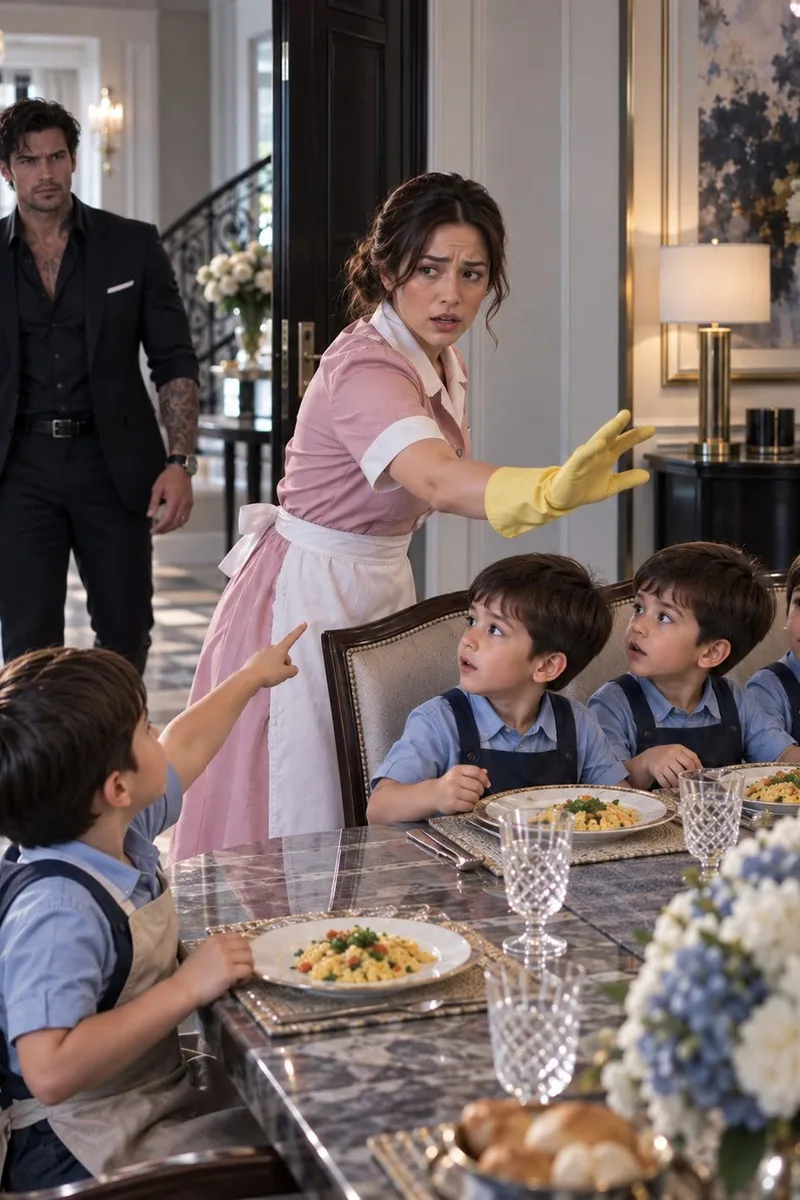
 When Four Little Boys Who Looked Like Me Appeared in My Mansion, Sofia's Warning Finally Made Sense
Chapter 2
The Records Sofia Left
Elena brought the folder to my study after breakfast, when the boys were occupied with crayons at the dining table. She had not slept well. Her hands trembled as she set down a worn blue binder with Sofia's handwriting on the spine. The label was a date from six years earlier. I recognized it as the month we'd stopped going to the fertility clinic. I had told myself Sofia had accepted that we might never be parents. Looking at the binder, I wondered how much of that belief had come from asking no further questions.
Inside were medical records, consent forms, and letters copied to a law office I did not recognize. Nadia arrived before I began reading closely. She asked Elena whether she had legal authority to speak for the boys and where they ordinarily lived. Elena said they lived with a woman named Cora and her husband in Wisconsin. She helped care for them and had brought them to Chicago for a medical appointment and a short visit. The arrangement had been private but not casual. Nadia asked for documents rather than accepting a story because it sounded plausible.
The records showed that Sofia and I had created and stored embryos during treatment years before she died. The clinic had discussed future use, including circumstances in which one partner died. I remembered signing forms. I did not remember giving consent for transfers after Sofia's death, and Nadia said the distinction was critical.
One letter, dated shortly before Sofia became gravely ill, described a plan involving a gestational carrier. Sofia had asked Elena to assist if she could no longer participate. The letter contained a reminder that any transfer required authorization under the applicable rules. It was not proof such authorization existed.
"Were the boys born through that arrangement?" I asked. Elena nodded, then looked toward Nadia. "Cora carried them," she said. "They were born several months after Sofia died." I stared at the page. It explained the years without making the situation simple. The boys were about four because they had been born after the funeral.
Four children in one pregnancy seemed almost impossible to me, and I asked whether the records were accurate. Elena said the pregnancy had been medically complicated and the boys had needed extensive care after birth. Nadia warned that we should verify every part of the account before discussing parentage or rights.
I asked whether the children were genetically mine. Elena said she believed so, but she had never seen a full paternity report. "Sofia wanted you to have a family," she said, then shook her head. "She also wanted them safe from the life around you." The contradiction filled the room. Nadia asked who had signed the posthumous transfer authorization.
Elena opened her hands. She didn't know, and the records in her folder were incomplete. I felt anger rising, not at the boys, but at the possibility that someone had made a permanent decision using forms I had barely understood. Nadia said anger was reasonable; action would have to wait for facts.
Elena told us Cora and her husband had raised the boys from infancy, with help from a small trust Sofia had established during her illness. She had been designated to assist with care and communication if complications arose. The children knew Sofia as the woman in the picture who had loved them before they were born.
They did not know much about me, except that I was someone they might meet when they were older. I asked why they had come into my house. Elena looked ashamed. She said Cora had received threatening calls, and Elena thought she could hide the boys briefly while seeking legal advice.
"Here?" I asked. "In the one house everyone associates with me?" Elena's eyes filled. She said it had been a mistake made in fear. The staff believed I was away until evening, and she had hoped the boys could have lunch before she moved them to a safer location. She hadn't expected me to return three hours early. I wanted to ask why she had trusted my security arrangements but not me. Then I remembered the way I'd once boasted that nobody crossed my property without my knowing. The contradiction belonged to me as much as to her.
Nadia called the law office listed on the binder, confirmed it existed, and requested a meeting with the professionals responsible for the original arrangement. She told us not to contact the clinic directly with demands or assume that a name on a form meant parental authority. She would seek records through appropriate channels. Meanwhile, she advised that the children's current caregivers and any existing legal orders had to be respected. I listened, realizing how quickly my world of orders and consequences had become a place where someone else's consent mattered more than my temper.
The boys came into the study after lunch because Mateo wanted to know whether the house had a garden. Elena had warned me not to overwhelm them with questions. I stood and showed them the view from the window. Four heads leaned toward the glass. One boy, Leo, pointed at the fountain and asked whether fish lived there.
Another, Nico, said fountains didn't need fish. Tomas, who was quietest, wanted to know whether the birds came back in winter. I answered as well as I could. For ten minutes I forgot to wonder whether they were mine. They were four children curious about a garden.
I offered to have Rafael open the courtyard so they could look at the fountain from a distance. Elena agreed if she went with them. I stayed inside. Through the window I watched Leo run ahead, Mateo hold Tomas's sleeve, and Nico stop to inspect a fallen leaf. They had the same dark hair and eyes, but their movements already differed. I was ashamed of how I'd reduced them to four versions of myself when I first saw them. They were individuals I knew almost nothing about.
That evening Nadia returned with a preliminary answer. The law office had confirmed that Sofia created instructions and a trust, but it could not yet establish the full circumstances of the embryo transfer or the children's legal parentage. Cora had agreed to speak through counsel. Martin Vale, the visitor at the gate, was not listed as an attorney on any current state registry Nadia had checked. He appeared to be working for someone connected to a dispute over the trust's administration. She urged caution without turning the allegation into proof of danger.
I asked Elena whether the threatening calls had named me. She said one caller warned that Alejandro Moretti would eventually take the children and make their lives part of his business. Another claimed the trust money belonged elsewhere. I felt the old urge to find both callers myself. Nadia saw it on my face.
"If you act through intimidation," she said, "you will confirm every reason Sofia wanted distance." I looked toward the dining room, where the boys were singing something out of tune with Elena. The most difficult thing I could do for them was not an order. It was to refrain from giving one.
The End









