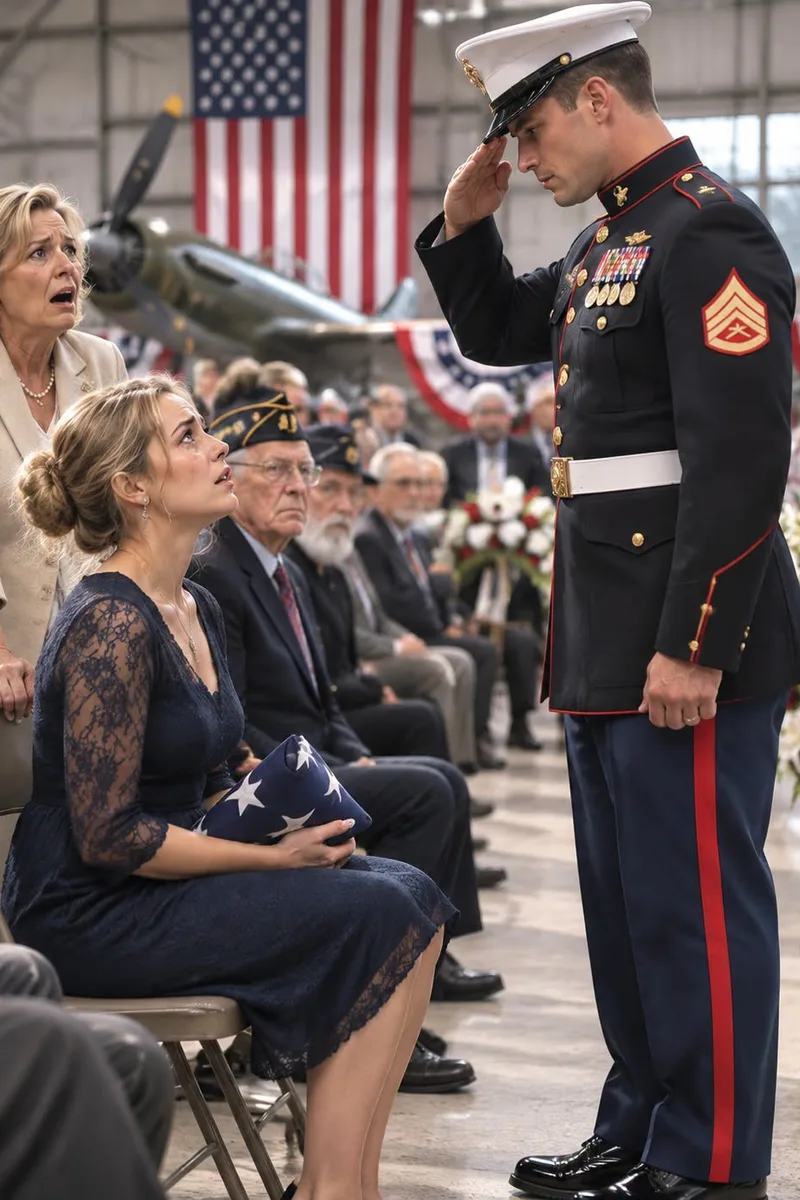
 When a Navy Officer Saluted Me at My Father's Ceremony, My Stepmother's Story Collapsed
Chapter 8
What I Could Say in Public
At breakfast, Evelyn surprised me by arriving without a folder, agenda, or list of people we ought to greet. She ordered eggs, asked whether I had slept well, and listened to the answer without looking past me for a more interesting guest. Dad was plainly nervous. I was nervous too. Three people can spend years following a script and still feel unprepared when somebody leaves it behind. After the waiter brought coffee, Evelyn said, "I owe you a clearer apology than the one I gave on that call." She looked at me rather than Dad. I put down my fork and waited.
"I said you had left the Navy because I thought people would admire your father more if they believed he'd been gracious about your trouble," she said. "I knew you hadn't told me that was true." There was no graceful way to receive the admission. I had suspected part of it, but the calculation still stung. She continued, "I was afraid that if everyone asked about your achievements, they would stop noticing everything he and I had done." Dad stared at her. For a moment I thought he would interrupt, but he let her finish. "That was unfair to you," she said. "And dishonest."
I asked whether she'd considered the harm to my reputation among people who might later meet colleagues of mine. She said she hadn't thought beyond the ceremony. I believed her. That, too, was part of the problem: she had treated my life as a small detail within the event she wanted to orchestrate. "I appreciate the apology," I said. "I don't know yet what our relationship will look like. I need you to understand that repairing the public statement doesn't automatically repair my trust." She nodded, and for once she didn't ask me to make the moment easier by promising forgiveness.
Dad asked Evelyn why she'd felt their work might be forgotten. She looked embarrassed, then admitted that people praised him for veterans' outreach while rarely mentioning the logistics she handled. She had spent long hours arranging rides, finding donated food, checking accessibility, and writing letters to families. "I know that doesn't excuse what I did," she said. "But I don't want to disappear either." Dad reached across the table and took her hand. I felt an unexpected ache. I could see how two people had become trapped in a bargain neither had understood: she kept everything running, and he let her decide what everyone else should know.
I suggested something practical. If the association depended on Evelyn's labor, the board should make that labor visible and share it rather than treating her as an invisible assistant. But that responsibility shouldn't require controlling Dad's phone, correspondence, or relationships. Dad said he would raise the question at the next meeting. Evelyn looked doubtful. "People volunteer because they care," she said. "They don't expect recognition." I answered that asking for fair responsibility wasn't vanity. "But you can't get it by making somebody else smaller."
Back in Norfolk, the conversation stayed with me longer than I expected. I had wanted a clear villain when I returned to the town that had pitied me. Evelyn had given me ample reason to be angry. Her explanation didn't remove that anger, but it made the choices ahead more specific. I could remain wary without treating every future gesture as manipulation. I could accept an accurate apology without opening every part of my life to her. Most importantly, I could refuse the role of family judge. The next decisions belonged to Dad and Evelyn, with their own histories and obligations.
Two weeks later the veterans' association invited me to write a short paragraph for a newsletter about what service meant across generations. I declined at first. The same organization had circulated a false description of my career, and I didn't want to replace one simplistic story with a flattering one. Then I reconsidered. A few sentences about respect and asking questions might be useful, provided the piece wasn't framed as my family's redemption. I called the editor, explained the boundary, and asked to approve the final text. She agreed without argument.
I wrote about a lesson Dad had taught me when I was ten. During a flag-folding demonstration, I'd been so eager to finish perfectly that I'd corrected another child's grip in front of everybody. Dad had taken me aside and said that service wasn't an excuse to make another person feel foolish. If I wanted to help, I could ask whether they wanted my help and then give it without an audience. I had forgotten the story until the saluting officer walked into the hall. I kept the paragraph simple. I wrote nothing about my assignment, nothing about Evelyn's lies, and nothing about my rank.
When the newsletter appeared, Dad called to say he'd recognized the story. He laughed at the memory of my solemn ten-year-old face. "I probably didn't say it that neatly," he admitted. I told him that was the advantage of being the one who remembered it. Evelyn sent a brief message saying the paragraph was thoughtful. I thanked her. There was no sudden warmth between us, but no contest either. For the first time I could imagine communicating with her without waiting for the second sentence to turn into an accusation.
The association also announced that it was forming a volunteer committee rather than relying on Evelyn to coordinate every event. Dad had raised the issue, and several people offered to share the workload. Evelyn was asked to help design the transition because she knew the practical needs better than anyone. I liked that outcome. It neither erased her contribution nor rewarded the control she'd exercised. She would have to learn how to accept help and disagreement without treating either as rejection. Dad would have to learn how to manage his own life even when somebody else was better at making a schedule.
That Sunday Dad told me he had found an old photograph from the year I enlisted. We were standing outside the recruiting office, both squinting against the sun. "I want to put it in the hall," he said. "Is that all right?" I said yes. Then he added that he'd already checked with Evelyn and that she had suggested the shelf near the front door. I was surprised by how pleased I felt. The photograph would not prove anything to the town. It would simply be visible in the house where I once wondered whether I belonged.
I hung up and returned to a stack of work papers. My new role demanded more judgment than my last one, and sometimes I was exhausted by how much remained uncertain. But uncertainty at work was not the same as being unmoored at home. There was now a time when my father would call, a way to reach him directly, and evidence that he could defend a boundary without making me perform gratitude afterward. I had begun this visit wanting only to watch him receive an award. I hadn't expected to learn how to let the relationship grow beyond that evening.
The End









