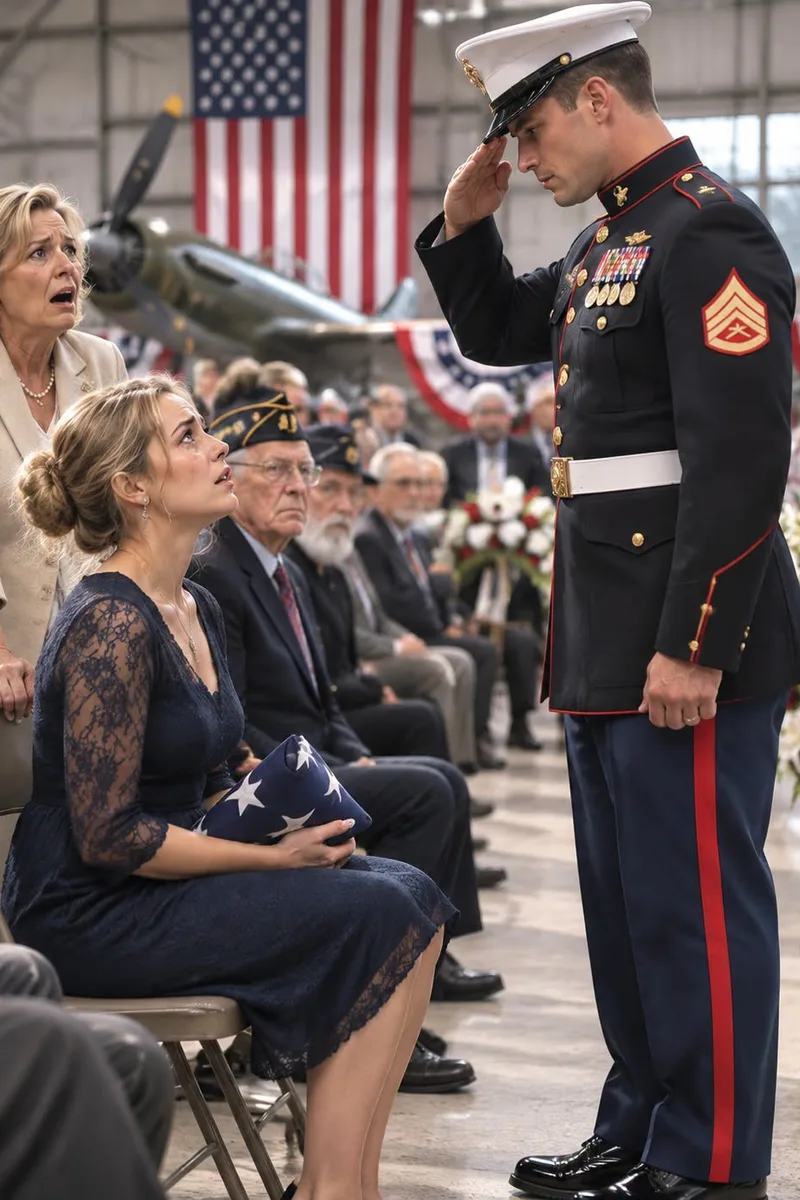
 When a Navy Officer Saluted Me at My Father's Ceremony, My Stepmother's Story Collapsed
Chapter 10
The Seat Beside Me
Dad arrived in Norfolk on a Friday afternoon carrying a modest duffel and a paper map he'd printed because he didn't trust his phone to guide him. I met him at the station, and he grinned when he saw me standing in the crowd. There was no mayor, no ceremony, and no one waiting to salute. He hugged me, then asked whether I'd had lunch. We found a small restaurant near the water and ate fish sandwiches while he told me about the volunteer committee's latest project. I listened without feeling that I had to compete with it for his attention.
At my apartment, he admired the photographs on the wall and the books stacked beside a chair I had not yet found time to replace. He asked about a framed picture of my promotion. "May I look?" he said. I handed it to him. He studied the faces of the officers beside me and asked who each one was. I told him what I could: the friend who'd helped me study, the colleague who'd covered for me when I was sick, the mentor who'd insisted that leadership began with listening. Dad set the frame down carefully. "I'm sorry I wasn't in that room," he said. I told him I knew.
We visited a maritime museum the next morning. Dad spent nearly an hour examining a display about shipboard repair, telling stories that made a volunteer guide laugh. When we reached a section on modern communications, he asked questions rather than pretending he knew the answers. I watched him with a mixture of affection and grief. My father was still the person who'd taught me to fold a flag. He was also a man who had needed to relearn how to listen to his grown daughter. Both versions belonged to the same life. I was finally able to hold them without requiring one to cancel the other.
At lunch he asked whether the new position made me happy. It was an ordinary question with a complicated answer. I told him I was proud of the people I worked with, sometimes frustrated by administrative tasks, and occasionally lonely in a city where my closest friends often traveled. I said the work mattered, but it wasn't the only thing I wanted from my life. He nodded. "I think I spent too many years assuming that people in uniform only wanted to be praised for being strong." I smiled. "Sometimes we just want someone to remember to call on Sunday."
That evening Evelyn phoned while we were cooking dinner. Dad answered, put the phone on speaker after asking me whether I minded, and told her about our day. She asked if the weather was good enough for a walk and reminded him to take the medication he'd packed. He thanked her, said he'd already taken it, and asked how her committee meeting had gone. She reported that two volunteers had stepped forward to manage the next event and that she was taking a weekend off. There was pleasure in her voice. She asked me whether I'd found a restaurant Dad liked. I told her about the fish sandwiches, and she laughed because he'd ordered the same meal twice.
After the call Dad looked thoughtful. "Evelyn and I are talking differently," he said. "Not perfectly. Sometimes we still fall into old habits." I told him that sounded believable. He said they had begun meeting with a counselor, not because either wanted to end the marriage but because both wanted to stop confusing care with control. I was glad he'd sought help beyond his daughter. It meant I could be part of his life without becoming the person responsible for keeping his household together. He asked whether I thought Evelyn and I might ever be close. I said I didn't know. "We can be truthful and civil now," I told him. "That's a place to start."
On Sunday morning we walked along the waterfront before his train. Dad brought two coffees and remembered that I no longer took sugar. The detail made me unexpectedly emotional. He noticed, but he didn't insist I explain. We sat on a bench and watched gulls circle above the harbor. He told me he'd been thinking about the plaque from the church ceremony. "I used to imagine that honor meant people remembered what I did years ago," he said. "It wasn't until that night that I saw how much I was avoiding right in front of me." He paused. "I can't give you those years back. I can be here now, if you'll let me."
I thought of the unopened invitation in the filing drawer, the empty chair at my promotion, the whispered stories in the church hall. They still hurt. I wasn't going to pretend the pain had vanished because Dad had spent one pleasant weekend with me. But he had opened his own mail, corrected false statements, respected my boundaries, listened when I said no, and come to see me without asking for a public role. His choices had begun to answer the question I'd carried for years. "I want you here," I said. "I need you to keep doing the ordinary things, even when nobody notices." He promised he would try. This time I knew what that promise looked like in practice.
At the station he asked whether there was a photograph we could take together. I agreed. We stood in front of a plain brick wall beside the departure board, two people carrying modest bags and looking slightly windblown. A passerby took the picture. There was no flag behind us and no stage. Dad checked the image, smiled, and asked whether he could put it on the shelf beside my enlistment photograph. "Only if you don't turn it into a newsletter," I joked. He laughed and said the photograph was for him. I believed him.
After his train left, I walked back toward the water. My phone showed a message from Evelyn thanking me for hosting him. Another from Dad arrived a few minutes later: Made it to my seat. I'll call Sunday. I smiled at the unremarkable words. The officer's salute had made a hall fall silent, and the truth of my service had finally become impossible to deny. But the part of the story I wanted to keep was quieter: my father asking a question, waiting for the answer, and learning that love did not mean deciding in advance what someone else was allowed to be.
I returned to my apartment, put the photograph from the station on my desk, and prepared for Monday's work. The sealed orders that had once seemed like proof I couldn't show anyone were filed where they belonged. My career needed no defense inside these walls. I had spent years thinking the choice was between telling my family everything and letting them believe a lie. Now I understood there was a third possibility: I could keep the responsibilities that required privacy and still ask to be known as a whole person. In the picture, Dad stood beside me with one hand resting lightly on my shoulder. Neither of us was looking at an audience. We were looking straight ahead.
The End









