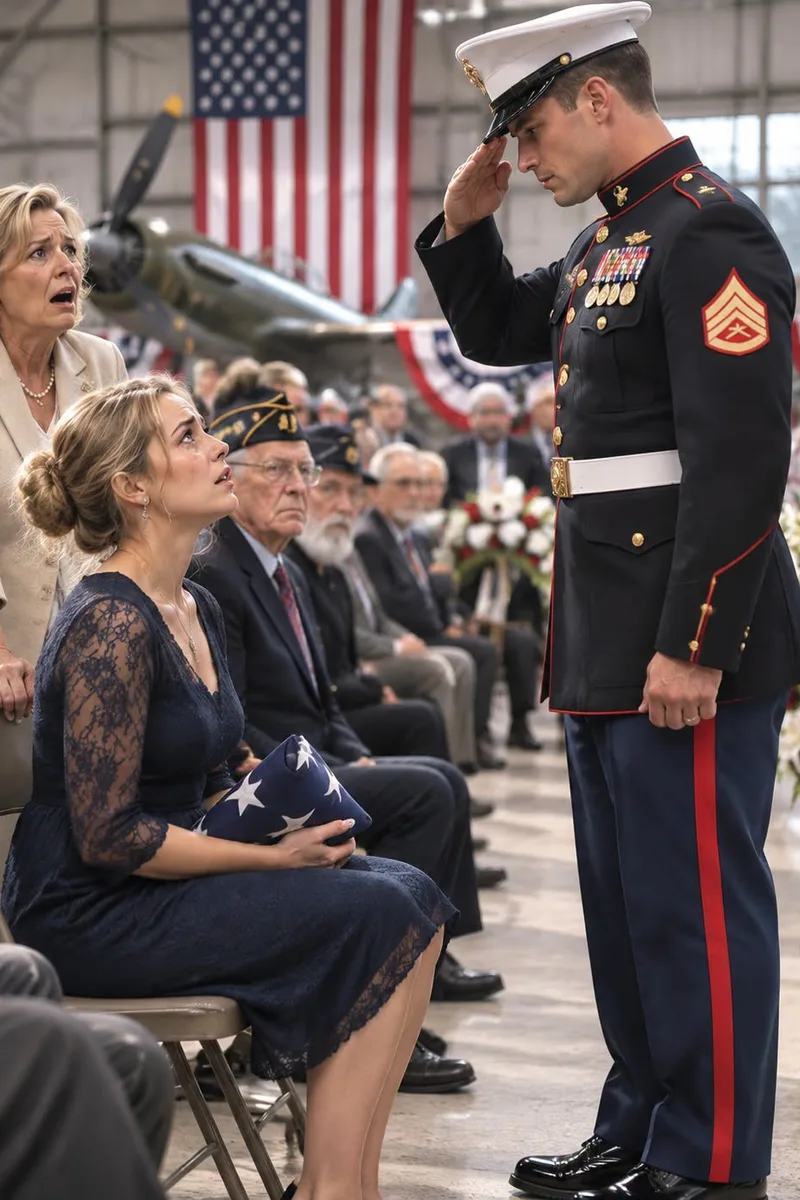
 When a Navy Officer Saluted Me at My Father's Ceremony, My Stepmother's Story Collapsed
Chapter 6
A Correction Without a Stage
The correction appeared two days later in the veterans' association's email newsletter. I read it standing at my kitchen counter, wearing a uniform still creased from the previous day's travel. It said that an earlier description of Clare Hale as a former service member had been inaccurate, and that I was currently serving in the United States Navy. Evelyn's name appeared beneath a brief sentence acknowledging that she'd supplied the incorrect information. There was no story about overcoming hardship, no invented medal, and no suggestion that I had asked for a public tribute. It was exactly the correction I'd requested.
I expected to feel triumphant. Instead, I felt tired. The facts had been restored on one mailing list, but the weeks of whispers were not something a few sentences could reach. I sent Dad a message thanking him for helping correct the record. He called later and said Evelyn had been upset about the replies. Most people had simply thanked her for clarifying. One had asked why she had made the claim in the first place. Dad sounded uncomfortable. "She thinks everyone is judging her." I told him that people were entitled to wonder why they'd been misled. "You don't have to make that feeling disappear for her."
He changed the subject to a veterans' outreach event the following month. The association wanted to host a small workshop about navigating military benefits and transitions. Dad had been asked to open it with a personal story about service. "I was going to talk about the first friend I lost," he said, "but now I'm wondering whether the lesson about listening might be more useful." I asked what he meant. He explained that older veterans sometimes assumed younger service members had easier lives or had no experience worth hearing. "I used to say we should respect the person in front of us," he said. "Then I forgot to do that with my own daughter."
I didn't want him to convert our family conflict into a public confession. It would make another audience the center of something that belonged to us. I said he could talk about listening without using my story as a lesson, and he agreed. We discussed the workshop itself. He was nervous about presenting material that might have changed since his retirement. I suggested that the association invite someone with current expertise to answer technical questions. That, too, was part of respecting the people in front of you: not pretending that experience in one decade made a person an authority forever.
During the next week, work consumed my attention. A team member needed help navigating a complicated staffing issue, and the right response was less dramatic than the one everyone expected. We listened to the people involved, documented what we actually knew, and avoided turning rumors into conclusions. I recognized the parallel with my family and was irritated at myself for bringing it into work. Professional judgments required their own standards. Still, the experience reminded me why I trusted careful questions more than confident stories repeated from person to person.
On Thursday night Evelyn sent a message directly to my phone. It contained no accusation. She said she had read the final correction and hoped the matter could now be considered closed. I read the sentence several times before replying. "The false information has been corrected. Thank you for doing that. Our relationship is a separate question." She answered the next day. "I don't know what else you want from me." I considered writing a long explanation and decided against it. I'd already been precise. I wanted my father to receive his mail, to speak with me directly, and for my stepmother not to tell stories about my life she hadn't verified. I repeated those three things calmly.
Evelyn replied that she had spent years caring for Dad and that I couldn't understand the burden. I told her I didn't dispute her work. Then I asked whether she wanted to discuss a practical way to share responsibilities rather than using them as a reason to control communication. The message sat unanswered for three days. I went to work, cooked dinner, and called a friend. I was trying to learn something important: not every unanswered message required me to manage the other person's feelings. The correction was an action. Whether Evelyn could build on it was her responsibility.
Dad called on Sunday and reported that he had attended a medical appointment alone for the first time in years. Evelyn usually accompanied him, and there was nothing wrong with that. This time he'd wanted to ask his physician some questions privately. He said the appointment had gone well. Then he laughed, a little embarrassed, and admitted he'd forgotten where he parked. "I found the car eventually," he said. "No disaster." It sounded like a trivial victory. To him it meant he could accept help without believing he was incapable of making ordinary choices.
I asked whether Evelyn had been angry. He said she'd been hurt that he hadn't wanted her there, but they'd talked about the difference between privacy and rejection. "I told her I want us to be partners, not a supervisor and a patient," he said. The sentence sounded rehearsed, and perhaps it was. Rehearsing a difficult truth was not the same as lying. I told him I was glad he'd said it. He asked how I was adjusting to my new responsibilities, and I offered a few safe details. He listened without pressing for classified information. We were learning the shape of a normal conversation.
The workshop took place the next weekend. Dad called afterward, excited that younger volunteers had asked good questions and that a retired medic had offered to help with future meetings. He told me he'd used a story about an early mistake in his own service rather than the family conflict. "I said we learn more when we ask what we don't know," he said. He sounded pleased with the ordinary usefulness of the evening. Then he asked if I'd be willing to attend a future event as his daughter, not as a speaker or guest of honor. I said I would consider it when my schedule allowed.
That night I found a photograph from the ceremony in a local newsletter. Dad held the plaque with both hands. Evelyn stood at his side in her carefully chosen dress. In the background, half obscured by a volunteer, I could see the last row of folding chairs where I'd spent the evening. The image did not show the salute. It showed a family before its quiet assumptions had been challenged. I saved it without knowing exactly why. Perhaps I wanted to remember that the ceremony had belonged to my father before it became a story about me. Perhaps I wanted proof that I could honor his service without pretending he'd been a perfect parent.
Before bed I wrote him a short message about the workshop: I'm glad they heard you. He responded with a photograph of the new volunteers standing around a table of printed resources. For years the town had treated my father as a man who knew everything about service. He seemed happiest now that other people were doing the work alongside him. I realized that I could want that future for him without volunteering to repair every part of his marriage. Distance was no longer only something imposed on us. Used carefully, it could give each of us room to act honestly.
The End









