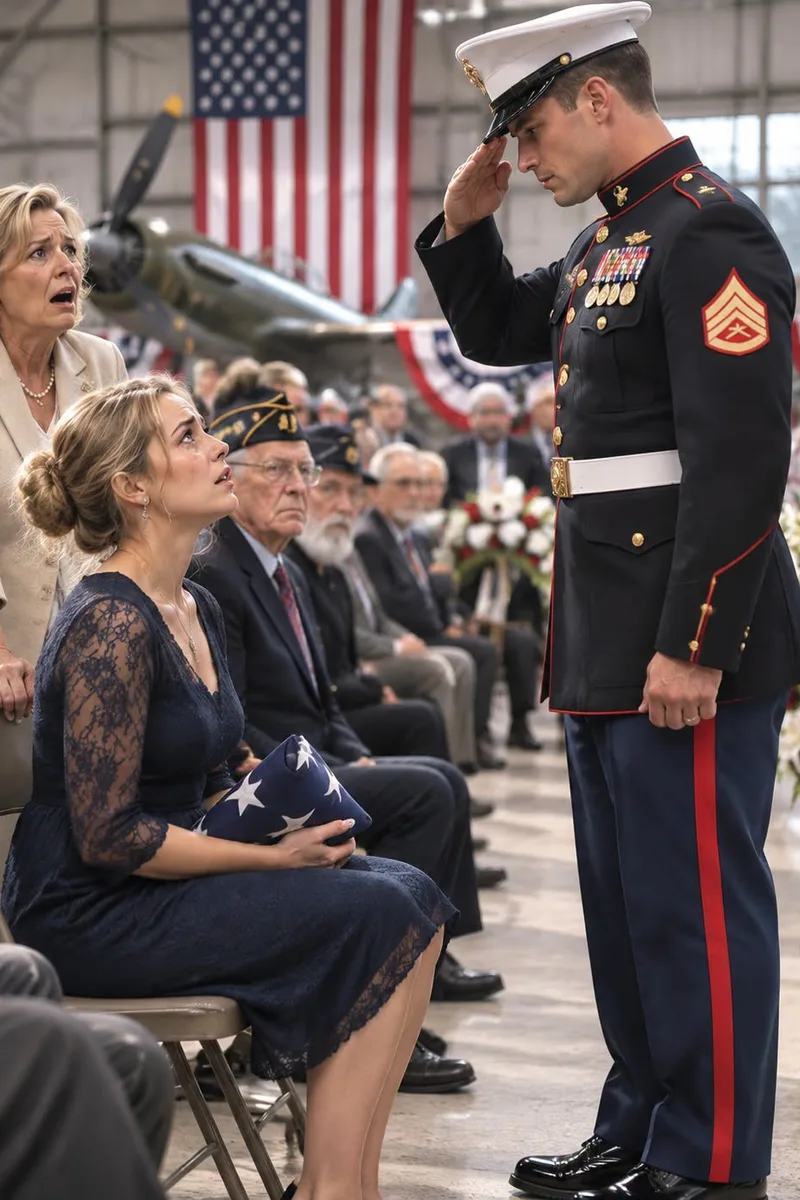
 When a Navy Officer Saluted Me at My Father's Ceremony, My Stepmother's Story Collapsed
Chapter 1
The Salute He Could Not Explain
I returned the salute before I could decide whether I wanted the attention. The officer's hand fell to his side, but mine stayed poised for half a second longer. Across the fellowship hall, the fluorescent lights hummed over a hundred people who had suddenly forgotten the veterans' program. I knew the man standing beside my chair. Commander Daniel Mercer had been my commanding officer until the previous month, and he'd crossed the room with the deliberate expression he wore when something mattered more than convenience.
"Commander Hale," he said quietly. "May I have a word?"
I stood. My knees were stiff from the folding chair, and I was conscious of the jeans Evelyn had found so offensive. "Of course, sir." I could hear my father push his chair back near the front. Evelyn was still half standing, her fingers gripping a program. Nobody had asked the officer to stop, and nobody seemed willing to break the silence. Mercer was looking at me, not the audience, and I appreciated that distinction more than he could have known.
"I apologize for arriving during the ceremony," he said. "I was told you would be here and that you'd fly out tomorrow. My schedule changed. I thought I could deliver this in person rather than send another message." He handed me a slim envelope bearing no theatrical seal, only an ordinary official address and my name. My new assignment had already been settled. Whatever the envelope contained, it was not a public announcement I had requested.
"Thank you, sir," I said. Then I lowered my voice. "My father is the veteran being honored tonight. Would you mind if we spoke after his presentation?" Mercer glanced toward the stage. A gray-haired man in a VFW jacket had risen beside the podium, waiting for someone to tell him whether to continue. Mercer gave a brief nod. "That is exactly why I came quietly. I didn't intend to interrupt." A few people exchanged glances. The damage to Evelyn's carefully managed story, though, was already done.
The mayor stepped toward us with an outstretched hand. "Commander, we're honored. Perhaps you'd like to say a few words?" Mercer shook his hand but declined politely. "I'm here on a personal errand, Mayor. Tonight belongs to the veterans being recognized." He returned his attention to me. "I'll wait outside until the formal program ends." It was an ordinary accommodation, made without spectacle. Yet the way he'd addressed me had traveled through the room faster than any rumor Evelyn had spread.
As Mercer headed toward the side door, a woman two seats ahead whispered, "Commander?" Her companion answered with the kind of silence people use when they realize they have repeated something cruel. I picked up my folded program and began moving toward my father. I had not intended to leave my seat before his name was called, but I couldn't let the moment harden into another performance. Dad reached me halfway down the aisle. He looked bewildered, and under the bewilderment I saw a hurt that made my own anger briefly hesitate.
"Clare," he said, "what was that about?" I wanted to ask which part he meant: the officer, the title, or the fact that he'd believed Evelyn's version of my life without asking me. "Commander Mercer brought a document," I answered. "He's someone I've served with." Dad studied my face. "You told me you were working near Norfolk." "I am." He swallowed. "Evelyn said you'd left active duty." Before I could reply, she appeared beside him, wearing the serene expression she reserved for donors and photographs.
"It's probably a courtesy title," Evelyn said. "People keep their ranks socially. We shouldn't make an uncomfortable scene." I looked at her. She hadn't sounded uncertain at the diner, or at our front door, or when she'd told the hall that I was struggling. Now she spoke as if the truth were an etiquette problem. "I haven't left the Navy," I said, clearly enough for my father to hear and no louder. "You knew I never told you I had." Her smile thinned. "I only repeated what I understood." "You repeated something you hadn't asked me. Those aren't the same thing."
Dad glanced between us, then toward the waiting audience. The veteran in the VFW jacket gave him a patient nod. "I think they're ready for you," I told Dad. He looked reluctant to turn away. For one moment I thought he might ask the question he'd avoided for years: why his daughter had become a stranger in his own house. Instead he said, "We can talk after." "Yes," I said. "We should." I returned to my chair, this time aware that the people around me were trying not to stare.
The speaker introduced my father's service with an accuracy that surprised me. His years aboard a repair ship. The deployments he rarely discussed. His work helping younger veterans navigate medical appointments after he retired. I applauded because the man being described had done those things. Evelyn's behavior had not erased them. When Dad accepted the plaque, he looked across the room and found me in the back row. He did not look away this time. For the first time all evening, I saw him listening to the words spoken about courage as though they concerned more than his past.
After the ceremony, Miss Donna approached before anyone else could. She held her handbag in both hands. "I owe you an apology," she said. "I asked about your service as though a rumor was a fact." She looked genuinely ashamed. I could have made her feel worse, and I was tempted. Instead I said, "You can ask me directly next time." She nodded. "I will." Behind her, Evelyn was telling the mayor something I couldn't hear, using sharp gestures that suggested she was struggling to regain control of the evening. The mayor looked uncomfortable and excused himself.
Mercer waited beneath the awning outside, holding a paper cup of coffee somebody had given him. He asked whether I had time to discuss the upcoming transition. I said yes, after I spoke briefly with my father. Mercer nodded, then added, "Your father asked the organizing committee to honor everyone who serves. I don't think he knows how much that includes his own daughter." It was an observation, not a rebuke, and that made it harder to dismiss. I watched Dad standing inside the glass doors, the plaque held at his side, while Evelyn approached him with an urgent expression.
My phone vibrated. It was a message from Dad, though he stood only twenty feet away: Please don't leave without talking to me. I read it twice. Years of small decisions had placed Evelyn between us, and one public salute hadn't repaired them. But my father had finally asked me to stay. I replied that I would wait by the side entrance after speaking with Mercer. Then I stepped toward the officer to hear what he had come to say, knowing that the difficult conversation with Dad would require a different kind of courage than anything I had worn a uniform to do.
The End









