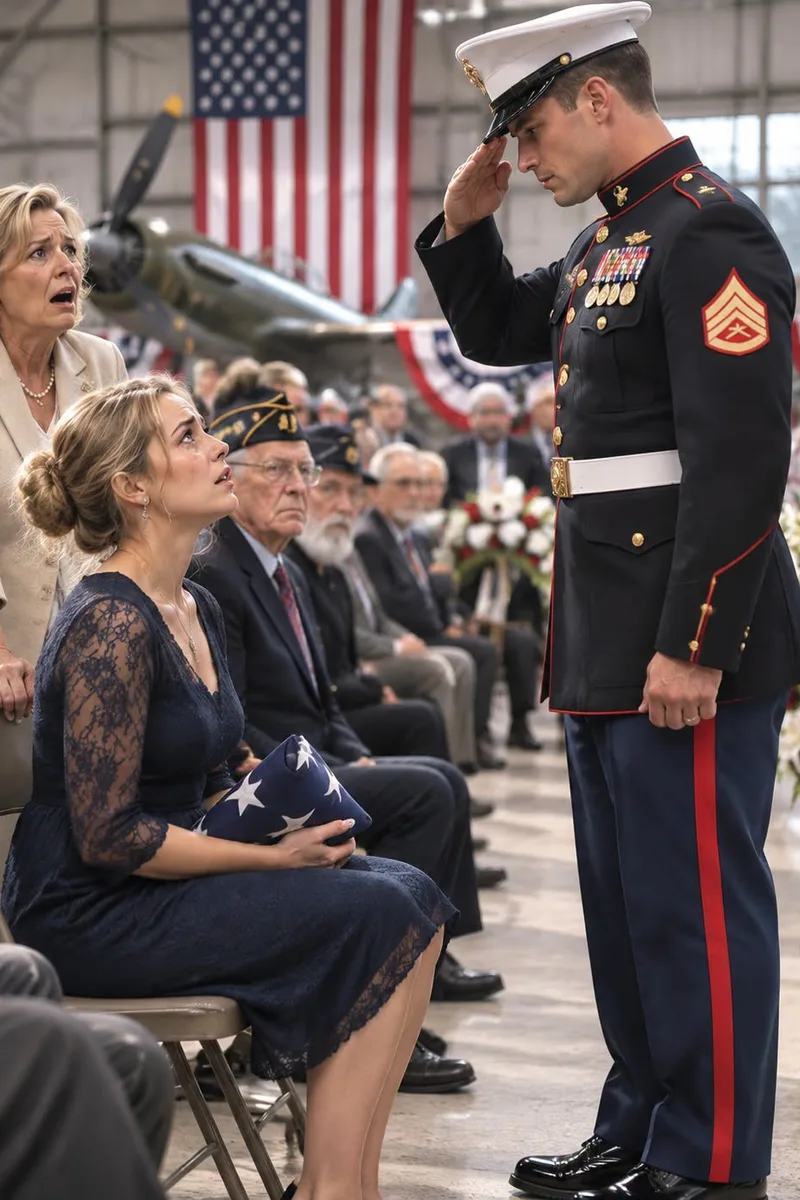
 When a Navy Officer Saluted Me at My Father's Ceremony, My Stepmother's Story Collapsed
Chapter 3
The Letters That Never Arrived
At nine the next morning, I found Dad sitting at the kitchen table with two mugs of coffee and a stack of envelopes. Evelyn was nowhere in sight. Through the back window I could see the garden he had planted after retirement, the neat rows of herbs now sprawling beyond their borders. He seemed to have spent the night thinking rather than sleeping. "I went through the drawer where we keep important mail," he said before I took off my coat. "I found these." He slid the envelopes toward me, and I recognized my handwriting on the first one.
There were birthday cards, an invitation to my promotion ceremony, and a note I'd sent when I learned that an old friend of his had died. Two were opened. Three were not. None bore a returned-to-sender mark. I touched the envelope with the promotion invitation and remembered standing in a post office, hopeful that Dad would be there even if he couldn't know everything about the unit I served with. "Where were they?" I asked. "In a folder marked for filing," he said. "Evelyn put it with the tax papers." His voice was rough. "I don't know when she intended to give them to me."
I opened the invitation. The ceremony had happened eleven months earlier. I remembered the empty chair I'd kept for him until the last moment, then the private embarrassment of explaining that my father hadn't been able to travel. I had not accused him. I had invented a scheduling conflict because it seemed kinder than saying he hadn't answered. Now that kindness felt misplaced. "I wanted you there," I told him. Dad looked away. "I'm sorry." This time he wasn't simply sorry about what he'd believed. He was sorry about something he could see and hold.
We heard footsteps in the hall. Evelyn appeared wearing exercise clothes and a cheerful expression that vanished when she saw the envelopes. "Why are you going through files before breakfast?" she asked. Dad placed one hand over the invitation. "These letters were addressed to me." "I was keeping everything together," she said. "You know how disorganized the mail gets." I waited for Dad to ask the obvious question. He did. "Why didn't you give me Clare's promotion invitation?" Evelyn looked at me, then back at him. "Because you were exhausted. She'd said the details were confidential. I assumed it wasn't something you could attend."
"The invitation had a date, time, and address," I said. Evelyn ignored me. "You always get upset when Clare sends vague military messages. I was trying to spare you." Dad held up the page. "It wasn't vague." She lifted her chin. "Well, I can't remember every envelope. If you want to blame me for a filing error, be my guest." A filing error might have accounted for one forgotten card. It didn't explain the stories she'd told at the diner, the gas station, or the ceremony. I had no interest in treating each piece as a separate accident until the pattern became invisible.
Dad asked her directly whether she had told people I'd left the Navy. Evelyn took a long drink of water. "I said I'd heard she was taking a break." "You told me she'd quit," he replied. She looked startled by the firmness in his voice. Then she turned toward me. "You won't tell us what you do. What did you expect people to think?" I said that she could have told them she didn't know. "That wasn't an option?" She laughed sharply. "In this town, people expect a wife to know her family's business." "Then the honest answer would have been that my business wasn't yours to share."
The conversation might have become a familiar circle if Dad hadn't intervened. He asked Evelyn to stop speaking for him and said he intended to handle correspondence addressed to him from now on. Her face tightened. "So I'm being punished because an officer made a spectacle at the hall?" Dad answered, "He came to deliver a letter. You made the story about Clare long before he arrived." I watched him speak without raising his voice. The difference mattered. He wasn't performing courage for me; he was taking back a responsibility he had surrendered.
Evelyn pushed her chair away. "I've spent years arranging your medication, appointments, donations, and ceremonies," she said. "And now I'm the villain because your daughter shows up with a fancy title?" There was real strain beneath her anger. Dad had relied on her for more than he liked to admit, and I did not want to pretend that work had no value. "Helping him isn't the problem," I said. "Using that work to decide what he gets to know about me is." She looked as though I'd made an insulting accusation. Perhaps I had. It was also an accurate description of the letters lying between us.
Dad asked her to give us the rest of the morning alone. She said she would go to the market, then paused in the doorway. "You have no idea how many things would fall apart if I stopped taking care of them." He answered, "Then we need to learn to take care of them together." After she left, the silence was so complete that we could hear the refrigerator cycle on. Dad let out a breath and rubbed his forehead. "I should have said that years ago." I didn't know whether he could keep saying it when I was back in Norfolk. I hoped he could.
We went through the envelopes one by one. Dad asked questions about public milestones, listened when I explained what I could, and accepted when I said a particular topic was restricted. He told me that he'd begun letting Evelyn answer his phone because too many people wanted his attention after he became active in veterans' events. Over time, convenience had become habit. Then habit had become a system in which his daughter needed an intermediary to reach him. He seemed horrified by how ordinary each step had felt. "It wasn't one decision," I told him. "That's what made it easy not to notice."
Before lunch, he showed me the small box where he kept photographs from my childhood. There were pictures of me learning to ride a bicycle, standing on his shoulders at a parade, and folding a flag with enormous concentration. He selected one and placed it on the counter. "I want this at the next veterans' meeting," he said. "Not because you outrank anybody. Because you're my daughter." I reminded him that he didn't need to prove anything to the town for my sake. He nodded. "I know. I think I need to stop pretending my family begins and ends with whoever is in the front row."
I looked at the time. My flight was scheduled for the evening, and Mercer expected me at the preparation session the next day. Dad offered to drive me to the airport. I accepted, though I wasn't ready to call the morning a resolution. The envelopes were still on the table when Evelyn returned with groceries. She saw the photograph beside them and stopped. Dad met her eyes and said, "Clare and I are going to talk more. You don't have to arrange it." Evelyn set the bags down without answering. I realized then that the hardest part of the morning wasn't discovering what she had done. It was discovering whether Dad would remember his decision after I left.
The End









