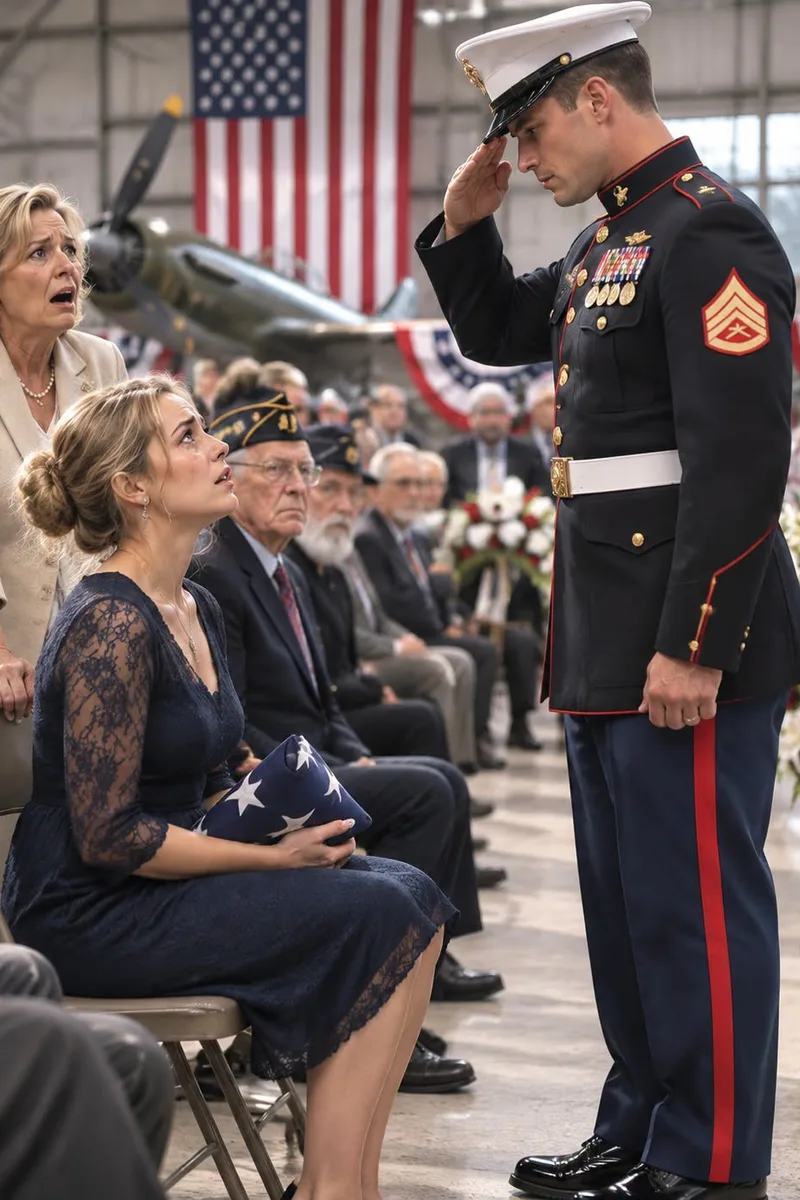
 When a Navy Officer Saluted Me at My Father's Ceremony, My Stepmother's Story Collapsed
Chapter 7
The Story He Chose Not to Tell
The next test arrived as an invitation. A regional veterans' organization asked Dad to speak at a dinner several towns away, and the coordinator suggested that he bring the decorated daughter whose service had recently attracted attention. Dad forwarded me the invitation without adding his own request. At the bottom he wrote, I haven't answered. I thought you should see exactly what they're asking. The message mattered more than the invitation. A year earlier, Evelyn would probably have responded on his behalf and told me where I was expected to sit. Now he had placed the choice where it belonged.
I was available that weekend, but I didn't want to become a symbol of a repaired family before we'd done the work. I called Dad and asked why he wanted me there. He said he would enjoy having dinner with me. Then he added, "I also know some people will expect you to stand up when they mention your rank. You shouldn't have to." I told him I'd attend as his guest if the organizers agreed not to put me on the program or ask me to discuss my assignment. He promised to check. His willingness to protect my ordinary preferences was almost harder to accept than an enthusiastic public tribute.
The coordinator replied with an apology for making assumptions. She said they would be delighted to welcome me without a formal role. Evelyn, however, had her own ideas. She emailed a proposed introduction describing our family as a multigenerational military legacy reunited after a difficult period. The phrase reunited made my stomach turn. It suggested a neat ending to a story that was still being lived, and it transformed my private choice to visit Dad into material for fundraising. I forwarded the proposal to him and asked whether he'd approved it. He called immediately. "No," he said. "I haven't seen that."
He spoke to Evelyn before replying to the coordinator. Later he told me she'd argued that the organization's donors loved human-interest stories and that he should appreciate the publicity. Dad had said our relationship wasn't a program item. When she insisted that their work depended on donor enthusiasm, he reminded her that service organizations were supposed to help veterans rather than use family drama as decoration. She had been furious. I could hear how much the confrontation had cost him. "I don't know how to have an ordinary disagreement with her anymore," he admitted. "Every time I say no, she hears that I don't love her."
I asked what he wanted from their marriage, not what he wanted me to do about it. He was quiet for so long I thought we'd lost the connection. Then he said he wanted to be allowed to make mistakes without having them corrected before anyone saw. He wanted his wife to help because she chose to, not because she feared what would happen if she stopped. And he wanted to know whether she'd been lonely too, organizing everyone else's days until there was no space for her own. Those questions were more generous than my anger had been. They were also questions he had to ask her directly.
On the evening of the dinner, Dad met me outside the hotel rather than asking me to find him in a crowded reception. He wore the dark suit he'd worn at the church ceremony, but he looked more comfortable in it. Evelyn arrived a few minutes later and offered a restrained hello. We walked inside together, and I felt everyone at our table trying very hard not to mention the earlier rumors. I couldn't blame them entirely. Public embarrassment makes people awkward long after the person at its center wants to move on.
During the meal, a retired sergeant asked what I did now. I said I served in the Navy and that I couldn't discuss the assignment in detail. He accepted the answer and began telling me about his granddaughter's decision to enlist. We spoke about preparation, asking questions, and the difference between pride and pressure. It was the first conversation with a stranger in months that hadn't asked me to correct my own biography. Across the table, Evelyn watched without comment. Dad seemed quietly happy simply to see us talking.
When the speeches began, a member of the organizing committee approached the table with a microphone and asked whether I would stand for a moment. My chest tightened. The coordinator had promised there would be no formal introduction. Before I could answer, Dad rose. "Clare's here as my guest," he said, smiling politely. "She's not part of tonight's program." The man apologized and returned to the stage. Dad sat down as though nothing unusual had happened. I stared at him. He leaned toward me and whispered, "I believe that's called keeping a promise." It was a small joke, and I laughed before I could stop myself.
Evelyn didn't laugh. Later, while Dad spoke to a former shipmate, she asked whether I had engineered the awkward exchange to make him look protective. Her voice was low enough that nobody else could hear. I felt anger rise, then recognized a familiar choice. If I argued about my motives, we'd be trapped in the old contest. I told her I'd arranged nothing and that Dad had spoken because he'd understood what I wanted. "You can ask him why," I said. "You don't have to make me the explanation for every decision he makes." She looked away, her expression unsettled.
The evening ended without incident. Dad's speech was short, focused on the work of local volunteers, and generous to people whose names would never appear on a plaque. He didn't refer to me. Afterward he thanked Evelyn for helping organize his notes and she said she'd been glad to do it. Their exchange was almost ordinary. It reminded me that I did not have to choose between seeing her worst actions clearly and admitting she was capable of kindness. What I could not do was allow occasional kindness to excuse decisions that hurt other people.
Outside, as we waited for the valet, Dad asked whether I'd come to breakfast before I left. I agreed. Evelyn said she had already booked a table at a restaurant near the hotel. I felt the old resistance, but then she added, "I can change it if that's not what you want." It was the first time I remembered her offering a choice without immediately explaining why her own plan was better. Dad looked surprised too. We accepted the restaurant, and for a moment the three of us stood beneath the awning without a fight to manage.
On the drive back to my hotel I thought about the microphone and Dad's easy refusal. It had cost him only one sentence, but it had taken months of conversations and uncomfortable evenings to make that sentence possible. I did not know what Evelyn would do next. I did know that my father had honored a promise when an audience was present and when the easier option was to let the organizer proceed. For the first time, I was willing to consider that our family might learn something more durable than the correct public version of my career.
The End









